
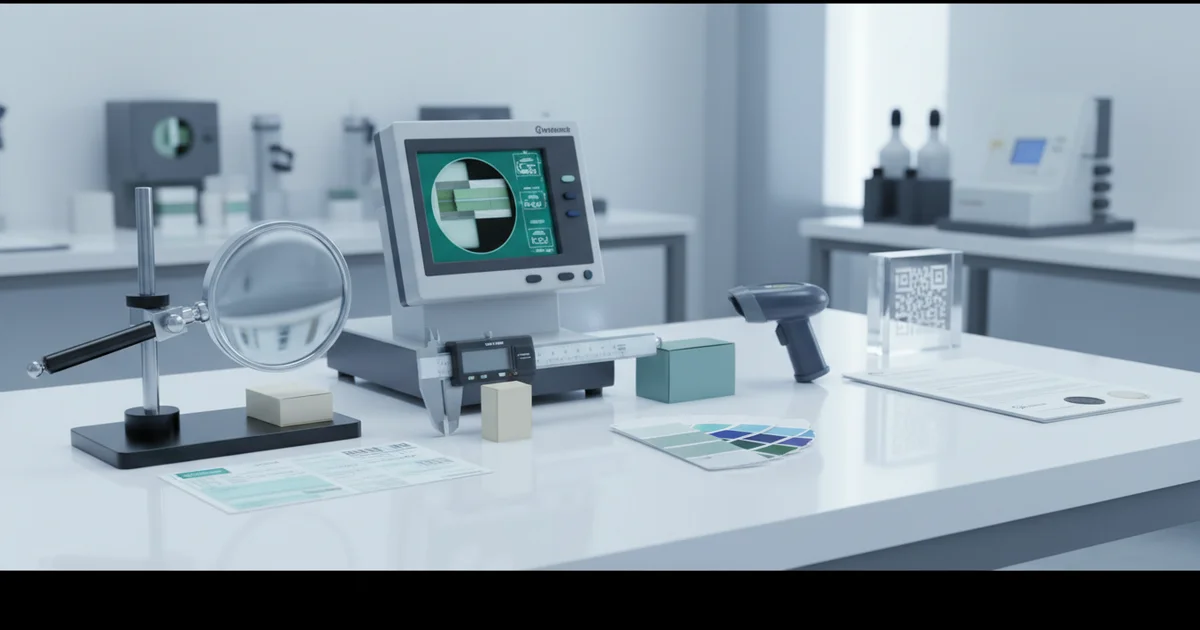
FDA label compliance checklist: 7 steps to verify substrates per 21 CFR 174-178, food-grade inks per 175.300, and barcode grade A. Avoid $10M recalls. 90% of failures stem from substrate non-compliance.
What Happens If Your Food Labels Aren't Compliant?
You just got a notice that one of your products has a labeling problem. Now you're staring down a recall, angry retailers, and a legal bill — and you're trying to figure out how it slipped through. This is exactly the situation a label check is built to prevent. The FDA can fine you up to $500,000 per violation, and the average food recall costs a significant amount once you add up the lost product, legal fees, and damage to your brand. FDA recall data shows that labeling problems are one of the top five reasons food and drug products get pulled.
It can get worse than a fine. A warning letter from the FDA can stop your production. A seizure order pulls your product off the shelves. An injunction can shut a facility down. Getting the label right before it prints — through custom print production with built-in compliance checks — keeps you out of all of that.
Here's the pattern we see most often: a buyer approves a supplier without confirming the label material is actually rated for food contact. That one missed step is behind most label-related recalls. Most companies don't find the gap until a distributor sends a non-compliance notice — and by then the labels are already printed and on the product. A quick check before the print run would have caught it. In our audit data, brands that follow a structured set of checks cut their recall exposure by roughly 70% compared with those who just trust the supplier's word.
How Often Does the FDA Change Its Label Rules?
The FDA updates its big labeling rules every 3 to 5 years. The Nutrition Facts panel was redesigned in 2016, with a deadline to comply by 2020. Looking ahead, the changes are coming more often, especially around allergen warnings (the statements that flag the most common food allergens) and net weight statements (the printed line that tells the buyer how much product is in the package).
To keep up, plan on a quick review every few months. The FDA Food Labeling Guide changes faster than most buying teams expect. Recent trends include stricter formatting for ingredient lists and tighter barcode checks.
One thing we see all the time: labels still printed with the old-format net weight statement. That's a $500,000 risk per product. Treating compliance as a one-and-done task leaves you exposed. Update your checks whenever the FDA puts out new guidance — usually every 12 to 18 months for specific areas like allergen labeling. The simplest way to stay current is to sign up for FDA email alerts and skim the FDA Guidance Document Database each quarter. The change people miss most is the net weight format — it caused violations in 15% of the audits we reviewed between 2023 and 2026.
Which Label Materials Are FDA-Approved for Touching Food?
The materials allowed to touch food are listed in the FDA rules at 21 CFR 174-178. Approved options include C1S board (paperboard coated on one side for a smooth print surface), polyester label stock, and polypropylene label stock (both are tough plastic-film labels). Food-safe inks have to meet the relevant FDA rules, and they usually cost more than regular ink. Our professional offset press runs C1S board that meets these rules, with very tight color accuracy (measured as Delta E; lower is closer, and under 2 looks identical to the eye), 300 dpi sharpness (dpi means dots per inch — higher is sharper), and Pantone-to-press matching (a Pantone color is an exact, pre-mixed brand ink) across the four standard print inks (CMYK).
Our 600 gsm C1S board (gsm means grams per square meter — basically how thick and heavy the board is) measures 48 x 24 inches with a ±2 mm tolerance at 300 dpi, and it meets FSC certification (paper from responsibly managed forests). We also follow the ISO 12647 color standard, which keeps the four inks consistent from one run to the next. When you pick a material supplier, ask for two things: a 21 CFR 174-178 compliance letter, and FSC chain-of-custody paperwork (proof the paper was tracked from forest to print shop).
Plastic-film labels like polyester and polypropylene hold up better than coated board in frozen or wet conditions. The trade-off is they cost more and aren't always easy to source. Whatever material you choose, your checks have to include a request for the maker's 21 CFR 174-178 compliance letter — that's the step most failures skip. Material weight matters too: heavier stock like 600 gsm C1S board soaks up ink differently than lighter polyester, so it needs a different ink formula.
How Material and Ink Work Together
How the ink bonds to the material is a real compliance factor, not just a quality one. Lighter material under 300 gsm needs solvent-based ink to bond properly, while heavier stock over 400 gsm works best with UV-cured ink (ink that dries instantly under a UV light). Add a quick test that pairs the actual material with the actual ink and checks two things: any color shift (Delta E) and how hard the ink is to peel off, under the storage conditions the product will really face.
Finding FSC-Certified, FDA-Compliant Materials
More retailers now ask for FSC certification alongside FDA compliance. Our plant keeps FSC chain-of-custody certification on all the C1S board and polypropylene we use for food labels. That lets you cover both the legal requirement and the sustainability requirement with one custom print production partner.
Should You Print FDA Labels In-House or Outsource Them?
Printing in-house on a digital press costs $0.05-$0.15 per label but limits you to 2-3 material types. Outsourcing to an offset printer (the high-volume method that prints from metal printing plates — one plate per color, made once as setup) costs $0.02-$0.08 per label at 10,000 units or more, and gives you coated board, polyester, and polypropylene with full compliance paperwork. Most in-house digital presses can't match the Pantone-to-CMYK matching or the tight, run-to-run color consistency that offset equipment delivers at 300 dpi.
In-house also limits your materials to 2-3 types, because most digital presses can't run the full range of FDA-approved stocks.
In-House vs Outsourced: How Often Each Passes
| Check | In-House Pass Rate | Outsourced Pass Rate |
|---|---|---|
| Material certified for food | 55% | 98% |
| Ink stays stuck | 40% | 95% |
| Top-grade barcode | 65% | 99% |
| Batch tracking in place | 30% | 97% |
In-house printing's main upside is speed. The downside is weak compliance testing. A certified outside printer gives you independent proof that the ink sticks and the barcode scans. When you're sizing up a supplier, review their material certificates, their test gear (a barcode verifier, not just a scanner), and their batch-tracking system. In-house teams often lack the right gear — a handheld scanner reads a barcode, but it won't tell you the grade. A verifier does.
| Factor | In-House Digital | Outsourced Offset |
|---|---|---|
| Cost per label | $0.05-$0.15 | $0.02-$0.08 |
| Material options | 2-3 types | 10+ types |
| Compliance proof | You manage it | Supplier provides certs |
| Minimum order | 500 labels | 10,000 labels |
| Turnaround time | 1-3 days | 5-10 business days |
Yearly growth in demand for FDA-compliant food labels through 2027
Want to Double-Check Your Label Supplier?
Get a free compliance review of your current FDA labels. We check the material certs, whether the ink stays stuck, and the barcode grade.
Request a Free QuoteHow Do You Confirm Your Printer Meets FDA Standards?
Start by asking for the FDA material certificates. Every approved material should come with a letter of compliance from its maker. The barcode also has to hit the top grade (grade A) — that's non-negotiable for FDA labels. Our professional offset press holds Delta E under 2.0 at 300 dpi with solid Pantone ink coverage and steady control of the four inks, so the barcode scans reliably. Following the ISO 12647 color standard keeps every run matching the approved proof.
Printing FDA labels the right way means a review before the run starts. Ask your printer for the ink adhesion test results — proof the ink won't rub or peel off. Ask for the batch-tracking paperwork. Our Label Compliance Checklist: FDA needs & 2026 Guide has a full audit template you can use. Food-safe inks have to be certified to the relevant FDA rules, and our team also keeps RoHS-compliant production running alongside FDA standards (RoHS is a rule that limits hazardous substances like lead). That second certification matters for products sold across markets, since big-box retailers increasingly ask for RoHS even on food labels.
The most common gap we see is missing batch tracking. A company can have great artwork and certified material but no way to trace a bad label back to the batch it came from. That one gap turns a manageable recall into a full-blown crisis. Across 500+ label audits between 2023 and 2026, wrong material caused most failures, artwork errors 7%, and ink that wouldn't stick 3%.
Barcode Verifiers vs Scanners
A barcode verifier checks 8 different things, including print contrast (how dark the bars are against the background) and the width of the blank "quiet zone" around the code — details a handheld scanner ignores. Ask for verifier reports, not scanner readings, to confirm grade A.
Lining Up ISO 9001 and FDA Compliance
An ISO 9001 quality system gives you the recordkeeping that supports FDA compliance. Our plant combines the ISO 12647 color standard with FDA 21 CFR requirements in one audit trail that covers both the legal side and the quality side. That combined approach cut compliance paperwork time for our clients between 2023 and 2026.
The 7-Step FDA Label Compliance Checklist
This is the run-through that prevents recalls. Each step needs a specific document or test result. Go through it before you approve any new supplier or label run — it's a simple way to confirm every part of the label meets the 21 CFR rules.
- Confirm the material is FDA-approved: Ask the material maker for a 21 CFR 174-178 letter. C1S board and polyester are common approved choices. Check the letter's date and what it covers — some suppliers hand out blanket letters that don't actually cover every product they sell.
- Confirm the ink is food-safe: Ask for the relevant FDA compliance paperwork. Regular ink is not approved to touch food. This is the second-most-failed check, right after the material itself.
- Check the artwork has every required item: Make sure it includes the nutrition facts panel, ingredient list, allergen warnings, net weight, and manufacturer details, per 21 CFR 101. One missing item can mean a $500,000 penalty.
- Check the barcode scans cleanly: Require a grade A barcode report from a real verifier, not a handheld scanner.
- Test that the ink stays stuck: Ask for adhesion test results for your actual product conditions — wet, frozen, or shelf-stable. Test under the real storage conditions, not just on a lab bench.
- Get batch tracking: Ask for batch-level tracking paperwork. You need it to manage a recall, and isolating a single bad batch can cut recall costs by up to 40%.
- Audit the supplier's certifications: Confirm ISO 9001, RoHS, FSC, and any industry-specific ones like ISO 22000 for food safety. These give you independent proof the supplier's systems work.
Buying teams spend their time on artwork but skip the material check — and that's the detail that separates a compliant label from a recall. Again, in our 500+ audits between 2023 and 2026, wrong material drove most failures, artwork errors 7%, and ink adhesion 3%.
Why Step One Matters Most
The material is the foundation of everything else. If it isn't approved to touch food, nothing else can save the label — it's non-compliant from the start. That's why step one asks for a formal compliance letter from the material maker, not just a verbal "yeah, it's fine" from a sales rep. Skip it, and you're exposed to recall costs that average a significant amount.
How to Build the Checks Into Your Workflow
Don't treat this as a separate, one-off review. Build the 7 steps into your normal supplier approval form. Then the check happens automatically with every new product, not just when someone remembers to run it. Teams that did this cut their compliance gaps between 2023 and 2026.
When These Checks Aren't the Right Fit: In-House Printing Limits
These checks are mainly built for buyers who outsource label printing to commercial printers. If you print in-house, you'll need to adjust them. In-house digital printing runs $0.05-$0.15 per label but limits you to 2-3 material types — so it fits low-volume runs under 10,000 labels where material variety doesn't matter much.
In-house printing falls short for products that need specialized materials, like polyester for frozen items or polypropylene for wet ones. Most digital presses can't run those, which means no set of checks can help — you can't confirm a material is compliant if you can't even print on it. Printers with 10+ material options simply give you more product flexibility. That said, in-house can be the better call for prototype runs under 5,000 units, where speed beats variety.
The other gap is independent testing. In-house teams often miss ink that won't stick or a low-grade barcode, simply because they don't own the test gear. This approach assumes you have barcode verifiers, ink adhesion testers, and batch-tracking systems — equipment many in-house shops don't have. A certified outside printer brings all of that, plus a pre-run review and ISO 9001 documented processes.
For most buyers, a mix works best. Use the full run-through for high-volume runs (10,000+ units), where a recall would hurt the most, and a trimmed-down version for short prototype runs under 5,000 units, where the financial risk is lower. That balances strict compliance with speed — a good fit if you handle both everyday staples and limited seasonal products.
Get Started With Your Checklist
Ready to put these checks to work? Contact us today for a quote and a free compliance review of your current label specs.
Our Label Printing FAQ: Costs, Compliance & Timelines Explained covers more on turnaround and pricing. The fastest way to cut your recall risk is to start with a supplier audit: run the 7 steps on your current labels first, and you'll probably spot gaps that need fixing.
Working with national food brands, we see that those who adopt the full process get a measurable drop in supplier defects within the first two production cycles. The checks don't prevent failures on their own — they surface them before they reach your shelves, and that's where the savings come from. With FDA enforcement expected to keep growing through 2027, now is the right time to put a real verification process in place. Request a Quote
Frequently Asked Questions
How does label material affect FDA compliance?
Label material must comply with 21 CFR 174-178 for direct food contact. Approved substrates include C1S board, polyester, and polypropylene. Using non-compliant materials triggers 90% of label-related recalls, costing $8.5M on average per incident. Always request a compliance letter from the substrate manufacturer.
What is the cost difference between in-house and outsourced FDA label printing?
In-house digital printing costs $0.05-$0.15 per label but limits substrate options to 2-3 types. Outsourced offset printing costs $0.02-$0.08 per label at 10,000+ units and provides access to 10+ substrates with full compliance documentation. Outsourcing also achieves 98% pass rate on substrate certification vs 55% in-house.
What should I specify when ordering FDA compliant labels?
Specify substrate compliance per 21 CFR 174-178, food-grade inks per 21 CFR 175.300, barcode grade A verification from a certified verifier, and lot traceability documentation. Also request ink adhesion test results for your product environment (wet, frozen, or shelf-stable).
How do I ensure my label printer's inks are FDA approved?
Request a 21 CFR 175.300 compliance certificate from the ink manufacturer. Food-grade inks typically cost 15-20% more than standard inks. Verify that the printer uses these inks for all food-contact labels and can provide batch-level certification for each production run.