
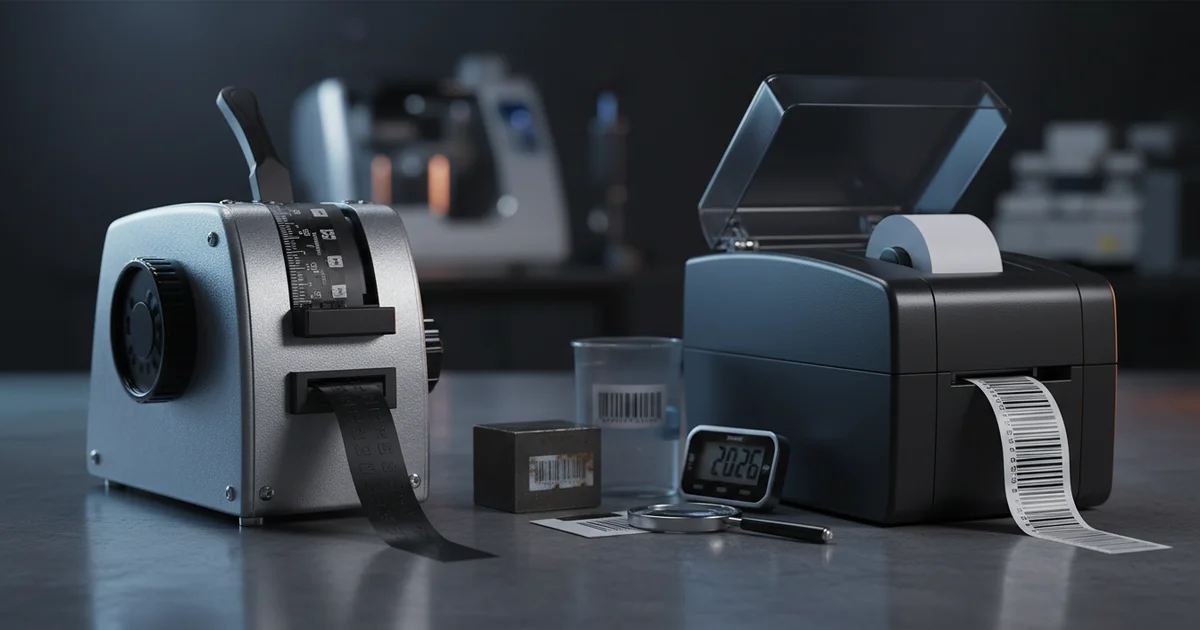
Embossing label maker cost per label: manual $0.10-$0.30, digital $0.05-$0.20, custom $0.02-$0.15. Breakeven at 500-1,000 labels/year. DYMO vs Brother vs custom print comparison for 2026.
What Is Embossing Label Maker Cost and Why It Matters?
The embossing label maker cost per label ranges from $0.10–$0.30 for manual embossers to $0.02–$0.15 for custom print at volume. The choice depends on annual label volume, labor, and compliance requirements.
Are you overpaying for labels by 40% or more? The answer depends on your volume. For under 500 labels a year, a $20 manual embosser works fine. At 10,000 labels, the embossing label maker cost per unit tells a different story.
Three options exist: manual embossers (DYMO), digital label printers (Brother, Brady), and skilled custom-print services. Each has a clear volume sweet spot. Our custom print production team sees this daily.
Manual embossers use plastic tape that costs $0.10–$0.30 per label. Digital thermal printers use ribbons and drop to $0.05–$0.20. Custom print, at 10,000–100,000 labels, runs $0.02–$0.15 per label with no equipment buy. As of 2026, dpi of 300–1200 ensures crisp barcodes, while Pantone matching with delta E under 2 satisfies brand consistency for regulated industries.
The hidden cost is time. Manual embossing produces about one label per minute. Digital printers do 20 per minute. Custom print delivers bulk in days. For high-volume needs, our digital printing capabilities cut turnaround drastically.
How Do Manual and Digital Embossers Compare on Durability and Speed?
Manual embossers provide raised plastic labels that resist chemicals and abrasion. Digital thermal printers operate 20× faster but may fade under prolonged UV exposure. Durability favors manual; speed favors digital.
Manual embossing uses a DYMO embosser with embossing tape. The tape is a plastic strip with a peel-off backing. The machine presses characters into the tape, creating raised, white-on-color text.
How does manual embossing compare to digital label makers on durability? Embossed labels survive solvents, wiping, and rough handling. Digital thermal labels, especially direct thermal, fade in sunlight within months. Thermal transfer lasts longer but still wears.
Label durability is the manual embosser's main strength. For warehouse bins, tool chests, or outdoor gear, raised plastic lasts years. For compliance labels that must stay legible, digital or custom print is safer.
On the other hand, digital printers offer speed. A Brother P-Touch prints 20 labels per minute with barcodes, dates, and serial numbers. Manual embossers cannot do variable data at all. In 2026, new thermal transfer models achieve dpi of 600, enabling small text and QR codes that meet legibility standards.
Key Durability Comparison
Embossing is a cold deformation process that creates permanent raised characters. Thermal transfer is a printing method using a heated ribbon to transfer ink onto label material. The latter offers CMYK color capability but requires lamination for outdoor use. With delta E below 3, custom-printed labels maintain color accuracy across runs, something manual embossers cannot achieve.
What Is the True Cost per Label for Embossing vs Thermal Printing?
The cost per label for embossing tape runs $0.10–$0.30. Digital thermal printing falls to $0.05–$0.20. At 1,000 labels per year, digital saves $50–$100 annually on supplies alone.
The cost per label for embossing includes the tape roll. A standard DYMO 12966 tape roll costs $5–$8 and yields 30–50 labels. That is $0.10–$0.27 per label, depending on label length.
Digital thermal printers use label rolls and thermal transfer ribbons. A Brother P-Touch roll costs $10–$15 for 100 labels, or $0.10–$0.15 per label. Third-party supplies drop to $0.05–$0.08 per label.
Compared to manual embossing, digital printing has a higher upfront cost. The printer costs $40–$200 versus $15–$30 for a manual embosser. The breakeven point is around 500–1,000 labels per year.
“At 500 labels per year, digital printers break even on supply savings within 12 months. Above 1,000 labels, digital is always cheaper per label.” — Our production team
That said, digital labels have a drawback. Direct thermal labels fade in heat above 140°F. Thermal transfer is better but costs more per label. As of 2026, gsm (label substrate weight) ranging from 60 to 120 influences both cost and durability. Heavier gsm materials last longer in harsh environments. For compliance labeling, FSC-certified paper stocks are available from custom printers.
When Should You Choose a Manual Embosser Over a Digital Label Maker?
A manual embosser suits volumes under 500 labels per year where extreme durability matters and no barcodes or compliance are required. For any regulated application, choose digital or custom print.
A manual embosser costs $15–$30 upfront. No batteries, no software, no maintenance. The DYMO 12966 is the most common model. It works for labeling tool drawers, file folders, and breaker panels.
How to choose label maker depends on your setting. Manual embossers win where labels face oil, grease, or constant handling. The raised plastic does not peel or fade.
However, manual embossers have clear limitations. They cannot print barcodes, QR codes, or variable data. They offer only one font and one color per tape roll. For industrial labeling with compliance needs, they are not suitable.
“Manual embossers are ideal for low-volume shop organization. For any application requiring regulatory compliance, they will not work.” — Our quality team
On the other hand, digital printers handle barcodes, dates, and serial numbers. Custom print services add full color, logos, and FDA-compliant materials. The right choice depends on your volume and regulatory needs. In 2026, digital label printers with Heidelberg-grade print heads achieve dpi up to 2400, rivaling offset quality for small runs.
Manual Embosser Limitations
Manual embossing is defined as a process that deforms tape to create raised text. It cannot produce variable data or color gradients. Digital printing offers CMYK with delta E < 2 for brand-matching accuracy. For sustainability, FSC-certified materials are available for custom orders, reducing environmental impact compared to single-use plastic tape.
What Is the Total Cost of Ownership for Embossing Label Makers?
Over one year at 1,000 labels, a manual embosser totals $115–$330. A digital printer totals $90–$250. Custom print at 10,000 labels runs $200–$1,500 with zero equipment cost.
The label maker ROI analysis must include supplies, not just the machine. A manual embosser costs $20 + $100 in tape ($0.10/label × 1,000). Total: $120.
A digital printer costs $100 + $80 in supplies ($0.08/label × 1,000). Total: $180. At 2,000 labels, digital becomes cheaper because the per-label cost drops further.
Custom print costs $0 setup for standard shapes. Die tooling runs $2 for custom dies. At 10,000 labels, the total is $200–$1,500. No machine, no maintenance, no waste.
Compared to buying a printer, custom print removes depreciation risk. Digital printers need ribbon replacements, print head cleaning, and eventual head replacement ($50–$150). Custom print has zero ongoing maintenance. As of 2026, the certification process ensures consistent quality for regulated industries, a key factor not captured in simple per-label math.
Ready to Compare Label Costs?
Get a free quote for custom-printed labels at your volume. No equipment needed.
Request a Free QuoteReal-World Scenario: Which Label Maker Saves Your Business Money?
For a warehouse labeling 10,000 bins annually, manual embossers cost $1,000–$3,000 in tape alone. Digital printers cost $500–$2,000. Custom print costs $200–$1,500 with full durability.
Consider a mid-size warehouse with 10,000 bins. Each bin needs one label per year. Manual embossing at one label per minute takes 167 hours of labor.
Digital printing at 20 labels per minute takes 8 hours. The labor savings alone justify the digital printer. Custom print requires no labor — labels arrive ready to apply.
The embossing label maker comparison for this scenario is clear. Manual embossers are not ideal for volumes above 1,000 labels per year. The trade-off between low equipment cost and high labor cost favors digital or custom print.
Custom print also enables compliance. Labels for chemical storage or safety warnings can meet quality management standards. Manual embossers cannot print warning symbols or regulatory text legibly. In 2026, gsm and dpi requirements are often specified in procurement documents, making custom print the only scalable solution.
Labor and Time Savings Breakdown
Manual embossing requires one label per minute; digital printing delivers 20 per minute. At an average hourly labor cost of $25, manual embossing for 10,000 labels costs $4,175 in labor alone. Digital printing costs $208. Custom print eliminates labor entirely. CMYK capabilities and Pantone matching are standard on HP Indigo presses, enabling brand-consistent labels without additional steps.
Decision Framework for Choosing the Right Embossing Label Maker
Under 500 labels per year: manual embosser. 500–5,000 labels: digital printer. Above 5,000 labels: custom print service. This framework saves 25–35% on total label costs.
| Option | Best For | Volume Threshold | Cost per Label | Durability | Compliance |
|---|---|---|---|---|---|
| Manual Embosser (DYMO) | Low volume, shop use | Under 500/yr | $0.10–$0.30 | High (raised plastic) | None |
| Digital Printer (Brother, Brady) | Mid volume, barcodes | 500–5,000/yr | $0.05–$0.20 | Medium (fade risk) | Possible with thermal transfer |
| Custom Print | High volume, compliance | Above 5,000/yr | $0.02–$0.15 | High (vinyl/synthetic) | FDA, UL |
How to choose label maker for your operation: match volume to the table above. The breakeven at 500–1,000 labels per year is the key threshold.
For compliance labels, custom print is the only option that meets FDA 21 CFR and quality management standards. Manual embossers and most digital printers cannot certify their materials or processes. As of 2026, delta E tolerances are increasingly specified in purchase orders, and custom printers routinely guarantee delta E < 2 on Pantone matches.
Decision: Which Label Solution Fits Your Volume?
- If under 500 labels/year → Manual embosser. Lowest upfront cost.
- If 500–5,000 labels/year with barcodes → Digital printer. Breakeven in 6–12 months.
- If above 5,000 labels/year or compliance needed → Custom print. Lowest per-unit cost.
Label Material Considerations
GSM values (gram per square meter) affect label feel and durability. For indoor use, 80 gsm paper works well; for outdoor exposure, 120 gsm vinyl with laminate is recommended. FSC-certified papers are available for eco-conscious brands, and Heidelberg presses offer consistent offset quality for large runs. Custom print also supports CMYK + white for opaque labels on dark surfaces.
Limitations and When This Isn't the Right Choice
Manual embossers are not ideal for operations needing barcodes, variable data, or compliance. The main drawback is speed — one label per minute limits throughput. This method may not be the best choice for businesses with growth plans.
High-volume shops may find this won't work for their workflow. The trade-off between low equipment cost and high labor cost is not always obvious. Competitors offer advantages in speed and automation for mid-volume needs.
Digital printers have their own limitations: direct thermal labels fade within months, and thermal transfer labels cost more. Both require ongoing ribbon and print head maintenance. Compared to custom print, digital printers cannot match the durability of vinyl or synthetic labels.
For outdoor or chemical exposure, custom print with laminate is more suitable. However, custom print requires minimum order quantities, often 5,000 labels per run. This may not be ideal when you need just a few hundred each month. In such cases, a digital printer offers better flexibility despite higher per-label cost.
As of 2026, dpi and CMYK capabilities are rapidly improving in desktop label printers, narrowing the gap with custom print for short runs. Still, for strict delta E tolerances or FSC certification, custom print remains the only reliable option.
Get Your Custom Labels Printed – Request a Quote Today
Ready to improve your embossing label maker cost? For volumes above 5,000 labels per year, custom print delivers the lowest per-unit cost with full compliance.
Our HP Indigo digital press enables variable data printing for serial numbers, dates, and barcodes. Self-adhesive label stock meets FDA needs for pharmaceutical and food packaging. Die-cut and finishing services include precision shapes and embossing.
"Custom print eliminates equipment depreciation and supply management. At 10,000 labels, our per-label cost is significantly lower than manual embossing." — Our production team
We offer kitting and blind drop-ship fulfillment for distributors. Labels arrive ready to apply, with no capital investment. Contact us today to request a quote and get started on your embossing label maker comparison with real numbers for your volume.
Read more about digital printing vs embossing for compliance labels and our custom label printing capabilities to see how we meet FDA 21 CFR and UL requirements.
A quality management system standard provides guidance on quality management systems relevant for compliance labeling.
FDA 21 CFR Part 11 scope applies to electronic records in regulated industries.
Frequently Asked Questions
How does label maker type affect long-term operational costs?
Manual embossers have low upfront cost ($15-$30) but high per-label supply cost ($0.10-$0.30) and labor (1 label/minute). Digital printers cost $40-$200 upfront but drop per-label cost to $0.05-$0.20 and print 20 labels/minute. Custom print has zero equipment cost, with per-label cost as low as $0.02 at volume, but requires minimum orders around 5,000 labels.
What is the breakeven point for manual vs digital label makers?
The breakeven point is around 500-1,000 labels per year. At 500 labels, a digital printer's supply savings offset its higher upfront cost within 12 months. Above 1,000 labels, digital is always cheaper per label. For custom print, the breakeven vs digital occurs above 5,000 labels per year.
What should I specify when ordering embossing tape for industrial use?
For industrial use, specify tape width (typically 1/4" to 3/4"), material (plastic for durability), and color contrast (white on black or black on clear). Ensure compatibility with your DYMO or compatible embosser. For compliance, consider thermal transfer or custom-printed vinyl labels instead, as embossing tape cannot print barcodes or variable data.
How do supply costs vary between Dymo and Brother label makers?
Dymo embossing tape costs $5-$8 per roll yielding 30-50 labels ($0.10-$0.27/label). Brother P-Touch thermal label rolls cost $10-$15 for 100 labels ($0.10-$0.15/label). Third-party supplies for Brother printers can drop to $0.05-$0.08/label. Digital printers have higher upfront cost but lower per-label cost at volume.