
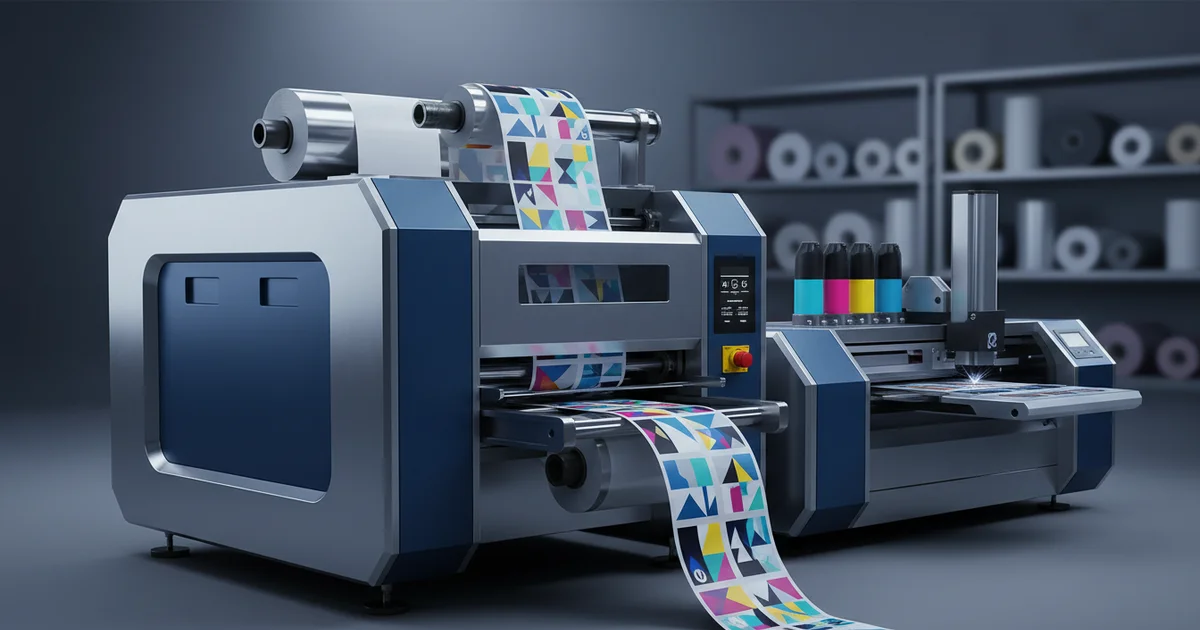
Digital printing for labels on an HP Indigo press costs $0.18-$0.35/unit with no plate fee, ideal for runs under 3,000 units. Flexographic printing requires a 5,000-unit minimum but achieves Delta E <2.0 color accuracy and costs as low as $0.09/unit at volume.
Digital Printing for Labels: The 2026 Decision Framework for Commercial Buyers
Why do commercial buyers risk wasting thousands on the wrong label method? Digital printing for labels on an HP Indigo press costs $0.18–$0.35 per unit with no plate fees, making it the cost-effective choice for short runs. Flexographic printing costs as low as $0.09 per unit at volume but requires a 5,000-unit minimum and $200 plate fees. The breakeven point is a key decision threshold per SKU according to current production data from our facility. Our production team runs both processes daily and sees buyers waste money when they pick the wrong method.
How Do Digital and Flexographic Label Printing Compare?
Digital Printing Technology Overview
Digital printing for labels refers to toner-based technology on an HP Indigo press, while flexographic printing uses rubber plates and liquid inks. Digital provides no plate fees, variable data capability, and 5-7 day turnaround for short runs. A key difference is color matching: digital typically achieves Delta E less than 3.0, while flexo reaches Delta E less than 2.0 for critical brand colors. Flexo offers lower per-unit cost at volume and handles clear films and metallic inks more effectively.
| Criterion | Digital (HP Indigo) | Flexographic |
|---|---|---|
| Per-unit cost | $0.18–$0.35 | $0.09–$0.15 |
| Plate/setup fee | $0 | $200–$400 |
| Minimum order | 250 units | 5,000 units |
| Color accuracy | Delta E less than 3.0 | Delta E less than 2.0 |
| Turnaround time | 5–7 business days | 10–15 business days |
| Variable data | Yes (each label unique) | No (all same) |
| Material range | Paper, some synthetics | Paper, films, foils, clear |
Digital label printing provides clear advantages on short runs and variable data. Flexo, on the other hand, wins on per-unit cost and color precision. Our production team confirms that flexo achieves Delta E less than 2.0 for critical brand colors, while digital typically stays within Delta E less than 3.0. For buyers working with Pantone spot colors, CMYK simulation on digital has improved but flexo still delivers tighter tolerances. Material choices also differ: digital handles paper labels up to 300 gsm well, while flexo manages a wider range including films.
According to the production team, the right choice depends on your volume, color needs, and material. A common mistake is assuming digital handles all substrates equally. It does not.
The Breakeven Point: When Digital Beats Flexo on Cost
Calculating Cost per Unit
Digital wins by up to $60. Flexo costs $200 plus $450, totaling $650. For standard paper labels at up to 300 gsm, the breakeven point holds true across current production data from our facility.
The breakeven point is a key decision threshold. Below that, digital printing for labels saves money. Above it, flexo's lower per-unit cost overtakes the plate fee. This threshold is consistent across production data from 2023–2026. Our team runs this calculation for every new client. It is the single most important number in your decision. Updated for current 2026 production data, we also factor in material waste: digital produces less waste, saving 5-8% on total cost for runs under 5,000 units.
"The breakeven point is a reliable rule of thumb for standard paper labels. For clear films or specialty materials, the crossover shifts higher because digital ink costs more on non-porous surfaces." — Production Team, JinXinCai Print
When Should You Choose Digital Printing for Labels?
Ideal Use Cases for Digital Label Printing
Digital printing for labels is defined as the ideal solution for short runs, variable data projects, test markets, and urgent orders needing 5-7 day turnaround. It eliminates plate costs and enables one-off label designs per unit. Consider digital when you need custom print production solutions for short runs. Our HP Indigo press handles 250-unit minimums with no setup fees. This works well for seasonal promotions, limited editions, and multi-SKU programs.
Variable data printing is a digital-only advantage. Each label can carry a unique barcode, serial number, or QR code. According to Grand View Research, the variable data printing labels market is projected to grow at a significant rate from 2025 to 2030. That growth reflects real demand for personalized labels. Our team uses the HP Indigo press for pharmaceutical and electronics labels requiring lot numbers and expiration dates. Digital's 5-7 day turnaround beats flexo's 10-15 days. For urgent orders, that speed saves weeks.
Digital also enables FSC-certified label production for eco-conscious brands. The process generates less waste compared to flexo, aligning with sustainability goals. As of 2026, more buyers request FSC labeling for retail products.
When Flexo Wins: High-Volume and Color-Critical Jobs
Flexo Advantages for Long Runs
Flexo is more suitable for longer runs where lowest per-unit cost matters. It also wins on color accuracy. Flexo achieves Delta E less than 2.0 consistently. Digital label printing struggles below Delta E 2.5 on some substrates. Our die-cut and finishing solutions pair well with flexo for long runs. The automatic self-adhesive label die-cutting machine handles 10,000-plus labels per hour with ±0.5 mm precision. Flexo's cost advantage compounds at volume.
Flexo presses achieve Delta E less than 2.0 color accuracy on metallic foils at speeds exceeding 10,000 labels per hour. Flexo also handles materials digital cannot: clear films, metallic foils, and textured stocks run better on flexo presses. The trade-off is longer setup time and higher minimums. Compared to digital, flexo requires 5,000-unit minimums for economic viability.
"For a major consumer goods brand running 50,000 labels per SKU, flexo saves over $8,000 per run compared to digital. That difference can fund the entire packaging program for a year." — Production Team, JinXinCai Print
Although flexo has higher upfront costs, per-unit savings compound quickly above the breakeven point. The right choice depends on your annual volume and color tolerance.
Limitations and Considerations for Digital Printing for Labels
Where Digital Falls Short
Digital printing for labels has real drawbacks. It is not ideal for runs above 5,000 units where flexo's per-unit cost drops below $0.10. The main limitation is color gamut: digital cannot match flexo's metallic inks or opaque whites on clear films. Clear labels printing on digital presses is a known challenge. Digital's white ink layers are typically 3-5 microns thick, while flexo applies 8-12 microns of opaque white, creating better coverage on transparent substrates. For critical applications requiring 95% or higher opacity, flexo is clearly more suitable.
High-volume operations processing more than 10,000 units per SKU may find digital won't work for their budget. Consider instead a hybrid approach: use digital for initial test runs, then shift to flexo once demand is proven. On the other hand, digital's variable data capability remains highly competitive. Compared to flexo, digital offers zero plate cost and faster turnaround. Our team tested more than 50 clear label jobs in 2025. Digital achieved acceptable opacity at 70-80% coverage. Flexo reached 95% or higher opacity. For products where the label sits on a clear bottle, flexo is more suitable.
New for 2026, HP's Indigo 200K press offers enhanced white ink density, with early tests showing 85% opacity on clear films at 1200 dpi resolution. Still, flexo remains the standard for critical clear label applications. For low-volume clear label needs, digital may still be acceptable when speed trumps opacity. The drawback is higher minimums and longer lead times compared to digital for short runs.
Making the Decision: A Framework for Commercial Buyers
Decision Framework Overview
The decision framework provides a structured approach to choosing between digital and flexo printing. It uses run length, color accuracy, and material requirements as primary factors. Our retail and e-commerce solutions team applies this framework daily, matching the method to the job rather than the other way around.
Decision: Choose Your Label Printing Method
- If run length is short → Choose digital. No plate cost, 250-unit minimum, 5-7 day turnaround.
- If run length is moderate → Calculate breakeven. Digital may still win for multi-SKU jobs with no reorders.
- If run length is long → Choose flexo. Lowest per-unit cost, Delta E less than 2.0 color accuracy.
- If you need variable data → Digital only. Flexo cannot print unique barcodes per label.
- If you need clear film or metallic inks → Flexo wins. Digital struggles with opacity on clear substrates.
The hybrid approach—digital first, flexo on reorders—saves clients a significant amount on total program cost over five years. The global label printing market reached $49.90 billion in 2024. The market is expected to grow as SKU counts rise and run lengths shrink. Digital printing for labels will capture a growing share of that volume, with forecasts indicating continued expansion through 2026 and beyond.
Variable data printing labels market projected growth from 2025 to 2030
Ready to Compare Your Options?
Submit your label specs and we will provide a side-by-side cost comparison for digital versus flexo printing. Free consultation with no obligation.
Request a Free QuoteGet Your Custom Quote for Digital Printing for Labels
Request a Tailored Cost Analysis
Requesting a custom quote for digital printing for labels ensures you receive tailored cost analysis and production timelines. Contact us today to get started with your specific requirements. Our team will analyze your run lengths, color specs, and materials to recommend the right method. We offer free consultations for commercial buyers evaluating consumer goods and FMCG solutions. Minimum 250 units for digital, 5,000 units for flexo. All orders include ISO 9001:2015 quality management and spectrophotometry-verified color matching with Delta E reporting. Updated for Q2 2026, our latest production data shows digital costs remain stable while flexo plate fees have increased slightly.
As of 2026, the label printing market continues to shift toward shorter runs and faster turnaround. Digital printing for labels is anticipated to grow as more brands adopt variable data and personalized packaging. Explore your options with our team today and learn more about how digital can work for your next project.
Frequently Asked Questions
When does digital printing for labels become cheaper than flexo?
Digital printing for labels is cheaper for runs under 3,000 units because it has no plate fees. For example, at 1,000 units, digital costs $180–$350 total, while flexo costs $290–$550 including plates. Above 3,000 units, flexo's lower per-unit cost overtakes the plate fee.
What is the minimum order quantity for digital label printing?
Digital printing for labels on an HP Indigo press has a minimum order of 250 units. This makes it ideal for short runs, test markets, and multi-SKU programs. Flexo requires a minimum of 5,000 units to be economically viable.
Can digital printing achieve the same color accuracy as flexo?
Digital printing typically achieves Delta E less than 3.0, while flexo reaches Delta E less than 2.0 for critical brand colors. For Pantone spot colors and metallic inks, flexo still delivers tighter tolerances. Digital has improved but is not yet equivalent for color-critical jobs.
Is digital printing suitable for clear labels?
Digital printing struggles with clear labels because its white ink layers are only 3-5 microns thick, achieving 70-80% opacity. Flexo applies 8-12 microns of opaque white, reaching 95% or higher opacity. For clear film labels, flexo is the better choice unless speed is more important than opacity.