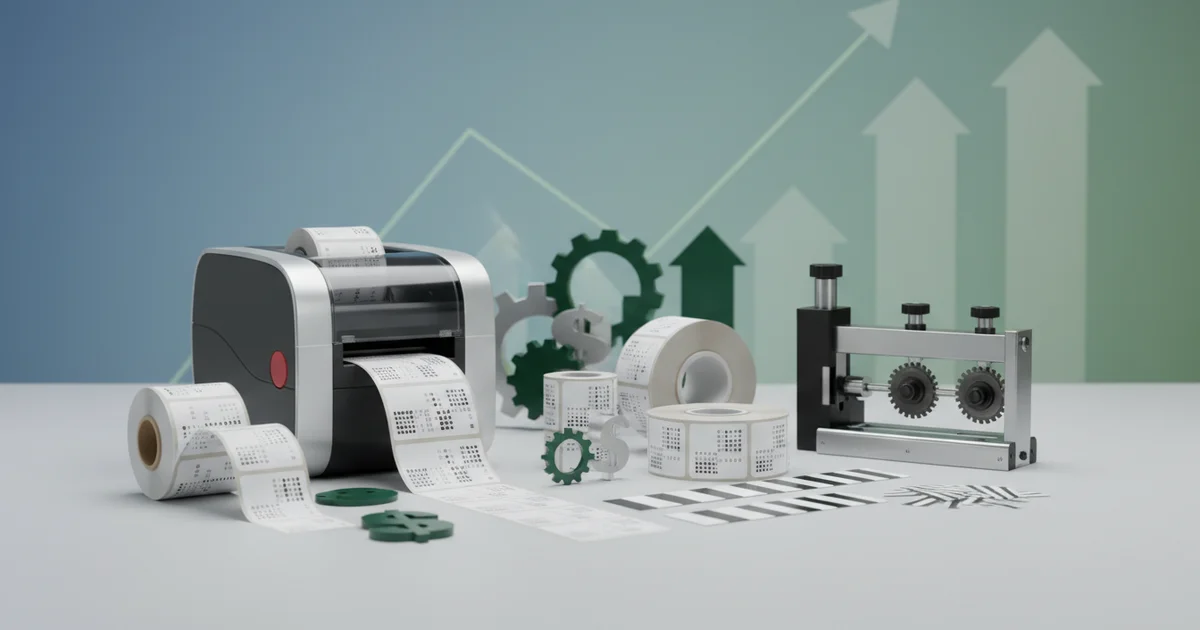
Custom zebra labels require Grade A barcode quality per ISO/IEC 15416, thermal transfer printing for 5+ year durability, and peel adhesion of 2.5 N/25mm or higher to prevent scanning failures.
Who Should Use This Custom Zebra Labels Guide?
Are your custom zebra labels causing scanning failures and costly downtime? Custom zebra labels are a critical component for purchasing directors and purchasing managers in manufacturing and logistics who source asset tracking labels for fixed asset management or inventory control. You manage annual volumes between 10,000 and 500,000 labels, and your typical decision timeline runs 4-8 weeks from initial RFQ to first order. This guide is for buyers who need labels that scan reliably in automated environments. If your operation loses time to manual scanning or relabeling, the strategies here apply directly. On the other hand, low-volume users under 2,000 labels per year may find simpler stock-label programs more cost-effective.
Why Do Custom Zebra Labels Fail in Scanning Applications?
Custom zebra labels require three critical specifications to avoid scanning failures. First, the barcode print contrast must meet Grade A per ISO/IEC 15416. Second, the adhesive must bond permanently to the application surface with verified peel adhesion. Third, the label material must withstand the operating environment—temperature, chemicals, and UV exposure.
Our production team at JinXinCai Print Production Team sees these failures daily. A common mistake is specifying a label based on price alone. Compared to generic stock labels, custom options deliver better adhesion and print durability, but the trade-off is higher upfront engineering time.
Thermal transfer printing provides 5+ year durability for industrial labels. Direct thermal printing fades in sunlight or heat and won't work for long-term asset tracking. This distinction is the most common specification error we see.
What to ask suppliers: The first step in evaluating suppliers is to request a barcode verification report per ISO/IEC 15416 showing Grade A (≥3.5) for at least 10 samples per production run. This is the only reliable proof that your custom zebra labels will scan correctly in automated systems. Request samples printed on your actual equipment before approving production. As of 2026, the latest barcode verification standards require reporting on 8 parameters including edge contrast and minimum reflectance. Suppliers who cannot provide this data are likely producing labels that will fail in automated scanning.
How to Evaluate Adhesive Performance for Asset Tracking Labels
Asset tracking labels require adhesives that bond permanently to the application surface. The key metric is peel adhesion, measured in Newtons per 25 millimeters (N/25mm) per FINAT FTM 1 or ASTM D3330. For permanent applications on metal or plastic, target 2.5 N/25mm or higher.
A drawback of high-peel adhesives is they may leave residue on delicate surfaces. For temporary labels or reusable containers, consider removable adhesives with peel values below 1.0 N/25mm. The right choice depends on your surface material and the label's intended lifespan.
Our team tests every adhesive recommendation against the client's actual surface. A label that bonds perfectly to stainless steel may fail on low-energy plastics like polyethylene. Always request a sample test on your surface before committing to a full run.
Barcode quality grade required for reliable scanning in automated logistics environments per ISO/IEC 15416
What Are the Evaluation Criteria for Custom Zebra Labels Suppliers?
This table provides a structured approach for comparing custom zebra label suppliers before signing a contract. Each criterion includes a verification method, a red flag to avoid, and a green flag to confirm.
| Criterion | How to Verify | Red Flag | Green Flag |
|---|---|---|---|
| Barcode Grade (ISO/IEC 15416) | Request a verification report showing Grade A for 10+ samples per run | Supplier cannot provide a verification report or offers Grade C or lower | Supplier routinely achieves Grade A (4.0) and provides report with each shipment |
| Adhesive Peel Strength (N/25mm) | Ask for datasheet per FINAT FTM 1 or ASTM D3330 | Supplier does not specify peel strength or offers values below 2.0 N/25mm for permanent | Supplier offers 2.5 N/25mm or higher for permanent labels |
| Thermal Transfer Print Durability | Request printed samples and test with a Sutherland 2000 rub tester | Supplier cannot provide printed samples or recommends direct thermal for long-term use | Supplier recommends thermal transfer for 5+ year durability and provides test data |
| Material Compatibility | Specify surface type, temperature range, and chemical exposure | Supplier offers one-size-fits-all material without asking about application conditions | Supplier asks about surface energy and temperature extremes before recommending material |
| Quality Certification | Verify ISO 9001:2015 and ISO 14001:2015 certifications | Supplier holds no quality certifications or cannot provide certificate numbers | Supplier holds ISO 9001:2015 and ISO 14001:2015 with current valid-through dates |
| Lead Time | Ask for first-order and repeat-order lead times in writing | Lead time exceeds 4 weeks without explanation or varies widely | Repeat orders ship in 10-15 business days; first orders in 3-4 weeks including samples |
Red Flags in Custom Zebra Label Suppliers
Warning signs of an unreliable custom zebra label supplier include missing barcode verification reports and vague adhesive specifications. Without this data, you cannot confirm the labels will scan in your system. Another red flag is a supplier who recommends direct thermal printing for labels that need to last over 5 years—they are either inexperienced or cutting corners.
Although low pricing is attractive, it often signals lower quality materials or skipped quality checks. Suppliers who avoid specifying DPI (e.g., 300 dpi minimum), Pantone color matching, or tolerance for label dimensions (e.g., ±0.5 mm) may lack precision manufacturing. Competitors offering verified ISO 9001 compliance with documented QC processes often provide more reliable results.
RFQ Questions to Ask Before Ordering Custom Zebra Labels
This section provides seven essential RFQ questions to evaluate supplier quality. Each question includes what to look for in a reliable response.
- Q: What barcode grade (ISO/IEC 15416) do you guarantee, and can you provide a verification report with each order? — What to look for: Grade A (≥3.5) guarantee with written commitment to provide verification reports for every production run.
- Q: What is the peel adhesion strength (in N/25mm) of your permanent adhesive, and which standard is used to measure it? — What to look for: Minimum 2.5 N/25mm per FINAT FTM 1 or ASTM D3330 for permanent applications.
- Q: Do you recommend thermal transfer or direct thermal printing for labels that need to last over 5 years in an industrial environment? — What to look for: Thermal transfer recommendation with specific ribbon compatibility details.
- Q: What is your minimum order quantity for custom printed zebra labels, and what are the lead times for first order and repeat orders? — What to look for: MOQ under 500 units for digital, under 1,000 for offset; repeat orders in 10-15 business days.
- Q: Can you provide a sample of a label printed with our barcode and test it on our actual surface before production? — What to look for: Yes, with a clear sample approval process and timeline.
- Q: What certifications do you hold and how do they affect your quality control process? — What to look for: ISO 9001:2015 and ISO 14001:2015 with current certificates; explanation of how certifications drive daily QC.
- Q: How do you handle barcode verification for variable data — do you verify every single label or use a sampling plan? — What to look for: 100% verification for serialized labels using automated inspection equipment like the PULISI fully automatic optical/visual inspection machine.
Pricing Signals and MOQ Thresholds
Custom zebra label pricing is determined by material, adhesive type, barcode verification needs, and volume. Typical MOQs start at 500 units for digital printing and 1,000 units for offset. Cost per label drops 20-35% over 2 years as you consolidate suppliers and increase volume.
Lead times for repeat orders run 10-15 business days from final art approval. First orders take 3-4 weeks including sample production and approval. The main drawback of low MOQ suppliers is they often lack automated inspection equipment, which increases defect risk.
Compared to suppliers who batch-verify labels, those using automated optical inspection machines catch defects before shipping. Our PULISI fully automatic label optical/visual inspection machine scans every label at production speed. This is projected to become standard for industrial labels as of 2026, as automated scanning environments demand near-zero defect rates.
Ready to Source Reliable Custom Zebra Labels?
Get barcode verification reports with every order. Our ISO 9001:2015 certified facility produces custom zebra labels with Grade A barcode quality and verified adhesive performance.
Request a Free QuoteWhen Standard Custom Zebra Labels Won't Work for Your Situation
Standard custom zebra labels are not ideal for applications below 500 units per SKU. For low-volume needs, consider digital-printed stock labels or pre-printed blank labels with variable data. The setup costs for offset-printed custom labels won't work for runs under 500 units.
Another limitation is extreme environments. Labels exposed to chemicals, outdoor UV, or temperatures above 120°C require specialized materials. Standard polyester or paper labels may not be suitable. Consider instead polyimide or ceramic-coated labels for high-temperature applications.
Although custom labels offer better durability, the trade-off is longer lead times compared to stock labels. If you need labels in 2-3 days, stock options from certified suppliers are more suitable.
On the other hand, for long-term asset tracking programs, the upfront engineering investment in custom labels pays back through reduced relabeling costs.
For specific needs like FSC-certified materials or Pantone color matching, standard custom zebra labels may lack the required precision. Competitors offering digital printing with 300 dpi resolution and ±0.5 mm dimensional tolerance provide better alternatives for color-critical applications. If your environment demands FDA 21 CFR compliant materials, ensure the supplier provides documented compliance data.
Explore Advanced Materials for Harsh Environments
When standard materials fall short, our specialty materials capabilities cover polyimide, ceramic-coated, and FSC-certified options. We test labels on your surface with barcode verification at 300 dpi and provide Pantone color matching within Delta E tolerance. For color-critical applications, we can match specific CMYK and Pantone colors with verified Delta E values (≤2.0). Our Heidelberg offset presses ensure consistent GSM material thickness (e.g., 80-120 gsm for paper, 50-100 gsm for film) for reliable printing. All production is supported by ISO 9001:2015 quality management.
Your 10-Point Custom Zebra Labels Supplier Checklist
This checklist provides ten measurable criteria for evaluating custom zebra label suppliers. Use it before signing any contract.
Before Signing Any Custom Zebra Labels Contract, Verify:
- Barcode grade guarantee: ISO/IEC 15416 Grade A (≥3.5) confirmed in writing with verification reports per shipment.
- Adhesive peel strength:
Ready to get started with custom zebra labels? Contact our team to explore the right solution for your next project.
Frequently Asked Questions
When does thermal transfer printing become cheaper than direct thermal for custom zebra labels?
Thermal transfer is cost-effective for labels needing over 5 years durability, as direct thermal fades in sunlight or heat. For short-term use under 1 year, direct thermal may be cheaper. The crossover depends on your required lifespan and environmental exposure.
What peel adhesion value is needed for permanent bonding on low-energy plastics?
For low-energy plastics like polyethylene, target peel adhesion of 2.5 N/25mm or higher per FINAT FTM 1. Always test samples on your actual surface, as adhesion can vary significantly between materials.
How can I verify a supplier's barcode quality claim before ordering?
Request a barcode verification report per ISO/IEC 15416 showing Grade A (≥3.5) for at least 10 samples from a production run. Suppliers using automated inspection machines like the PULISI can provide 100% verification for serialized labels.
What is the minimum order quantity for custom zebra labels with digital printing?
Typical MOQ for digital printing is 500 units per SKU. For offset printing, MOQ starts at 1,000 units. Low-volume users under 500 units may find stock labels more cost-effective.

Sarah Liu
Materials scientist with deep expertise in print substrates, adhesives, and finishing treatments. Certified in ISO testing protocols for label durability.
Need the Right Material for Your Application?
Free material samples shipped within 48 hours. 40+ specialty substrates available.
Related Resources
You Might Also Be Interested In
Specialty Materials
Learn more about our specialty materials solutions.
Read more →Custom Print Production
Learn more about our custom print production solutions.
Read more →Die-Cut & Finishing
Learn more about our die-cut & finishing solutions.
Read more →Retail & E-Commerce
Solutions tailored for the retail & e-commerce industry.
Read more →Consumer Goods & FMCG
Solutions tailored for the consumer goods & fmcg industry.
Read more →Contact Us
Get in touch or request a quote.
Read more →