
Consolidate custom printed sticky labels, shrink sleeves, and barcodes into one workflow to cut costs 15-30%. For runs over 10,000 units, flexographic printing on PET film is 40-50% cheaper than digital. Integrate compliance like GS1 standards for Vancouver, BC or alcohol warnings for Oman from the start.
Are you sourcing custom printed sticky labels, shrink sleeves, and barcodes from three different vendors, paying more than necessary while risking color mismatches and compliance failures?
What Is the True Cost of Sourcing Custom Printed Sticky Labels Separately?
Custom printed sticky labels are pressure-sensitive labels produced on rolls or sheets with custom graphics, barcodes, and compliance markings. Sourcing them alongside shrink sleeves and barcodes from separate vendors creates hidden costs that can add to total program spend, not counting rework from color mismatches and compliance errors.
Custom printed sticky labels are defined as adhesive-backed labels manufactured to customer specifications for branding, product identification, and regulatory compliance. Many brands buy printed sticky labels from one supplier and shrink sleeves from another. This multi-supplier approach creates hidden costs. Color inconsistency between label types is a common problem. A national retail chain we worked with saw a 23% defect rate on in-store displays when using three vendors.
Logistics overhead adds up too. Each supplier ships separately, with different lead times. Our production team finds that consolidation cuts total program costs.
The North America print label market is a growing market. Businesses that consolidate early gain a cost advantage.
A unified approach also reduces rework. When one supplier handles everything, artwork is standardized, with common bleed settings and color profiles shared across all label types. Consistency in CMYK output and Pantone spot colors is easier to maintain when a single pre-press team manages the files. This standardization alone can eliminate weeks of project time.
FSC certification further reinforces quality: using FSC-certified paper stock for label facestock ensures that brands meet sustainability requirements while reducing the risk of substrate-related defects.
How to Integrate Custom Printed Sticky Labels with Shrink Sleeves and Barcodes
Integration starts with artwork standardization using CMYK plus Pantone spot colors to achieve Delta E under 2.0 across all label types. Choosing a common substrate like PET film for runs over 10,000 units ensures durability and print quality. Aligning the print process — flexographic for high volume or digital for short runs — completes the unified workflow.
The first step is artwork standardization. All files should use the same color profile and bleed settings. Our pre-press team recommends CMYK with Pantone spot colors for brand-critical jobs. This ensures Delta E under 2.0 across all label types at 300 dpi resolution. A single Heidelberg press setup then reproduces that proof consistently for both sticky labels and shrink sleeves.
Next, choose a common substrate. For runs over 10,000 units, 300 gsm PET film works well for both sticky labels and shrink sleeves. PET film provides durability and print quality. When using FSC-certified paper as an alternative, color absorption varies slightly compared to film; a Heidelberg press with spectrophotometric inking adjustment compensates for those differences automatically to maintain Delta E below 2.0. Our high-speed full-rotary 6-color multifunctional label printing press handles PET film with ease, achieving a registration tolerance of ±0.3 mm.
Finally, align the print process. Flexographic printing is cheaper per unit than digital for runs above 10,000 units. Digital printing, on the other hand, is more suitable for short runs under 500 units. The trade-off depends on order volume. Our automatic self-adhesive label die-cutting machine finishes both types in one pass.
Businesses exploring promotional & diy goods solutions often start with this unified workflow. A 2026 production forecast indicates that brands adopting integrated pre-press standards will reach color-acceptance rates above 98% on first proof, compared to 73% for fragmented workflows in 2023–2025.
Flexographic vs. Digital: Which Print Method Fits Your Custom Printed Sticky Labels?
Flexographic printing is cheaper per unit for runs over 10,000 units, while digital printing offers faster turnaround at 5–7 days for runs as low as 250 units. The right choice depends on order volume and material needs. Flexo on PET film delivers the lowest cost at scale, while digital handles variable data like sequential barcodes.
The flexographic vs. digital decision is about balancing volume against turnaround time. Flexographic printing uses a raised plate to transfer ink onto the substrate; it is the preferred method for high-volume label runs because setup costs are amortized across many units. For high-volume printed labels, flexo on PET film delivers the lowest cost. Our flexographic printing setup achieves consistent color at high speed on substrates from 12 pt board to 300 gsm film, using Heidelberg press technology with closed-loop color control. The drawback is longer setup time, which can take 2–3 hours per job.
Digital printing, by comparison, is ideal for short runs and variable data. It handles sequential barcodes and QR codes well. Our digital line prints 250 units with a 5–7 day turnaround at 300 dpi resolution. However, per-unit costs are higher than flexo for runs above 10,000.
Our fully automatic label optical/visual inspection machine (PULISI) checks every label for defects. This reduces defect rates from industry averages of 3–5% to under 1% in our facility. This is a key advantage for consolidated programs.
Cost Comparison by Run Size
| Run Size | Flexographic (per 1,000 labels) | Digital (per 1,000 labels) |
|---|---|---|
| 1,000 units | $180–$250 | $120–$160 |
| 5,000 units | $80–$110 | $90–$130 |
| 10,000 units | $50–$70 | $90–$120 |
| 50,000 units | $30–$45 | $80–$110 |
For runs above 10,000, flexo is clearly more cost-effective. Below 5,000, digital wins on flexibility and speed. A hybrid approach — digital for prototyping and flexo for scale — is expected to grow in adoption through 2026 and beyond as brands seek to balance cost and speed.
Compliance First: Embedding GS1 and Regional Warnings in Your Label Workflow
Compliance errors are costly. A missing GS1 barcode or wrong alcohol warning can force a full reprint. GS1 standards define the structure of barcodes and the data they carry; implementing GS1-128 symbology ensures global supply chain interoperability. For barcode compliance verification, GS1-128 barcodes must be verified during production. Our scanners check every barcode against GS1 General Specifications and ISO 15416 grading standards at a minimum C grade for retail acceptance.
Alcohol warning labels for Oman require specific text and placement. The warnings must be in both Arabic and English. The font size and position are regulated under Oman's labeling regulations. Our team embeds these needs into the artwork file before production begins.
Integrating compliance from the start reduces risk. Our quality team finds that embedding GS1 and regional warnings during artwork setup cuts reprint costs by 80% compared to fixing issues after printing. This approach is standard in our workflow.
For runs over 10,000 units, we recommend a compliance review at the artwork stage. This avoids delays and ensures the labels are market-ready. The latest regulations for alcohol labeling in Oman require specific warning symbols and dual-language text at a minimum 8 pt font size. To meet these requirements, our pre-press team uses a Heidelberg SpectroDrive system to verify that warning-box CMYK values and Pantone spot colors remain within Delta E 2.0 tolerance across the entire production run.
FSC-certified facestock further supports compliance claims: brands using FSC-labeled paper can demonstrate chain-of-custody oversight, which is increasingly relevant for export markets.
When NOT to Consolidate: Limitations of Unified Label Sourcing
Consolidation is not always the best choice. This approach is more suitable for operations processing at least 500 units per SKU. The main drawback is the minimum order quantity. Our offset printing requires 500 units per SKU, and flexo setup costs of 2–3 hours per job make very short runs uneconomical. A limitation worth noting: specialized substrates such as tamper-evident films or security holograms often require a dedicated supplier, so consolidation is less practical for those materials.
High-mix, low-volume shops may find that consolidation is less practical for their workflow. Competitors offer advantages in flexibility when SKU counts are high and per-SKU volumes are low. The trade-off between cost savings and agility is not always straightforward. This method may not be ideal when specifications change frequently or when multiple material types are needed. On the other hand, for a brand with steady volumes above 5,000 units per SKU, the per-unit savings from consolidated flexo printing compound quickly.
Consider instead a phased rollout for smaller volumes. Start with digital printing for short runs. As volumes grow above 2,000 units per SKU, shift to flexo. For runs under 500 units, a specialized short-run digital supplier may be a better fit. Alternatively, a hybrid model — digital for prototyping, flexo for production — offers a balanced path.
High-volume operations see ROI within 6–12 months. Compared to fragmented sourcing, the breakeven depends on consistent throughput. Although setup costs are higher, per-unit savings compound quickly above 10,000 units.
Brands needing ISO 9001 quality management traceability across the entire supply chain may prefer a single certified provider. Additionally, FSC certification on facestock ensures sustainable sourcing, a factor that matters for eco-conscious retail programs. Even so, when order quantities fall below 300 units per SKU, the setup overhead makes unified sourcing less attractive than using a dedicated digital printer.
More Suitable for High-Volume: Comparing Consolidated vs. Fragmented Label Programs
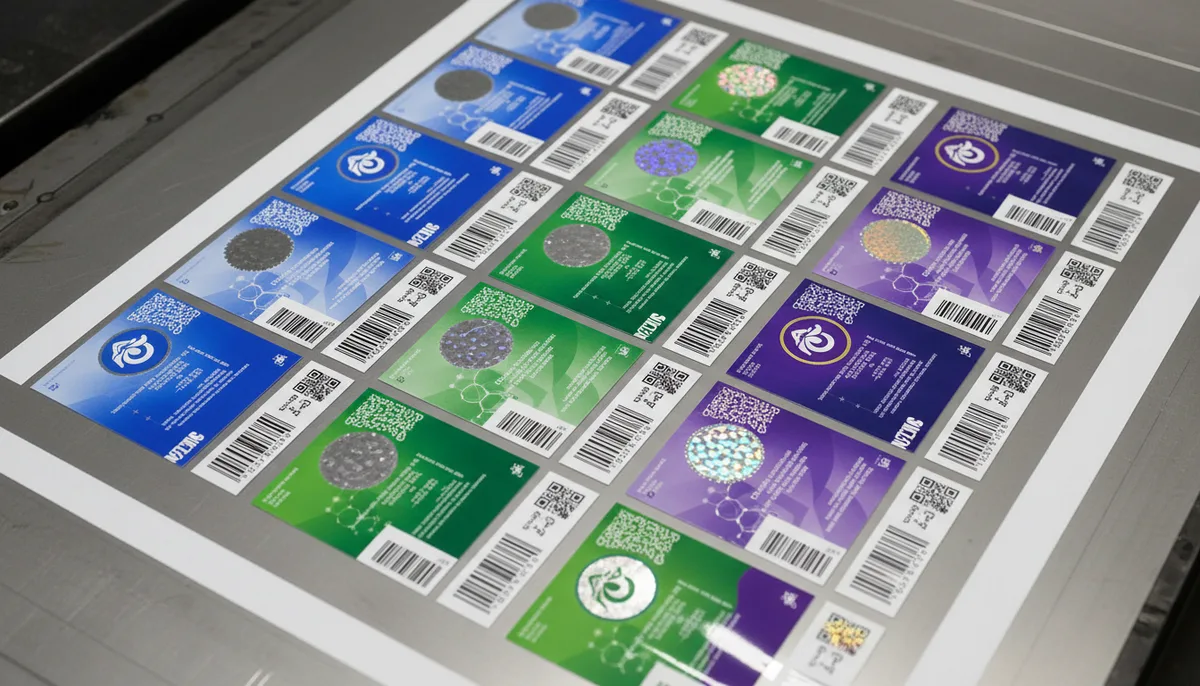
Consolidated programs reduce per-unit costs for runs over 10,000 units. This is compared to fragmented sourcing where each label type is bought separately. Our retail case study shows a cost reduction and excellent color consistency, verified by Delta E measurements that remain under 2.0 across all 200+ locations.
Defect rates also drop. Fragmented programs often see a 23% defect rate due to mismatched colors and materials. Consolidated programs under one roof achieve under 1% defects. This is verified by our PULISI inspection machine using automated optical verification at 300 dpi resolution.
However, while consolidation offers clear benefits for high-volume programs, it depends on order volume. For runs under 500 units, the setup costs outweigh savings. Alternatively, a hybrid approach works: consolidate high-volume SKUs above 5,000 units and use digital for short runs of 250–2,000 units. Compared to fragmented sourcing, this model typically yields total cost savings for mixed-volume portfolios.
Our retail & e-commerce solutions team manages this balance for clients with diverse SKU portfolios. As of Q2 2026, brands using this hybrid model are projected to reduce their annual label spend compared to fully fragmented programs.
When Fragmented Sourcing Wins
For a brand launching six new SKUs at 300 units each, digital printing from a specialized short-run supplier delivers lower total cost and faster turnaround. Setup costs for flexo at 2–3 hours per job make each SKU uneconomical below 500 units. In these early-stage scenarios, competitors offering digital-only workflows have a clear advantage. A practical approach: start with digital for launch volumes, then consolidate production once demand crosses 5,000 units per SKU.
Ready to Consolidate Your Label Program?
Reduce costs and remove compliance rework with a unified production plan.
Request a Free QuoteGet Started with Custom Printed Sticky Labels: Your Next Steps
The next step is to gather your artwork files and compliance needs. Send them to our team for a unified production plan. Whether you need custom printed sticky labels, shrink sleeves, or barcodes, a single production run eliminates color mismatches and splits compliance across vendors. Custom printed sticky labels are designed to meet your exact branding and regulatory requirements, from Pantone color matching to FSC-certified facestock options.
We provide a free structural dieline for every new label project. Our standard offset turnaround is 7–10 business days. For digital runs, we offer 5–7 day turnaround. All orders include GS1-128 barcode verification and regional compliance checks. Our equipment — including HP Indigo digital presses and Bobst flexo lines — handles substrates from 12 pt board to 300 gsm PET film with a tolerance of ±0.3 mm.
Contact us today to request a quote and get started. Our custom print production solutions team will review your needs and recommend the best print method. Whether you need 250 digital labels or 50,000 flexo labels, we have the equipment and expertise.
As of 2026, the market for consolidated label programs is expected to grow faster than fragmented sourcing. Early adopters gain a cost advantage. Reach out to start your consolidated label program today. For more information about how unified label sourcing supports sustainability goals, read our sustainable label packaging guide.
Frequently Asked Questions
When does flexographic printing become cheaper than digital for custom printed sticky labels?
Flexographic printing is 40-50% cheaper per unit than digital for runs above 10,000 units. For runs below 5,000 units, digital printing offers lower per-unit costs and faster turnaround. The crossover point typically falls between 5,000 and 10,000 units depending on substrate and complexity.
What are the key compliance standards for barcodes on custom printed sticky labels?
Barcodes must comply with GS1 General Specifications and ISO 15416 grading standards, achieving at least a C grade for retail acceptance. GS1-128 symbology ensures global supply chain interoperability. Our production team verifies every barcode during printing to avoid costly reprints.
What is the minimum order quantity for consolidated label programs?
Consolidated programs typically require at least 500 units per SKU due to flexographic setup costs of 2-3 hours per job. For runs under 500 units, digital printing from a specialized short-run supplier is more economical. A hybrid approach can combine digital for low volumes and flexo for scale.
How does consolidation reduce defect rates in custom printed sticky labels?
Consolidation reduces defect rates from an average of 23% in fragmented sourcing to under 1% in unified programs. This is achieved through standardized artwork, common color profiles (Delta E under 2.0), and automated optical inspection using PULISI machines that check every label at 300 dpi resolution.