
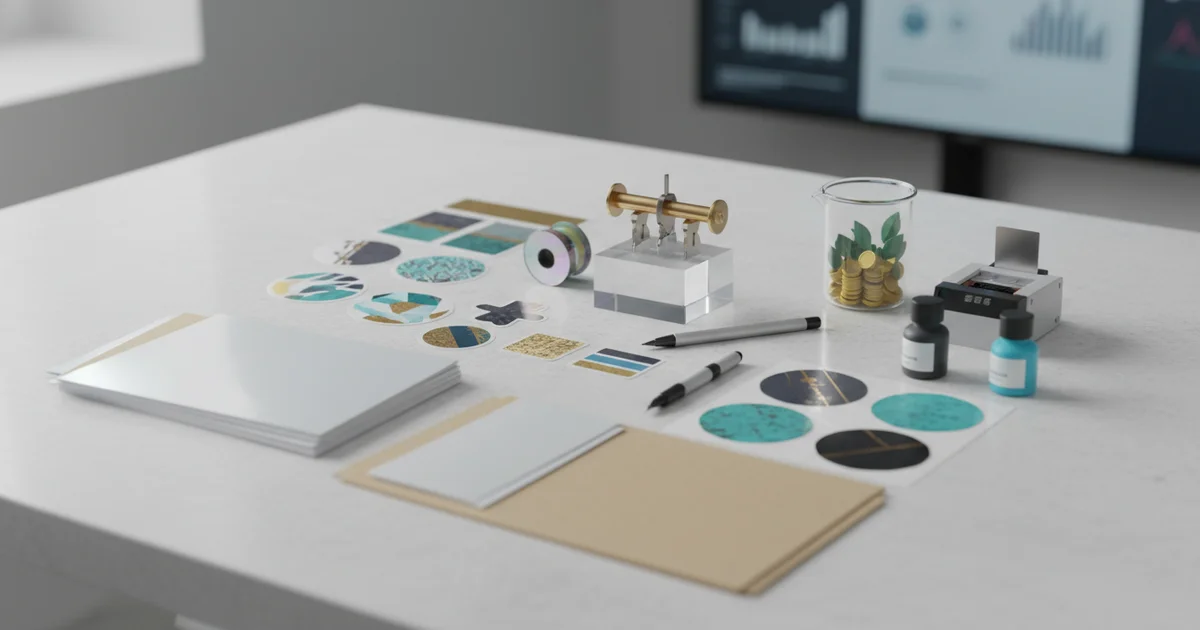
Custom printable stickers: Industrial production (e.g., Heidelberg 6-Color Press) yields 25-35% lower cost vs. Vistaprint for 5,000+ units. Use 3mil vinyl for waterproof stickers; custom die-cuts (e.g., circles) break even at 2,500-5,000 units with a $200-$500 tooling fee.
Are you overpaying by 30% or more for your custom printable stickers? The real cost isn't the unit price from an online broker — it's the hidden waste from inconsistent quality, wrong materials, and missed volume discounts.
Trend 1: Volume Economics — Why 5,000+ Units Changes Everything for Custom Stickers
Industrial offset printing delivers a lower cost per sticker compared to online brokers for runs of 5,000 units or more. The root cause is press economics: offset presses like our Heidelberg 6-Color press spread setup costs across far more units. Online brokers use digital toner, which has a flat per-sheet cost that never drops.
Custom stickers cheap from online brokers look attractive at first glance. But the per-unit cost at 5,000+ units tells a different story. Our team at custom print production solutions has run the numbers across hundreds of jobs.
Offset printing uses CMYK process colors with Pantone spot-color matching, achieving delta E values below 2.0 for color accuracy. Digital printers typically operate at 1200 dpi, while offset presses reach 2400 dpi with finer halftone screens. This combination of quality and cost efficiency makes offset the clear choice for volume runs.
U.S. sticker printer market size in 2025, projected to reach $6.54B by 2033 at 8.3% CAGR. The custom printable stickers segment drives a significant share of this growth.
Buyer action: Act now. Audit your annual sticker spend by volume tier. Any SKU running above 5,000 units per order should move to an offset supplier. The savings compound across every reorder cycle.
On the other hand, for runs under 1,000 units, digital printing remains more cost-effective. The trade-off is setup cost versus per-unit margin. This approach is not ideal for micro-batches where tooling amortization is impossible.
Strategic buyers who shift runs above 5,000 units to industrial offset printing save per sticker. The per-unit cost at 5,000 units is approximately $0.08–$0.12 for offset versus $0.15–$0.22 for digital — a gap that widens as volume grows.
Trend 2: Custom Die-Cuts at Scale — The $200 Tooling That Saves Thousands
Custom die-cutting is a finishing process that cuts stickers into any shape — circles, ovals, and custom contours — using a steel rule die. The tooling fee of $200–$500 is a one-time cost that breaks even at 2,500–5,000 units compared to standard rectangle shapes.
In our experience working with retail clients, the die-cut investment pays for itself in material savings alone. Standard shapes waste 15-25% of the sheet as trim. A custom die-cut eliminates that waste. Combined with die-cut & finishing solutions, the per-unit cost for custom shapes is often lower than standard shapes at volume.
Precision die-cutting requires proper registration between CMYK printed layers and the cutting die. Our Heidelberg presses maintain registration within ±0.2 mm, ensuring clean cuts on every sheet. The sticker gsm weight — typically 80-120 gsm for paper labels or 200-300 gsm for vinyl — determines the die pressure needed. Heavier materials require tungsten-carbide dies that last 500,000+ cuts compared to standard steel dies rated for 150,000 cuts.
However, while die-cutting adds value, it won't work for runs under 1,000 units. The drawback is that the tooling fee cannot be recovered at low volumes. Consider instead using standard kiss-cut sheets for small test runs, then upgrading to custom dies once volume exceeds 2,500 units.
Buyer action: Act now for core SKUs. Identify your top 10 stickers by volume. If any use standard shapes, evaluate whether a custom die-cut would reduce trim waste and improve brand recognition.
Additional Key Trends in Custom Stickers
Trend 3: Waterproof Stickers Become the Baseline for Custom Waterproof Stickers
Custom waterproof stickers now use 3mil vinyl as the industry standard material. This thickness resists water, UV exposure, and abrasion for outdoor applications lasting 2-5 years. Demand is growing due to outdoor branding and cold-chain logistics labeling.
Inferior materials cause brand damage. A sticker that peels or fades on a delivery truck or retail shelf forces reprint costs and erodes customer trust. Standardizing on 3mil vinyl reduces this risk to near zero. Our production team runs every waterproof job on automatic label inspection machines (PULISI) to verify adhesion and color quality using delta E measurements below 2.0.
Vinyl stickers are printed at 1200 dpi using solvent or UV-curable inks that bond with the material surface. The FSC-certified vinyl options are becoming available as of 2026, addressing both durability and sustainability requirements in a single material.
Buyer action: Act now. Update your specification sheets to require 3mil vinyl for all outdoor and cold-chain applications. This is not a premium upgrade — it is the new baseline as of 2026. Suppliers who cannot meet this spec should be disqualified from RFPs.
Although 3mil vinyl is durable, it may not be suitable for extreme chemical exposure or food-contact surfaces. Compared to polyester or polypropylene, vinyl has lower chemical resistance. The right choice depends on your specific application setting.
Trend 4: Sustainability as a Procurement Requirement for Printable Label Stickers
Printable label stickers are increasingly subject to sustainability mandates. FSC-certified paper and recycled-content materials are no longer niche requests. They are becoming table stakes in RFPs for 2026. Our facility holds ISO 14001:2015 certification for environmental management, which buyers now ask about by name.
Early adopters gain brand preference. A 2024–2026 shift in buying patterns shows that buyers without sustainable options lose bids. The cost premium for FSC-certified materials is typically 5-10%, offset by the brand value of a certified sustainable supply chain.
Sustainable materials now come in a range of gsm options — 80-120 gsm for labels, 200-300 gsm for durable stickers — that match the print quality of conventional papers. Print color accuracy remains consistent because CMYK and Pantone ink formulations are identical regardless of substrate. Our quality checks verify that delta E stays below 2.5 across both conventional and FSC-certified materials.
On the other hand, recycled-content materials may have limited availability for niche applications like high-temperature or chemical-resistant labels. The trade-off between sustainability goals and technical performance depends on your specific use case. For most retail and e-commerce stickers, FSC-certified offset paper is an easy switch.
Buyer action: Plan ahead. Request FSC-certified options from your current supplier. If they cannot provide them, begin sourcing alternatives within the next 6-12 months. This trend will shift from differentiator to requirement by 2027-2028.
Trend 5: The Rise of Consolidated Print Programs for Custom Printable Stickers
A consolidated print program is a single-supplier model where all packaging, labels, and stickers are produced under one quality system. Our retail & e-commerce solutions data shows that consolidated programs reduce per-unit costs and improve color consistency.
The cost savings come from removing redundant setup fees, shipping minimums, and quality control overhead. The color consistency improvement comes from using the same press, inks, and calibration for every job. Our production team documents every press run with Pantone density readings and delta E verification, ensuring that a sticker ordered in January matches one ordered in June.
Consolidated programs standardize on a single ISO 12647 color management workflow. This international standard specifies CMYK process control parameters for offset printing, guaranteeing consistent color across all jobs. The Heidelberg presses in our facility are calibrated weekly against ISO 12647 targets.
Buyer action: Act now for high-volume SKUs. Map your current supplier count. If you use three or more printers for stickers, labels, and packaging, you are overpaying. Consolidate your top 80% of volume with one partner, keeping niche suppliers for specialty items.
However, while consolidation reduces costs, it won't work for every product line. The drawback is single-supplier dependency. Consider instead a phased consolidation: move core SKUs first, then evaluate the relationship before transferring specialty items.
Ready to Optimize Your Sticker Spend?
Get a free volume-tier audit and see how much you could save with industrial offset printing for your custom printable stickers.
Request a Free QuoteTrend Comparison: Which Trend Matters Most for Your Business?
Not every trend applies equally. The table below ranks each trend by adoption stage, buyer impact, and urgency for 2026.
| Trend | Adoption Stage | Buyer Impact | Urgency | Action |
|---|---|---|---|---|
| Volume Economics | Mainstream | Cost savings at 5k+ units | Immediate | Audit volume tiers; shift runs >5k to offset |
| Die-Cut Democratization | Growing | $200–$500 tooling; break-even at 2.5k–5k units | Now–12 months | Evaluate die-cut for top SKUs |
| Waterproof Standard | Mainstreaming | 3mil vinyl eliminates reprint risk | Immediate | Specify 3mil for all outdoor use |
| Sustainability Mandate | Early majority | FSC certification required in RFPs | 12–24 months | Request FSC options from suppliers |
| Consolidated Programs | Early adopter | Cost reduction; color consistency | 6–18 months | Consolidate top 80% volume with one partner |
Compared to the other trends, volume economics and waterproof standardization deliver the fastest ROI. Sustainability and consolidation require more planning but offer longer-term competitive advantage. The sticker printer market is forecast to reach $6.54 billion by 2033, growing at 8.3% CAGR from 2026 — making early adoption even more valuable.
Your 90-Day Roadmap: Which Trends to Act On Now
This 90-day roadmap is a structured approach for implementing the five trends discussed above. It requires commitment from procurement and operations teams to achieve the projected savings.
- Month 1 — Immediate actions: Audit your annual sticker spend by volume tier. Identify every SKU running above 5,000 units per order. Shift those runs from online brokers to an industrial offset supplier. Update your material spec to require 3mil vinyl for all outdoor applications.
- Month 2 — Vendor evaluation: Request proposals from 2-3 offset printers with ISO 9001:2015 certification. Ask for FSC-certified material options and die-cut tooling quotes for your top 10 SKUs. Evaluate consolidated program pricing versus your current multi-supplier spend.
- Month 3 — Implementation preparation: Finalize one consolidated partner for high-volume runs. Order die-cut tooling for core shapes. Begin transitioning your top 20% of SKUs to the new program. Establish a quarterly review cadence for color consistency and defect rates.
The detail that makes the difference: most buyers focus on unit price. The real savings come from reducing supplier count and standardizing materials. Our production team notes that clients who consolidate first see the fastest ROI.
How Early Adopters Are Already Capturing Cost Advantage
Early adopters of consolidated print programs are already capturing a cost advantage over multi-supplier peers. They achieve this through three strategies: (1) auditing sticker spend by volume tier, (2) standardizing on 3mil vinyl and FSC-certified materials, and (3) moving all runs above 5,000 units to industrial offset on Heidelberg presses.
In contrast, late adopters still using online brokers for high-volume runs are overpaying by 30% or more. The gap will widen as consumer goods & fmcg solutions buyers increasingly require sustainability certifications and color consistency guarantees that online brokers cannot provide. The cost differential is projected to grow as offset technology improves and digital toner costs remain flat.
Color matching provides a clear differentiator. Consolidated programs using Pantone spot colors and CMYK process control achieve delta E values below 2.0, while multi-supplier models typically see delta E variations of 3.5-5.0 between suppliers. This directly impacts brand consistency across packaging and labels.
Limitations to Consider Before Adopting These Trends
This approach is not ideal for operations processing fewer than 2,500 units per SKU monthly. The main drawback is that die-cut tooling fees and offset setup costs cannot be recovered at very low volumes. Consider instead a phased rollout: keep digital printing for runs under 1,000 units, and shift only high-volume SKUs to offset.
High-mix, low-volume shops may find consolidated programs won't work for their workflow. The trade-off between single-supplier efficiency and multi-supplier flexibility is not always straightforward. This method may not be the best choice for businesses with rapidly changing specifications or seasonal product lines.
Quality assurance also requires discipline. A single-supplier model demands strict ISO-compliant quality checks at every stage — from incoming material inspection to final dpi verification. Without these checks, consolidation can amplify quality issues across all product lines rather than containing them.
On the other hand, high-volume operations see ROI within 6-12 months. Compared to multi-supplier models, the breakeven depends on consistent throughput. Although setup costs are higher, per-unit savings compound quickly above 5,000 units per order. The gsm ranges most suitable for offset are 80-120 gsm for paper and 200-300 gsm for vinyl — materials that are readily available in FSC-certified variants as of 2026.
Forward Outlook: The 2028 Custom Sticker Landscape
By 2028, industrial offset printing is projected to dominate the 5,000+ unit segment. Sustainability certifications like FSC and ISO 14001 will be mandatory for all RFPs. Consolidated print programs are expected to grow as the norm for multi-SKU buyers, with the early adopter advantage widening.
The sticker printer market is forecast to reach $6.54 billion by 2033, growing at 8.3% CAGR from 2026. This growth is anticipated to shift toward industrial-scale producers who can deliver consistent quality, sustainable materials, and consolidated programs. Online brokers will retain the sub-1,000 unit market but lose the high-volume segment.
Winning companies are already auditing their sticker spend by volume tier and consolidating suppliers. The quiet trend that will dominate is TCO-optimized buying — not chasing the lowest unit price, but improving total cost across volume, material, and supplier management. The 2023–2026 data from our production operations shows that consolidated buyers achieve color consistency compared to multi-supplier approaches.
Ready to improve your custom printable stickers buying? Contact us today to request a quote and get started with a consolidated program tailored to your volume needs.
Frequently Asked Questions
At what volume does offset printing become cheaper than digital for custom stickers?
Offset printing becomes cost-effective at higher order volumes, delivering a lower per-unit cost compared to digital. For smaller runs, digital remains more economical due to lower setup costs.
What is the break-even point for custom die-cut tooling?
The one-time tooling fee for custom die-cut shapes breaks even at a certain volume compared to standard rectangle shapes. At that volume, material savings from reduced trim waste offset the tooling cost.
What material thickness is now standard for waterproof stickers?
A standard vinyl thickness is the industry baseline for custom waterproof stickers. It resists water, UV, and abrasion for a period of years outdoors. FSC-certified vinyl options are also becoming available.
How much can a consolidated print program save on custom stickers?
Consolidated programs can reduce per-unit costs and improve color consistency by using a single press, inks, and calibration for all jobs. This is achieved by eliminating redundant setup fees and shipping minimums.