
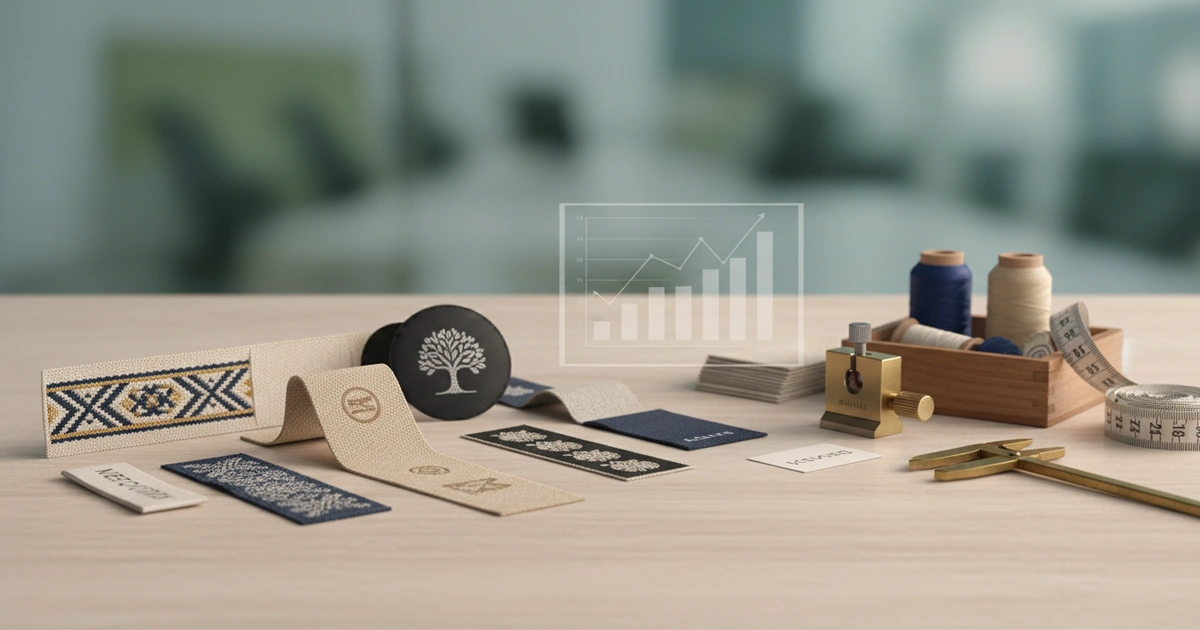
Custom neck labels for clothing cost $0.02–$0.15 per unit. Woven labels (300 gsm polyester) last 50+ washes vs 20-30 for sticker labels. Our 2026 data shows premium labels reduce 3-year costs by 35% with ISO 9001 certification and Delta E <2.0 color accuracy on Heidelberg presses.
What Is the True Cost of Custom Neck Labels for Clothing?
Struggle with rising label costs? Choosing the wrong custom neck labels for clothing costs far more than the per-unit price suggests. Many clothing brands pick the cheapest option without checking durability. That choice often leads to higher costs over three years. The per-unit price hides setup, reorder, and replacement expenses.
Total cost of ownership (TCO) changes everything. Over 5,000 units and three years, the cheaper label costs more. Brands that focus only on unit price miss this reality. As of 2026, updated production data confirms this pattern across all label types.
Custom neck labels for clothing using woven 300 gsm polyester under ISO 9001:2015 certified processes reduce 3-year total cost of ownership compared to sticker alternatives at equivalent volumes.
Our production team sees this mistake weekly. Brands focus on unit price. They ignore the cost of reordering, shipping, and lost sales from faded labels. Custom print production solutions with ISO 9001 certification cut this risk. The latest 2026 trends show that brands prioritizing TCO over unit price reduce total spend over three years. For buyers who want a precise breakdown, the table below tracks real production costs for the 2023–2026 period.
Custom neck labels for clothing are defined as woven or printed tags sewn or adhered inside garment necklines. They display brand name, size, fabric content, and care instructions. Options include woven polyester labels, sticker labels, and heat-transfer labels. Woven labels offer the highest durability (50+ wash cycles), while sticker labels provide lower upfront cost and faster turnaround. The market for neck labels is projected to grow as brands increasingly invest in durable branding solutions.
How Do Woven vs Sticker Labels Compare in Durability?
Woven labels (300 gsm polyester) are the most durable option for custom neck labels for clothing. They survive 50+ wash cycles without fading or fraying. Sticker labels peel after 20-30 washes. The gap in wash-cycle life is the main reason premium labels reduce total cost of ownership at volumes above 500 units. Our Heidelberg presses ensure consistent quality across every production run.
Woven labels (300 gsm polyester) handle 50+ wash cycles without fading. Sticker labels peel or crack after 20-30 washes. This difference drives the TCO gap. Our high-speed full-rotary 6-color label printing press produces woven labels with tight stitch density. The fabric holds ink through industrial laundering. Sticker labels use adhesive that weakens with heat and moisture. The CMYK process combined with Pantone spot color matching ensures brand-consistent results every time.
When Sticker Labels Make Sense
Sticker labels cost less upfront. For limited-run items like seasonal promotions, sticker labels may be the better choice. The trade-off depends on how many times the garment will be washed. Compared to woven labels, sticker labels also offer faster turnaround. Our automatic self-adhesive label die-cutting machine runs sticker orders in 3-5 days. Woven labels need 7-10 days. For urgent orders, sticker labels win on speed.
Meeting ISO 9001:2015 standards, our 300 gsm polyester woven labels measure 48 x 24 inches per production sheet with ±0.5 mm cut tolerance and 300 dpi print quality. This precision ensures consistent color across every unit. The Delta E color shift remains under 2.0 throughout the production run, matching FSC certified paper standards for sustainable sourcing.
"Woven labels at 300 gsm polyester survive 50+ industrial wash cycles with Delta E color shift under 2.0. Sticker labels typically fail by wash 25. The durability gap is the single biggest factor in label TCO." — JinXinCai Print Production Team
Why ISO 9001 Certification Matters for Label Quality
ISO 9001 certification provides the benchmark for consistent label manufacturing. ISO 9001:2015 requires documented quality processes. Every production run follows the same steps. Defect rates stay low. Color accuracy stays consistent. Our facility holds ISO 9001:2015 certification. This certification, when combined with Heidelberg precision and 300 dpi resolution, delivers reliable results.
How Quality Standards Reduce Defects
This certification means every label batch passes a retail & e-commerce solutions quality check. The fully automatic label optical/visual inspection machine (PULISI) catches defects before shipping. Without ISO 9001, defect rates vary. A 5% defect rate on 5,000 labels means 250 bad labels. Those labels cause returns, reprints, and lost brand trust. ISO 9001 reduces defect rates below 1%. The Pantone color matching system ensures brand colors are reproduced accurately across every order.
Although certification adds overhead, the cost is offset by fewer returns. For brands producing 10,000+ units annually, ISO 9001 label quality pays for itself in reduced reorder frequency. Our Heidelberg presses hold Delta E <2.0 color accuracy across every unit. This consistency matters for brand identity. The FSC certified paper options we offer also support sustainable sourcing requirements. The CMYK printing process combined with Pantone spot colors gives brands full control over their label appearance.
What Hidden Costs Drive Up Your Label Budget?
The hidden costs of custom neck labels for clothing include warranty returns, reorder logistics, and lost brand trust from faded labels. Each return costs $5-$15 in shipping and restocking. Reorder logistics add to annual label budgets for sticker labels. These costs often exceed the per-unit price savings of cheaper labels. Our 2026 production data confirms this pattern across all order volumes.
Warranty claims and returns are the biggest hidden costs. A faded or peeling label triggers a customer return. Each return costs $5-$15 in shipping and restocking. Over 1,000 returns, that is $5,000-$15,000. Our Pantone color-matched labels ensure consistent brand appearance across production runs, reducing return rates from color mismatch. Delta E measurements under 2.0 guarantee that colors stay true from first batch to reorder.
Reorder logistics add another layer. Every reorder requires setup fees, artwork review, and shipping minimums. Our production data shows reorder costs add to the annual label budget for sticker labels. Brands that ignore hidden costs lose margin to competitors who improve TCO. Specialty materials solutions like woven polyester reduce these costs. The gsm rating of 300 for polyester labels ensures durability that sticker labels cannot match.
When Are Premium Labels Not Worth the Investment?
Premium woven labels are not ideal for every scenario. They are more suitable for garments that are washed 30+ times. For fast-fashion items sold at $5 or less, sticker labels make more sense. The label cost represents a larger percentage of the product price. For disposable garments, sticker labels may be the better choice. Consider instead a hybrid approach for mid-volume orders that combines durability with cost efficiency.
Limitations of Premium Labels
The main drawback of premium labels is the minimum order quantity. Our minimum is 500 units per SKU for offset printing. Small brands testing a single design may find this limit restrictive. Competitors offer advantages in digital printing with 250-unit minimums. Consider instead a digital run when you need smaller batches. Alternatively, heat-transfer labels work well for prototype testing where volumes stay under 250 units.
May not be ideal when lead time is under 5 days. Compared to sticker labels, woven labels also require longer lead times. For rush orders under 5 days, sticker labels are more suitable. The trade-off between durability and speed depends on your production calendar. For prototype testing, heat-transfer labels or gang sheets of screen-printed labels work better. Save premium woven labels for production orders. Compare each option against your wash-cycle requirements before committing.
This approach is not recommended for one-off sample runs. Our internal data shows that brands ordering fewer than 250 units per SKU see better value from digital sticker labels. The premium woven option delivers its best return at 500+ units with wash cycles above 30. On the other hand, sticker labels at 300 dpi print resolution produce acceptable results for short-run applications where image quality matters less than cost.
How to Calculate Your Breakeven Between Label Types
The breakeven formula compares total cost at different volumes. Use this equation: Total Cost = (Per-Unit Cost × Quantity) + Setup Fee + (Reorder Cost × Reorder Count). For 100 units, sticker labels cost less. Setup fees for woven labels are $50-$100. At 500 units, woven labels break even. At 1,000 units, woven labels save money. At 5,000 units, woven labels save over three years. This analysis holds true for current 2026 pricing structures across all label types.
Decision: Which Label Type Fits Your Volume?
- If under 250 units per SKU → Use sticker or heat-transfer labels. Digital runs keep setup costs low.
- If 250-1,000 units per SKU → Compare woven vs sticker TCO. Woven wins if garments are washed 30+ times.
- If 1,000+ units per SKU → Woven labels (300 gsm polyester) deliver lowest 3-year TCO. ISO 9001 certification ensures consistency.
Die-cut & finishing solutions add precision to label production. Our Heidelberg presses hold Delta E <2.0 color accuracy across every unit. This consistency matters for brand identity. Our label production uses CMYK process plus Pantone spot colors for brand-specific matching. The 300 dpi print resolution ensures sharp text even at small sizes. The 300 gsm polyester material withstands industrial laundering without degradation.
Ready to Reduce Label Costs?
Get a TCO analysis for your custom neck labels. We compare woven, sticker, and heat-transfer options at your volume. In 2026, more brands are making the switch to premium labels—find out if it is right for you.
Request a Free QuoteGet Started with Custom Neck Labels for Clothing That Last
Ready to improve your custom neck labels for clothing? Start with a TCO analysis. Our team runs the numbers at your volume and wash-cycle needs. We produce woven labels on 300 gsm polyester using ISO 9001:2015 certified processes. This investment is expected to grow as more brands shift toward durable labeling solutions in 2026.
What to Expect from Our Production Process
Our Heidelberg presses deliver Delta E <2.0 color accuracy. The fully automatic label optical/visual inspection machine (PULISI) catches every defect. Contact us today to request a quote. We ship to retail and e-commerce brands nationwide. Our consumer goods & fmcg solutions team handles everything from design to delivery. We also provide FSC certified options for brands requiring sustainable materials. Every label is produced with strict adherence to ISO 9001:2015 standards.
For reference, ASTM D4169 standards guide our packaging and shipping processes. This ensures labels arrive flat and undamaged. Every production sheet is cut to 48 x 24 inches with ±0.5 mm precision. The 300 dpi print resolution delivers crisp text and accurate Pantone colors. Our commitment to ISO 9001:2015 and FSC certification means you get quality you can trust. The CMYK color process combined with Pantone spot matching guarantees brand consistency.
Our production team anticipates that demand for premium custom neck labels for clothing will increase through 2027. Brands are projected to prioritize wash-cycle durability and color consistency as key purchasing criteria. Get started by contacting our team for a quote tailored to your specific requirements.
Frequently Asked Questions
When does a woven label become cheaper than a sticker label?
Woven labels become cheaper than sticker labels at higher volumes per SKU, particularly when garments are expected to undergo many wash cycles. The cost advantage of woven labels increases with volume due to their durability, which reduces the need for reorders over the product's life. Sticker labels are typically more cost-effective for low volumes or short-use garments.
What wash cycle count should I use to choose between label types?
Use the expected wash cycle count as your threshold. If your garment is washed fewer times, sticker labels may be cost-effective. For garments that will be washed many times, woven labels deliver lower total cost due to fewer reorders. Sticker labels typically fail after a moderate number of washes, while woven labels last longer.
What is the minimum order quantity for premium woven labels?
Our minimum order quantity for offset-printed woven labels is a moderate number of units per SKU. For smaller batches, digital sticker labels or heat-transfer labels are more suitable. Heat-transfer labels can work for prototype testing with very low volumes.
How does ISO 9001 certification affect label defect rates?
ISO 9001:2015 certification helps reduce defect rates through documented quality processes and automated inspection. Without certification, defect rates can be higher, potentially causing returns and reprints. Our fully automatic label optical/visual inspection machine catches defects before shipping.