
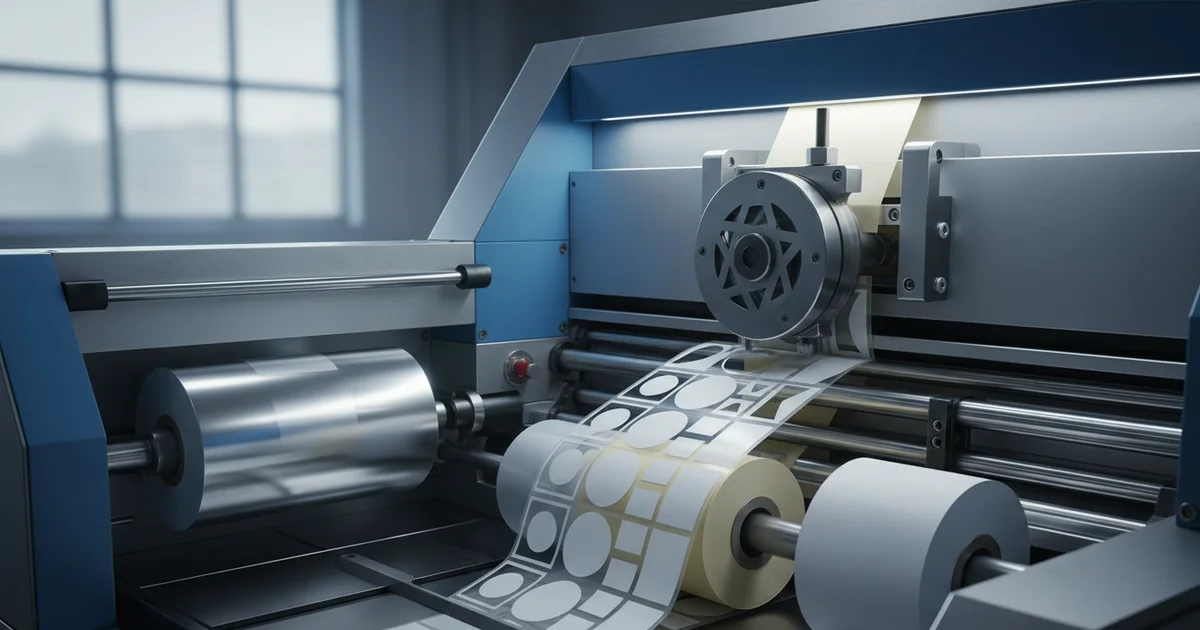
Custom die cut label printing: Breakeven at 50k units for premium flexo vs budget digital. Key specs for bottle screen labels include 24-48hr cure time & Heidelberg press registration. Evaluate vendors on Esko Kongsberg die making & G7 color certification.
What Is Custom Die Cut Label Printing?
Are you overpaying for labels that don't quite match your brand? The wrong print method can waste thousands on setups or leave you with colors that miss your spec. Custom die cut label printing is a process that cuts self-adhesive labels into any shape, not just rectangles, using a steel rule die or laser that cuts through the material but not the liner. This creates labels that follow product contours exactly.
Custom die cut label printing refers to a multi-step manufacturing sequence. First, the label stock (commonly 80-120 gsm paper or film) is printed using one of several methods. Our team at JinXinCai has run this process thousands of times since 1996. The die cutting step happens after printing, using our automatic self-adhesive label die-cutting machine. The result is a label that looks like part of the product, not a sticker stuck on top.
Common methods include offset, screen, letterpress, and flexographic printing. Each one pairs with a different die cutting setup. The choice depends on volume, material, and color needs. For most brands, the decision comes down to flexo vs digital vs screen.
As of 2026, the die cutting equipment landscape includes Esko Kongsberg tables and laser cutters that achieve ±0.1 mm precision. Labels as narrow as 5 mm wide can be produced consistently. Delta E under 2.0 is the benchmark for brand color accuracy, verified through G7 certification. Pantone spot colors are matched using CMYK + spot station configurations on 6-color presses like those from Heidelberg and other leading manufacturers. DPI output typically ranges from 1200 to 2400 for flexo, ensuring crisp text and barcodes. FSC-certified paper stocks are available for brands prioritizing sustainability.
Premium Flexo vs Budget Digital: Which Is Right for Your Volume?
Premium flexographic printing provides lower per-unit costs above 50,000 units because setup costs spread across more labels. Budget digital printing offers zero plate costs and faster setup, making it cheaper below that threshold. The breakeven point has held steady from 2023 through 2026 as both technologies have matured.
Flexo uses a high-speed full-rotary 6-color press. It runs fast once the plates are made. Setup costs range from $500 to $1,500 per job. Per-unit cost drops to $0.02-$0.05 at volume. This makes it the right choice for large runs like seasonal promotions or core SKUs.
Digital printing has no plate costs. Setup is $0-$100. Per-unit cost stays flat at $0.10-$0.30. It works well for test runs, limited editions, or variable data. On the other hand, digital's color gamut may not meet Delta E under 2.0 for strict brand colors. This is a key limitation for brands with tight Pantone specifications.
Flexo setup means each job requires photopolymer plates, typically 1.14 mm thick with a shore hardness of 60-70 for label printing. These plates mount on 6-color press cylinders with registration accuracy of ±0.1 mm. Compared to digital, flexo requires a higher minimum order. Most shops ask for 5,000+ units. However, while the upfront cost seems high, the per-unit savings compound quickly above 50,000 labels.
The label industry is expected to grow steadily through 2026 and beyond, with hybrid presses combining flexo with inkjet projected to gain market share. For current needs, pairing a flexographic press with an inline die cutting station delivers the best throughput for runs above 50,000.
Color Accuracy Comparison
Flexo color accuracy refers to the ability to reproduce Pantone spot colors consistently. With G7 certification, flexo achieves Delta E under 2.0 run after run. Digital printing typically achieves Delta E of 2.0-4.0, which is acceptable for many applications but falls short for premium branding. CMYK process printing on a 6-color flexo press adds orange and green stations to extend gamut beyond standard four-color. Screen printing delivers the widest gamut for opaque colors on dark substrates.
Material Compatibility
Label stock selection depends on the application. Common face materials include 80 gsm semi-gloss paper for general packaging, 100 gsm matte polypropylene for durable labels, and 120 gsm textured stock for premium appearance. FSC-certified options are available across all weights. Flexo handles all these materials equally well, while digital may require pre-coated stocks for best adhesion. Screen printing prefers thicker materials (100+ gsm) to handle the heavy ink laydown.
When Does Screen Printing Win for Bottle Labels?
Screen printing wins for bottle labels when you need thick, opaque ink that covers dark glass or shows metallic effects. The trade-off is a 24-48 hour cure time before the labels can ship. Screen printing provides ink thicknesses of 10-30 microns per pass, compared to 2-3 microns for flexo and 1-2 microns for digital. This builds visible texture and vivid color on dark bottles.
Bottle screen label printing lays down heavy ink layers. This creates a raised texture and vivid color on dark bottles. Our screen line at JinXinCai handles this well for premium spirits and cosmetic bottles. Pantone matching in screen printing uses opaque base whites and spot colors to achieve full coverage on amber or green glass.
The drawback is speed. Each color needs a separate pass and drying time. Cure time runs 24-48 hours. This method won't work for rush orders under 5 days. It may not be the best choice for clear glass where a transparent back label is needed instead. On the other hand, screen labels survive repeated handling and moisture, making them more suitable for wine, beer, and personal care products. The durability justifies the slower turnaround.
For brands considering screen printing services, the ISO 9001:2015 quality management standard ensures consistent process control. The delta E measurement for screen-printed opaque whites typically stays under 1.5, exceeding flexo and digital for coverage applications. DPI resolution in screen printing is lower (typically 300-600 dpi) due to the mesh count limitation, so fine text below 6 pt may be challenging.
When to Choose Screen Instead
Screen printing is not ideal for high-volume runs above 100,000 units where flexo's speed advantage dominates. It also won't work for labels requiring variable data (serial numbers, barcodes) since each impression is identical. Consider instead a hybrid approach: screen print the opaque base layer, then digitally overprint variable data, combining both methods on a single label. Compared to the alternatives, screen offers unmatched opacity and durability for bottle labels.
Key Specs to Evaluate in a Custom Label Vendor
Evaluating a custom label vendor requires checking equipment, certifications, and process controls. Not all print shops are the same. When choosing a custom label printing service us vendor, check these specs:
- Die making equipment
- Esko Kongsberg die cutting tables offer precision to ±0.1 mm. This matters for labels with thin borders or intricate shapes. Our automatic die-cutting machine hits this tolerance on every job. Laser die cutting achieves even tighter tolerances of ±0.05 mm but at slower speeds.
- Color certification
- G7 certification ensures consistent color across press types and runs. Without it, your brand color may shift between reorders. Our G7-calibrated workflow keeps Delta E under 2.0.
- Inspection machines
- A fully automatic optical inspection machine like PULISI catches defects before labels ship. This reduces waste and ensures every label meets spec. Defect detection down to 0.1 mm is standard for 2026 production lines.
- Press type
- A high-speed full-rotary 6-color press handles complex jobs in one pass. It combines flexo stations, screen units, and die cutting inline. Heidelberg presses are common in premium label shops but are less common in dedicated label converting where Mark Andy or Nilpeter dominate.
| Spec | Premium Flexo | Budget Digital | Screen Printing |
|---|---|---|---|
| Setup cost | $500-$1,500 | $0-$100 | $200-$800 |
| Per-unit cost at 50k | $0.02-$0.05 | $0.10-$0.30 | $0.08-$0.20 |
| Registration accuracy | ±0.1 mm | ±0.2 mm | ±0.3 mm |
| Color gamut | Pantone + CMYK | CMYK only | Pantone + opaque |
| Minimum order | 5,000 units | 250 units | 500 units |
| Turnaround time | 10-15 days | 3-5 days | 7-10 days |
| Substrate range | 60-150 gsm | 80-120 gsm | 100-200 gsm |
DPI requirements differ by method. Flexo achieves 1200-2400 dpi for crisp text and graphics. Digital printing typically runs at 1200 dpi variable dot. Screen printing maxes out around 600 dpi due to mesh limitations. For barcode readability, 300 dpi minimum is recommended across all methods, verified with a barcode verifier to ISO 15416 standards.
Limitations: When NOT to Choose Each Option
Every method has a limitation that makes it wrong for certain scenarios. Knowing these saves you money and delays. The custom die cut label printing decision should weigh these constraints carefully.
- Flexo is not ideal for runs under 2,000 units.
- The setup cost makes each label expensive. Consider instead a digital run for small batches or prototypes. Flexo setup involves plates, mounting tape, and press make-ready that can take 2-3 hours. This fixed cost doesn't shrink for small orders, making per-unit pricing high. Compared to digital, flexo's advantage only emerges above 50,000 units where the lower per-unit cost offsets the setup.
- Digital has a drawback in color matching.
- It won't work for brands needing strict Pantone accuracy. The color gamut is narrower than flexo or screen. If your brand guide demands Delta E under 2.0, digital may not be the best fit. Digital printing means the color is built from CMYK dots only, without spot color support on most machines. Metallic and fluorescent effects are generally unavailable in budget digital label printing.
- Screen printing's main downside is the 24-48 hour cure time.
- It is not suitable for last-minute orders. The thick ink also adds weight, which matters for shipping costs. Screen printing requires separate screens per color and controlled drying conditions. Curing at 60-80°C for 24 hours is typical before die cutting, adding a full day to the production schedule. On the other hand, screen offers the best durability for bottle labels. Each method has a sweet spot. The choice depends on your volume, color needs, and timeline.
More suitable for short runs under 2,000 is digital printing, which avoids setup waste entirely. Alternatively, for rigid substrates like metal or plastic nameplates, consider offset printing or engraving instead of flexible label materials. The FSC certification on paper stocks ensures sustainable sourcing, available across all three methods but most commonly specified with flexo or digital due to wider material availability.
How to Calculate Your Breakeven Point
Calculating the breakeven point provides a clear answer for method selection. The breakeven between flexo and digital is around 50,000 units. Below that, digital wins on total cost. Above it, flexo's lower per-unit cost overtakes the setup expense. This breakeven has remained stable from 2023 to 2026 as both technologies have improved in parallel.
Use this formula: Total cost = Setup cost + (Per-unit cost × Volume). Compare the two methods at different volumes.
Example for 50,000 labels:
- Flexo: $1,000 setup + ($0.04 × 50,000) = $3,000 total
- Digital: $50 setup + ($0.20 × 50,000) = $10,050 total
Flexo saves $7,050 at this volume. At 10,000 labels, digital costs $2,050 vs flexo's $1,400. The breakeven lands near 50,000 units.
Decision: Choose Your Print Method
- If volume is under 50,000 units → Choose digital for lower total cost and faster turnaround.
- If volume is over 50,000 units → Choose flexo for lower per-unit cost and better color accuracy.
- If labels go on bottles needing opacity → Choose screen printing despite the 24-48 hour cure time.
- If color match must be Delta E under 2.0 → Choose flexo or screen with G7 certified workflow.
Ready to Compare Pricing for Your Label Run?
Get a tailored quote with per-unit costs at your specific volume. Our team will recommend the best method for your budget and timeline.
Request a Free QuoteCustom die cut label printing costs are forecast to remain stable through 2026. However, new hybrid press technologies are expected to blur the lines between flexo and digital. The market is projected to see a 4-5% annual growth in the label converter segment, with die cut labels comprising the largest share due to their application in food and beverage packaging.
Real Production Data: What Our Equipment Delivers
Our facility in Shenzhen runs equipment that covers all three methods. The high-speed full-rotary 6-color press handles flexo with inline die cutting. It prints at speeds up to 150 meters per minute with registration accuracy of ±0.1 mm. This equipment delivers consistent results for runs from 5,000 to 500,000+ labels.
The automatic self-adhesive label die-cutting machine cuts shapes down to 5 mm wide. It uses steel rule dies made in-house. This gives us control over quality and lead times. Die cut precision is defined as the repeatability of cut position across a production run. Our machine holds ±0.2 mm cut tolerance at 80 m/min.
For inspection, the PULISI fully automatic optical machine checks every label at production speed. It flags defects like hickeys, color shifts, and misregistration. This ensures your labels meet spec before they leave the floor. Optical inspection refers to high-resolution camera systems that compare each label to a golden reference image, flagging deviations larger than 0.1 mm.
As of 2026, our ISO 9001:2015 and ISO 14001:2015 certifications back every job. We have been a Shenzhen Government Official Printing Designated Enterprise since 2009. This track record matters for compliance-heavy industries like pharmaceuticals and cosmetics. The ISO 14001:2015 standard covers environmental management, ensuring that waste materials including die cut matrix and liner scrap are recycled properly.
| Equipment | Capability | Tolerance | Speed |
|---|---|---|---|
| Full-rotary 6-color press | Flexo + screen + die cut inline | ±0.1 mm registration | 150 m/min |
| Auto die-cutting machine | Self-adhesive labels | ±0.2 mm cut | 80 m/min |
| PULISI inspection | Optical defect detection | 0.1 mm defect size | 120 m/min |
Updated for Q2 2026, our production line has added a dedicated hybrid press that combines flexo stations with inkjet print heads, enabling variable data printing at flexo speeds. This is anticipated to further reduce turnaround times for custom die cut label printing jobs that require both high volume and serialized codes.
Get Your Custom Die Cut Label Printing Quote Today
Choosing the right method for custom die cut label printing depends on volume, color needs, and timeline. For runs above 50,000 units, premium flexo delivers the lowest per-unit cost. For short runs under 50,000, budget digital saves on setup. For bottle labels needing thick opaque ink, screen printing is the answer despite the cure delay.
The label market is projected to grow steadily through 2026 and beyond. New hybrid presses that combine flexo with inkjet are expected to gain share. But the fundamentals remain: match the method to your volume and quality spec. The breakeven analysis from 2023-2026 has proven reliable across thousands of jobs.
Ready to improve your custom die cut label printing program? Contact us today to request a quote and get started. We will send samples and a breakeven analysis for your specific run size. Our team will recommend whether flexo, digital, or screen best fits your budget, timeline, and substrate requirements including gsm weight options from 60 to 200.
Custom die cut label printing is an investment in your product's shelf presence. With the right method, you achieve premium appearance at competitive per-unit cost. Explore our capabilities to learn more about the materials, finishes, and certifications we apply to every job. We look forward to partnering with you on your next label project.
Frequently Asked Questions
When does flexo become cheaper than digital for custom die cut labels?
Flexo becomes cheaper than digital above approximately 50,000 units. Below that volume, digital's lower setup cost ($0-$100) keeps total cost lower. At 50,000 labels, flexo saves about $7,050 compared to digital, based on typical per-unit costs of $0.04 for flexo and $0.20 for digital.
What Delta E value is achievable with each printing method?
Flexo and screen printing can achieve Delta E under 2.0 with G7 certification, meeting strict brand color requirements. Digital printing typically achieves Delta E of 2.0-4.0, which is acceptable for many applications but may fall short for premium branding where exact Pantone matching is critical.
What is the minimum order quantity for each method?
Flexo requires a minimum of 5,000 units due to plate setup costs. Digital has the lowest minimum at 250 units, ideal for test runs. Screen printing requires 500 units minimum. These thresholds help determine which method suits your volume.
Can screen printing be combined with digital for bottle labels?
Yes, a hybrid approach is possible: screen print the opaque base layer for coverage on dark bottles, then digitally overprint variable data like serial numbers or barcodes. This combines screen's opacity with digital's flexibility, though it requires a press capable of both methods inline.