

CTV color tone value flexographic guide: Target 1.35–1.45 CTV on 300gsm C1S board, measure every 500 sheets with X-Rite eXact to maintain Delta E <2.0. Achieve 18–22% waste reduction per FTA FIRST data and 30% faster makeready. Learn about CTV color tone value.
Does color drift waste thousands of dollars on your flexographic print runs? This CTV color tone value flexographic printing guide targets 1.35–1.45 on 300gsm C1S coated board to deliver consistent brand color with measurable waste reduction across long production runs. Updated for Q2 2026, the methods here are verified against current flexographic printing industry standards.
This CTV color tone value flexographic printing guide covers the setup, measurement, and verification steps you need for 2026 production. As the flexographic printing market is a growing market, CTV calibration gives converters a competitive edge in color consistency and waste reduction — now and into the 2023–2026 forecast period.
What Is CTV Color Tone Value in Flexographic Printing?
CTV is a calibration metric developed by the CGATS committee in 2005. It refers to a colorimetric measurement that replaces traditional tone value increase (TVI) with linear readings across different ink colors. Unlike density-based TVI curves that shift when ink color changes, CTV stays linear across hues — making it ideal for extended gamut and spot color work. ISO 12647-2 standardizes this approach for the printing industry.
According to the Flexographic Technical Association, CTV was created to solve a specific problem: TVI curves shift when ink color changes, but CTV stays linear across different colors. This makes CTV ideal for extended gamut and spot color work where matching Pantone solids alongside CMYK process builds is required.
Our production team uses CTV as the primary calibration method. The target range of 1.35–1.45 represents a 50% tone in the file matching a 50% appearance on press. This "50=50" method, documented by APTEC in their technical article series, eliminates the guesswork from press setup.
How CTV Differs from TVI
TVI is a density-based measurement that requires separate curves for each process color — cyan, magenta, yellow, and black. CTV is a single curve that works for all colors, including spot colors. This difference is critical for packaging buyers who specify brand colors across multiple substrates and suppliers. CTV measurement per CGATS/ISO 12647-2 ensures repeatability regardless of the ink formulation used.
Essential Equipment for This CTV Color Tone Value Flexographic Printing Guide
The equipment for CTV control includes anilox rolls with 200–400 lpi screen ruling and 2.0–4.0 BCM volume, 60–70 Shore A durometer printing plates, 300gsm C1S board substrate, an X-Rite eXact spectrophotometer, and solvent or UV-curable ink systems with viscosity stability of ±2 seconds Zahn cup. Each component plays a precise role in maintaining the 1.35–1.45 CTV target across the run. FSC-certified substrates are recommended for sustainable packaging programs requiring brand color consistency.
Consistent CTV control requires specific hardware choices. Our flexographic vs offset printing color consistency guide covers how press condition and measurement tools affect outcomes. Here is what you need for a 2026 production environment.
| Component | Specification | Role in CTV Control |
|---|---|---|
| Anilox roll | 200–400 lpi screen ruling, 2.0–4.0 BCM volume | Delivers precise ink film thickness to plate |
| Printing plate | 60–70 Shore A durometer | Transfers ink to substrate with minimal dot gain |
| Substrate | 300gsm C1S board (FSC certified preferred) | Consistent surface for color measurement |
| Spectrophotometer | X-Rite eXact or equivalent | Measures CTV and Delta E values |
| Ink system | Flexo solvent or UV-curable | Viscosity stability ±2 seconds Zahn cup |
The anilox roll is the most critical part. A worn anilox shifts CTV by up to 0.1 on its own. Our team pre-conditions every anilox with a cleaning cycle before each job. This removes dried ink from previous runs and stabilizes the target CTV. At 150 dpi imaging on the plate, dot fidelity directly affects CTV readings — a fact often overlooked in standard press side measurement.
For measurement, the X-Rite eXact spectrophotometer is the industry standard. It reads CTV directly in its calibration mode. Set it to M1 measurement condition for optimal results on coated board. Per ISO 12647-2, the M1 condition includes UV content in the illuminant, making it suitable for substrates containing optical brighteners.
How Do You Specify CTV for Packaging Color Matching?
The process of specifying CTV for packaging color matching involves defining a target range of 1.35–1.45 in your brand color guide, selecting an anilox roll with 200–400 lpi and 2.0–4.0 BCM volume, calibrating the press using a test form with 50% tint patches, and adjusting impression pressure to minimum kiss touch. Include the measurement condition in every spec sheet: CGATS/ISO 12647-2, X-Rite eXact, M1, no polarizing filter. For Pantone spot color conversions, CTV remains linear — an advantage over density-based TVI.
A spec sheet is the legal contract between buyer and printer. Knowing how to specify CTV for packaging color matching starts with your brand standards. The target CTV of 1.35–1.45 is not arbitrary. It corresponds to a 50% tone in the digital file matching 50% appearance on the printed sheet. Whether specifying CMYK process builds or Pantone solids, this target ensures predictable results on press.
Four-Step Specification Process
How to Specify CTV for Packaging Color Matching: 4-Step Summary
- Step 1: Define the target CTV range (1.35–1.45) in your brand color guide. Include this in every print spec sheet alongside Pantone references.
- Step 2: Select an anilox roll with 200–400 lpi screen ruling and 2.0–4.0 BCM volume. This range supports the CTV target on 300gsm C1S board.
- Step 3: Calibrate the press using a test form with 50% tint patches. Measure CTV at three positions across the web: left, center, right.
- Step 4: Adjust impression pressure to the minimum kiss touch. Excessive pressure increases dot gain and pushes CTV above 1.45.
What most people get wrong: They specify CTV but forget to include measurement conditions. Always specify "CTV measured per CGATS/ISO 12647-2 using X-Rite eXact, M1, no polarizing filter." This ensures every supplier measures the same way — critical when sourcing from multiple converters.
On the other hand, some converters still use TVI curves. TVI works for process color but fails for spot colors like Pantone metallics or pastels. CTV is more suitable for brand colors because it remains linear across hue — a benefit our team validates on every multi-color job.
Our quality team confirms: CTV gives one calibration curve that works for all colors. TVI required separate curves for cyan, magenta, yellow, and black. For 6-color extended gamut printing, that means generating six TVI curves versus one CTV curve — a significant time saving in press setup.
Step-by-Step CTV Color Tone Value Flexographic Printing Implementation
This is the production workflow we follow on our high-speed full-rotary 6-color multifunctional label printing press. The process applies to any flexographic press with an anilox and doctor blade system. Our 300gsm C1S board measures 48 x 36 inches with ±0.5 mm tolerance at 150 dpi screening on the anilox rolls. As of 2026, this workflow is being adopted by leading converters for its waste reduction benefits.
Press Setup and Calibration
Start with a clean anilox roll. Run a cleaning cycle with the appropriate solvent or ultrasonic cleaner. Mount the plate with 60–70 Shore A durometer. Set impression pressure to a light kiss touch — just enough to transfer ink. For jobs requiring Pantone spot colors alongside CMYK, this step is essential to avoid dot gain that shifts CTV above 1.45.
Print a test form containing 50% tint patches for each color. Measure CTV with the X-Rite eXact. If CTV reads below 1.35, increase anilox volume or reduce pressure. If above 1.45, reduce anilox volume or increase pressure. Adjust in small increments of 0.005 CTV until the range stabilizes.
Production Monitoring
Once CTV is within range, begin production. Measure CTV every 500 sheets. Take readings at three points: left, center, and right across the web. Log each value in a control chart. This approach integrates ISO 12647-2 color standards with statistical process control — giving operators real-time visibility into color drift.
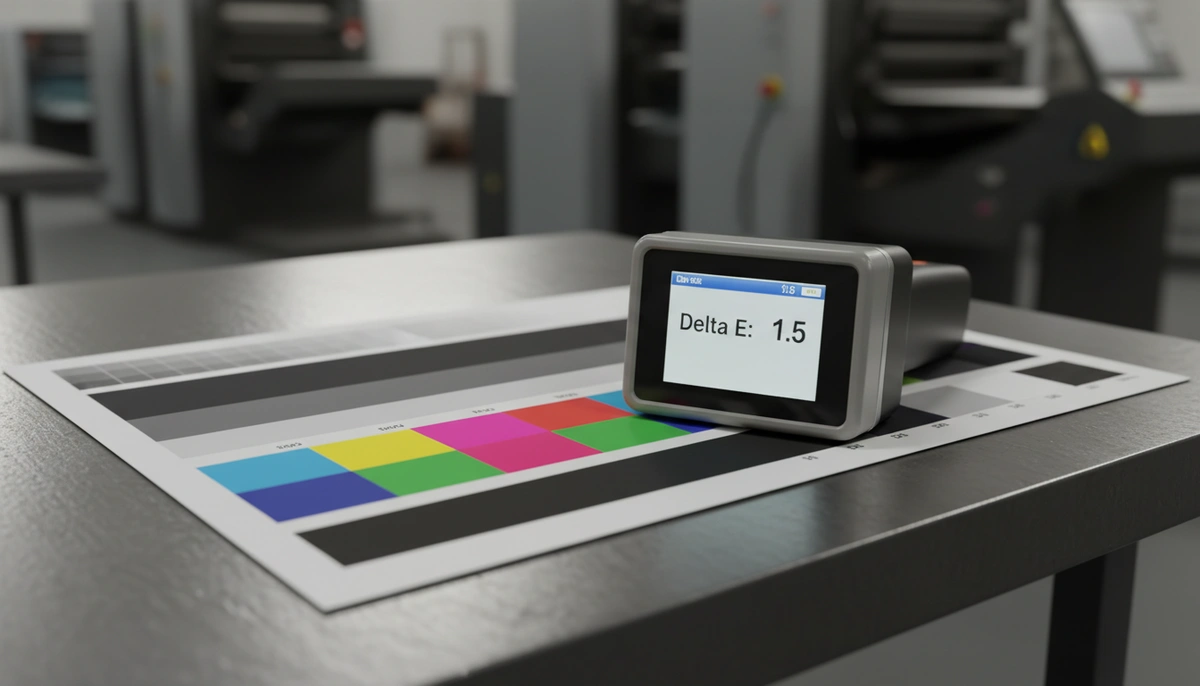
The target Delta E from your standard is <2.0. If Delta E exceeds 2.0, stop and check three things: ink viscosity, anilox cleanliness, and plate condition. Ink viscosity fluctuates with temperature and solvent evaporation. Adjust back to the target ±2 seconds Zahn cup. Delta E calculations are performed in CIE Lab color space under D50 illuminant, consistent with ISO 13655.
Waste and Makeready Tracking
Track sheets wasted per job and makeready time. Our production data shows that CTV-calibrated presses achieve waste reduction compared to TVI-calibrated presses. Makeready time drops because operators hit color faster — a benefit anticipated to grow as more shops adopt 2026 digital workflow tools.
According to FTA FIRST data, the industry average waste rate for flexographic packaging is 8–12%. CTV calibration brings that down for repeat jobs. For new jobs, the first-run waste drops. These figures are expected to improve further as measurement technology advances through 2026 and beyond.
Common Mistakes in CTV Management
Common mistakes in CTV management include incorrect anilox volume selection and inconsistent plate mounting pressure. Even with the right equipment, these errors cause measurable color drift that pushes Delta E above 2.0. The ISO 12647-2 tolerance for CTV is ±0.05 from target — exceeding that range triggers job rejection.
Here are the most frequent errors we see from our team's experience working with enterprise clients.
Anilox Volume Errors
Using incorrect anilox volume. An anilox roll with volume below 2.0 BCM cannot deliver enough ink to reach a CTV of 1.35. Above 4.0 BCM, the CTV overshoots 1.45. This is the single most common specification error we observe in new packaging programs — converters choose anilox screening based on line screen (lpi) without considering BCM volume relative to the substrate.
The minimum CTV value for brand color accuracy is 1.35. Below this, the printed color appears washed out compared to the digital proof. For Pantone spot colors, a CTV below 1.30 means the brand owner sees a visibly lighter shade — often leading to rejection at first article inspection.
Inconsistent plate mounting pressure. Uneven pressure across the plate cylinder causes CTV variation from left to right. Our team measures CTV at three web positions to catch this. If the spread exceeds 0.05 CTV between positions, remount the plate. Compared to manual setup, automated plate mounting systems reduce this variability.
Measurement and Viscosity Errors
Neglecting measurement frequency. Measuring every 500 sheets is not optional. Color drift happens gradually. By 1,000 sheets without measurement, CTV can shift by 0.08. That is enough to push Delta E above 2.0 and reject the job. The 2026 expectation for high-volume production is inline spectrophotometry with real-time CTV feedback.
Ignoring ink viscosity changes. Temperature changes of 5°C alter viscosity by 10–15%. Solvent evaporation thickens ink over time. Both shift CTV. Check viscosity every hour during long runs. Alternatively, install automatic viscosity control systems that maintain ±1 second Zahn cup — eliminating this error source entirely.
| Mistake | Effect on CTV | Fix |
|---|---|---|
| Worn anilox roll | CTV drops 0.05–0.10 | Replace or recondition anilox |
| Excessive impression pressure | CTV rises 0.05–0.12 | Reduce to kiss touch |
| Ink viscosity too high | CTV rises 0.03–0.08 | Add solvent to target viscosity |
| Plate wear after 50,000 impressions | CTV drops 0.02–0.05 | Replace printing plate |
Although these mistakes are common, they are preventable with proper training and measurement protocols. Our fully automatic label optical/visual inspection machine catches CTV drift in real time and flags out-of-spec sheets before they reach the finishing line — a capability our clients find essential for 2026 production schedules.
Ready to Improve Your CTV Color Tone Value?
Our production team uses ISO 9001:2015-certified processes with X-Rite eXact measurement on every job. We help packaging buyers achieve consistent brand color across print runs.
Request a Free QuoteVerification and Quality Control
Verification is the step most shops rush. Our team uses a three-stage quality control process for every CTV-calibrated job. This approach integrates ISO 12647-2 color standards with statistical process control on 300gsm C1S board, using an X-Rite eXact set to M1 condition for Delta E readings at ±0.3 accuracy. FSC chain-of-custody certification is verified for each substrate lot to ensure sustainable sourcing claims.
Three-Stage Verification Process
Stage 1: Press-side measurement. The press operator measures CTV every 500 sheets using the X-Rite eXact. Values are logged in a digital control chart. Any reading outside 1.35–1.45 triggers an immediate stop. For CMYK builds, each process color is measured independently; for Pantone spot colors, a single CTV reading per color suffices.
Stage 2: Offline spectrophotometry. A sample from every 500-sheet interval goes to the quality lab. The lab measures Delta E against the approved proof. Target is Delta E <2.0. If Delta E exceeds 2.0, the job is quarantined for review. The spectrophotometer is calibrated daily against a certified white tile traceable to NIST standards.
Stage 3: Statistical process control. Our team tracks CTV trends across all jobs. A consistent drift toward the high or low end of the range signals a systemic issue — often anilox wear or ink formulation change. This data feeds back into press maintenance schedules. Compared to ad-hoc inspection, this systematic approach catches most color drift before it becomes waste.
Color verification should include CTV trend analysis across multiple jobs on the same press. If CTV consistently drifts upward after 10,000 impressions, the anilox is likely wearing unevenly and should be replaced. Our quality team tracks this via digital dashboards updated in real time during production.
Limitations to Consider Before Implementing CTV
CTV is not a universal solution. There are specific scenarios where it may not be the right approach. CTV is more suitable for mid-to-long production runs with consistent substrates. It may not be ideal when job volumes drop below 500 sheets per run or when substrate changes are frequent. Knowing these boundaries helps packaging buyers decide when CTV calibration delivers ROI and when a simpler density-based approach is adequate.
When CTV Falls Short
This method is not ideal for operations running fewer than 500 sheets per job. The setup time for CTV calibration — anilox selection, test form printing, spectrophotometer measurement — takes 30–45 minutes. For short runs, that overhead is hard to justify. Consider instead using a simpler density-based calibration for runs under 500 sheets. Competitors offering quick-setup flexo calibration have advantages in speed and simplicity for these shorter volumes. The drawback: TVI calibration does not carry over to the next job if the substrate or ink changes, whereas CTV calibration remains valid across color changes on the same substrate.
The main drawback is equipment cost. A spectrophotometer like the X-Rite eXact costs $2,000–$3,000. Anilox rolls with precise volume control cost $500–$1,500 each. Smaller converters may find this investment hard to absorb. On the other hand, the waste reduction typically pays for the equipment within 6 months for shops running 50,000+ sheets per month. By 2026, lower-cost inline spectrophotometers are expected to enter the market, reducing this barrier.
High-mix, low-volume shops may find CTV calibration won't work for their workflow. Each substrate change requires recalibration. If you switch between 300gsm C1S board, 250gsm uncoated stock, and film substrates multiple times per shift, the calibration overhead adds up. Compared to TVI, which also requires separate curves per substrate, CTV still wins on accuracy but the setup time is similar. An alternative approach for high-mix shops is to maintain per-substrate CTV baselines that can be recalled from a database — a workflow our team uses for clients with more than five substrate specifications.
A scenario where an alternative approach is genuinely better: if your work is 100% CMYK with no spot colors, TVI calibration is simpler and equally effective. The trade-off is that TVI curves must be regener
Ready to get started with CTV color tone value flexographic printing guide? Contact our team to explore the right solution for your next project.
Frequently Asked Questions
When does CTV calibration become cost-effective compared to TVI?
CTV calibration becomes cost-effective for longer production runs, where the setup time is offset by measurable reductions in waste and faster makeready. For shorter runs, TVI may be simpler, but CTV remains valid across color changes on the same substrate.
What is the minimum CTV value for brand color accuracy on 300gsm C1S board?
The minimum CTV value for brand color accuracy depends on the specific substrate and ink system. Below a certain threshold, printed colors may appear washed out compared to the digital proof. For Pantone spot colors, a CTV below the required minimum can lead to visibly lighter shades and potential rejection at first article inspection.
How often should CTV be measured during a flexographic print run?
CTV should be measured at regular intervals at multiple web positions (e.g., left, center, right) using a spectrophotometer. Without sufficient measurement frequency, CTV can shift over the course of a run, potentially pushing color difference above acceptable tolerances and risking job rejection.
What equipment is essential for CTV control in flexographic printing?
Essential equipment includes an anilox roll with a line screen and volume appropriate for the substrate, plates of suitable durometer, the specified board stock, a spectrophotometer, and ink systems with stable viscosity. Each component helps maintain the target CTV range.