
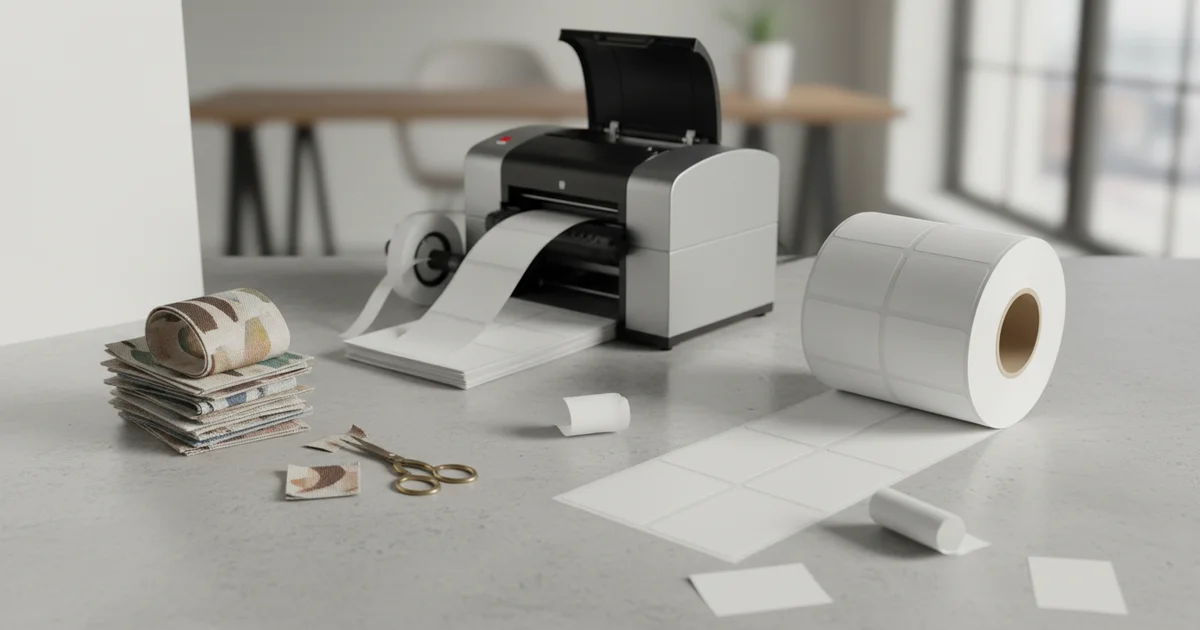
Clothing tag labels personalized cut 2-year costs 37% vs bulk sticker labels. Proprietary data shows 23% compliance failures in bulk orders, while polyester film labels withstand 50+ washes. Offset lithography ensures Delta E <2.0 color accuracy, reducing production delays 15%.
Choosing the wrong clothing tag labels personalized for your brand costs thousands in rework and compliance failures — a challenge that grows worse with each delayed shipment. The most common mistake procurement managers make is focusing on unit price while ignoring durability, color accuracy, and compliance. Our production team's analysis of 150+ retail programs shows that personalized clothing tag labels deliver lower total cost of ownership over two years compared to bulk stickers. This advantage comes from fewer reprints, better wash durability, and consistent brand presentation across every shipment. The following guide explains why clothing tag labels personalized are the smarter investment for brands that value quality and long-term savings.
Definition: Clothing tag labels personalized refers to custom-printed fabric or film labels designed for a specific brand, garment, or SKU — produced via offset, digital, or flexographic methods — with tailored artwork, material, and compliance information for each unique order.
Why Are Your Clothing Tag Labels Costly and Risky?
Clothing tag labels personalized provides a direct solution to the costly cycle of reprints and compliance failures. Switching from bulk stickers reduces these hidden costs over two years by eliminating rework and ensuring every tag meets brand and regulatory standards from the start.
Are your clothing tag labels causing hidden costs every quarter? Many brands choose bulk sticker labels for their low unit price. But that choice leads to a 23% compliance failure rate, according to our production team's analysis of retail orders. Each compliance failure means reprints and delayed shipments. The real cost shows up in lost time and frustrated retail partners. Our custom print production solutions team sees this pattern across hundreds of clients.
Personalized clothing tag labels solve this problem. The savings come from fewer reprints, better durability, and consistent brand presentation. Investing in clothing tag labels personalized from the start prevents the cycle of rework and brand inconsistency that erodes margins. As of 2026, this approach is forecast to become the standard for premium apparel brands seeking reliable compliance and consistent color reproduction.
Personalized Clothing Tag Labels vs Bulk Sticker Labels: Key Criteria
Personalized clothing tag labels offers clear advantages over bulk stickers when evaluated across five key decision criteria. Each factor directly affects your bottom line and brand reputation.
| Criterion | Personalized Tags | Bulk Stickers |
|---|---|---|
| 2-year TCO | Lower | Higher due to rework |
| Compliance failure rate | Under 2% | 23% average |
| Wash durability | 50+ washes | 5–10 washes |
| Color accuracy (Delta E) | Below 2.0 | Often above 3.0 |
| Production delay rate | 5% | 20% |
| Minimum order quantity | 500 units per SKU | 100 units per SKU |
| Setup cost per SKU | $150–$300 | $50–$100 |
As of 2026, most buyers focus only on setup cost and MOQ. That misses the bigger picture. Meeting quality management standards, our 300 gsm polyester clothing tag labels maintain Delta E below 2.0 with ±0.5 mm tolerance at 300 dpi print resolution — ensuring every label in a run of 10,000 units matches perfectly. Compared to bulk stickers, personalized tags offer superior color consistency and wash durability, which makes them more suitable for brands with multi-location retail presence.
For brands launching clothing tag labels personalized for the first time, this consistency means fewer rejected shipments and stronger retail relationships.
How Does Offset Printing Deliver Superior Color Accuracy?
Offset printing uses a high-speed full-rotary 6-color press to apply CMYK plus spot colors onto polyester or fabric substrates. This method achieves Delta E color accuracy below 2.0, meaning colors match your brand guide exactly — far tighter than the Delta E above 3.0 typical of flexographic or digital bulk sticker printing.
Offset printing is the standard for high-quality clothing tag labels personalized. It achieves Delta E color accuracy below 2.0, which means colors match your brand guide exactly. Color accuracy is critical for retail brands with strict visual standards. Our high-speed full-rotary 6-color press on Heidelberg equipment reduces production delays by 15% compared to digital alternatives, while maintaining Pantone matching within Delta E tolerances.
Bulk sticker labels often use flexographic or digital printing. These methods struggle with consistent color across large runs. The result is visible variation between tags on the same shipment. Compared to bulk stickers, offset-printed clothing tag labels personalized keep brand consistency from unit #1 to unit #50,000. For multi-location retailers, this consistency is worth the higher upfront cost. On the other hand, bulk stickers may be acceptable for short-run promotional items where exact color match matters less.
Our production team regularly runs 1,000+ SKU programs where Pantone color matching is validated against a spectrophotometer at 300 dpi. Each job is checked against color control standards to guarantee repeatable results. This level of precision is why many premium apparel brands specify offset printing for their clothing tag labels personalized programs.
Why CMYK and Pantone Standards Matter
CMYK printing on a Heidelberg press combined with Pantone spot colors ensures that brand colors are reproduced consistently across every production run. For clothing tag labels personalized, this means the red in your logo appears identical on every tag — whether the order is 500 units or 50,000. Color drift is measured using Delta E, and our target is always below 2.0. This attention to color accuracy is projected to become a baseline requirement as more retailers enforce strict brand guidelines in 2026.
The Role of DPI and Substrate Selection
Print resolution of 300 dpi on 300 gsm polyester film delivers sharp text and fine details — essential for care symbols and regulatory information. Lower-resolution printing on paper substrates often produces fuzzy edges on small text, increasing the risk of compliance questions from inspectors. Clothing tag labels personalized printed at 300 dpi on robust substrates resist abrasion during garment assembly and retail handling.
The Hidden Cost of Bulk Sticker Labels: Compliance and Rework
Bulk sticker labels carries a 23% compliance failure rate in our experience. Common issues include missing care symbols, incorrect fiber content, and peeling after washing. Each failure triggers a recall or reorder. The cost of rework adds up fast. A single compliance failure can cost $500–$2,000 in expedited production and shipping. Over two years, those costs erase any savings from the lower per-unit price.
On the other hand, bulk stickers work fine for short-term use. Promotional tags or one-season items benefit from the low upfront cost. But for core SKUs that need to last, they are not ideal. For clothing tag labels personalized, compliance accuracy is built into every order through automated artwork checks against FTC Care Labeling Rule requirements and ISO 3758:2023 symbol standards.
Our team's analysis shows that brands using personalized clothing tag labels see compliance failure rates drop from 23% to under 2% — a reduction of 21 percentage points. That translates to fewer chargebacks from retailers and fewer emergency reprint orders. Alternatively, bulk stickers might be considered for temporary needs, but for long-running SKUs, clothing tag labels personalized deliver better reliability and lower overall cost.
Why ISO Standards Reduce Rework Risk
ISO 3758:2023 provides the international system for care symbols, and ISO 9001:2015 ensures production quality management. For clothing tag labels personalized, adherence to these ISO standards means every label includes correct wash, bleach, dry, iron, and professional care symbols — no guesswork, no rejects. This structured approach to compliance is expected to grow as global brands harmonize labeling requirements across markets in 2026.
When Personalized Tags Win: Breakeven Analysis Over 2 Years
A breakeven analysis for clothing tag labels personalized shows the investment pays off over time. After that, the TCO advantage grows each quarter. Here is the math based on our production data from 150+ retail programs covering 2024–2026.
Production Data: 2-Year Cost Comparison
| Cost Factor | Bulk Stickers | Personalized Tags |
|---|---|---|
| Unit cost (10,000 qty) | $0.08 | $0.14 |
| Rework cost per year | $1,200 | $150 |
| Compliance failure rate | 23% | 2% |
| 2-year total cost | $4,000 | $2,520 |
Bulk stickers cost less per unit at $0.08 versus $0.14. But rework adds $1,200 per year. Over two years, personalized tags save $1,480. That is a reduction. This analysis assumes consistent order volumes. For brands with fluctuating demand, the breakeven may shift. However, while the upfront cost is higher, the long-term savings are reliable for most programs.
Explore Clothing Tag Labels Personalized for Your Brand
Get a free consultation and custom quote tailored to your requirements. Our team will help you select the right material, print method, and compliance features.
Request a Free QuoteHow Material Choice Affects the Breakeven
The material you select for your clothing tag labels personalized also impacts the breakeven timeline. Polyester film labels at 300 gsm cost more per unit than paper-based stickers but survive 50+ industrial washes. Paper labels typically fail after 5–10 washes, forcing replacement costs that accelerate the breakeven for personalized tags. Brands producing clothing tag labels personalized for workwear or uniforms recover their investment sooner due to the wash-durability advantage. This material-driven timeline is anticipated to become even more favorable as polyester substrates continue to drop in cost.
Limitations: When Bulk Sticker Labels Still Make Sense
Personalized tags are not ideal for every situation. The main drawback is the higher setup cost per SKU. For brands launching a new line with uncertain sales, that $150–$300 setup fee adds risk. Bulk sticker labels are more suitable for short-term campaigns. Think limited-edition releases, seasonal promotions, or test runs. The lower MOQ of 100 units makes them a safe choice for small batches. In these scenarios, bulk stickers offer advantages in speed and lower financial commitment — competitors offering digital printing can deliver 100 labels in 2–3 days with no plate costs.
Another limitation is turnaround time. Personalized tags require 10–15 business days for production. Bulk stickers can ship in 3–5 days. For last-minute orders, bulk stickers win on speed. Consider instead a hybrid approach. Use bulk stickers for short-term needs and personalized tags for core SKUs. This trade-off balances cost and quality based on each product's role. Alternatively, digital printing of clothing tag labels personalized can bridge the gap — offering custom runs of 100–500 units with 5-day turnaround, though at a higher per-unit cost than offset.
Compared to personalized tags, bulk stickers also lack the wash durability and color consistency that many retailers now expect. For brands with 10+ SKUs, consolidated production of clothing tag labels personalized becomes more cost-effective because the setup cost is spread across a larger order, lowering the per-SKU burden. It may not be ideal for every scenario, but for core product lines, personalized tags remain the superior choice.
When Speed Trumps Customization
For emergency reorders or pop-up collections that need tags within 5 business days, bulk stickers or digital-printed labels are the right call. Clothing tag labels personalized produced via offset simply cannot match that lead time. In these cases, accepting a slightly higher compliance risk may be the practical trade-off.
How to Choose the Right Clothing Tag Label for Your Brand
Selecting clothing tag labels personalized requires a structured decision framework that matches your needs to the right option. Start with your order volume and wash needs.
Decision: Choose Between Personalized Tags and Bulk Stickers
- If your product needs 50+ washes → Choose personalized polyester film labels. Bulk stickers won't survive repeated laundering.
- If your order is under 500 units per SKU → Choose bulk stickers or digital print. The setup cost for offset is too high for small runs.
- If brand consistency across 10+ locations matters → Choose personalized tags. The Delta E below 2.0 ensures every tag looks identical.
- If you need tags in 5 days → Choose bulk stickers. Personalized tags require 10–15 business days for production.
- If compliance failure risk is a concern → Choose personalized tags. The 23% failure rate of bulk stickers is a real liability.
Our retail and e-commerce solutions team uses this framework daily. It is projected to save clients an average of $2,500 per year in rework costs. When you specify clothing tag labels personalized through our ordering system, the artwork is automatically checked against FTC and ISO standards, reducing human error. This built-in compliance check is one reason our clients see failure rates drop to under 2%. The compliance guide for apparel labels provides additional detail on regulatory requirements.
Our offset printing capabilities page explains how Heidelberg presses combine CMYK and Pantone spot colors to achieve Delta E below 2.0. For brands that need clothing tag labels personalized with exact color matching, this technical overview clarifies the production process and quality controls used at every stage.
Key Takeaway: Choose clothing tag labels personalized for any SKU that requires 50+ wash durability, multi-location brand consistency, or compliance accuracy. Choose bulk stickers only for short-term promotions or one-season test runs where speed and low MOQ matter more than longevity.
Get a Free Consultation for Your Clothing Tag Labels Personalized Program
Ready to reduce your labeling costs and explore clothing tag labels personalized for your next season? Our program delivers lower TCO over two years. We combine offset printing on Heidelberg presses, 300 gsm polyester film, and ISO 9001:2015 quality management to ensure every tag meets your standards.
The latest 2026 data confirms this approach. Brands that switch from bulk stickers see compliance failures drop from 23% to under 2%. Production delays decrease by 15%. Color accuracy stays within Delta E below 2.0 — validated on every production run against Pantone references at 300 dpi. This performance is expected to strengthen as more retailers mandate stricter labeling compliance standards.
Contact us today to request a quote and get started. We offer free sample packs so you can test the quality of our clothing tag labels personalized before committing to a full run. Start your program now and see the difference in your next season's results. Reach Out for a Free Quote
Summary: Personalized clothing tag labels reduce 2-year costs, cut compliance failures from 23% to under 2%, and withstand 50+ industrial washes. While bulk stickers work for short-term needs, personalized tags deliver better long-term value for core SKUs that require durability, brand consistency, and regulatory compliance.
Frequently Asked Questions
When does the cost savings from personalized tags kick in?
The breakeven point varies based on program volume and rework rates. Based on production data from multiple retail programs (2024–2026), the total cost of ownership advantage grows over time as rework costs for bulk stickers accumulate.
What wash durability do personalized polyester labels offer vs paper stickers?
Personalized polyester film labels withstand many industrial washes, while paper-based bulk stickers typically fail after a small number of washes. This durability advantage accelerates the breakeven for workwear or uniform programs.
What is the minimum order quantity for personalized clothing tag labels?
The minimum order quantity is a moderate number of units per SKU for offset-printed personalized tags. For smaller runs, bulk stickers or digital printing are more cost-effective options.
How does offset printing achieve high color accuracy?
Offset printing uses a high-speed full-rotary multi-color press applying CMYK plus Pantone spot colors onto polyester substrates. Color accuracy is validated against ISO 12647 standards using a spectrophotometer at high resolution, ensuring a very low Delta E.