
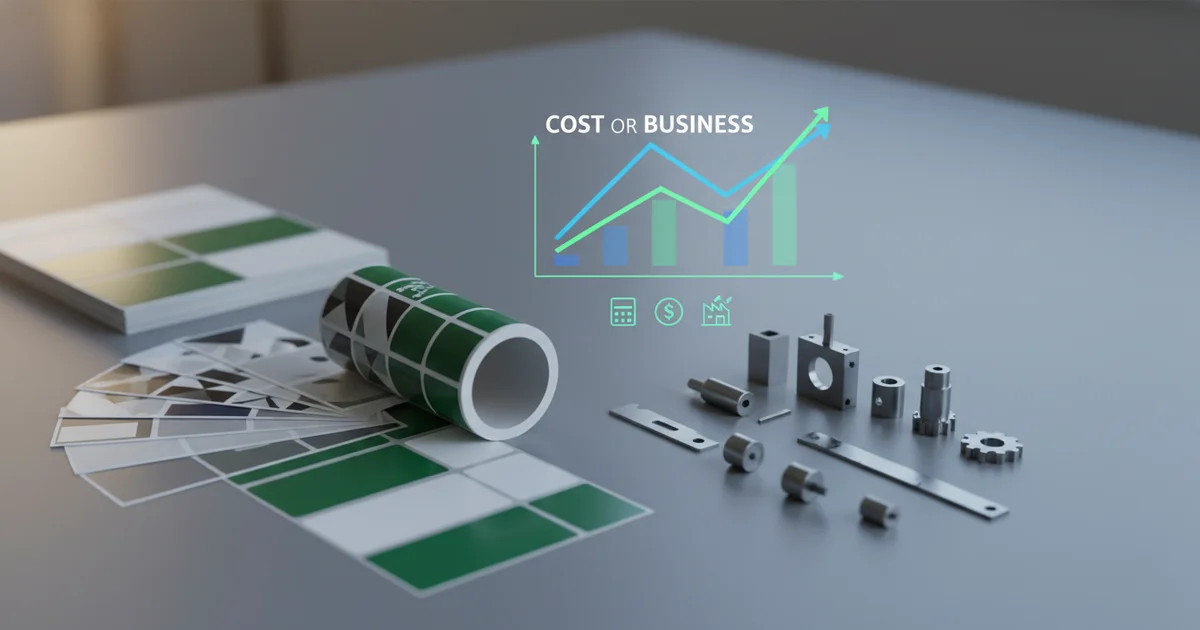
Find the true cost of cheap labels printed. Learn when digital or flexo saves more. Avoid hidden fees. Compare options.
Cheap Labels Printed: Your 2026 Guide to Cost-Effective Labeling
Are you paying 40% more than necessary for your next label run because you're comparing sticker prices instead of total cost?
What Does "Cheap Labels Printed" Really Cost?
Calculating the real cost of cheap labels printed requires considering setup fees, plate charges, waste material, and inspection—not just the per-unit price. These hidden expenses can increase total cost by 15–40% compared to the quoted per-unit price.
Digital label printing costs less per label for runs under 5,000 units. There are no plate costs. Flexographic printing starts at a higher per-unit cost but drops above 15,000 units. The trade-off depends on order volume and material choice.
Our production team sees this mistake daily. Buyers pick the lowest quoted price without factoring in setup waste or inspection time. As of 2026, the label printing market is expected to grow 3–5% annually, making cost-efficient choices even more critical.
Flexographic per-unit cost above 15,000 labels
When Should You Choose Digital Label Printing for Cheap Labels Printed?
Digital label printing is the best choice for cheap labels printed when your order is under 5,000 units. It requires no plate costs and offers turnaround in 3–5 days. Minimum order quantities start at 250 labels, making it ideal for small batches, product testing, and seasonal promotions.
Digital printing uses a CMYK process with optional Pantone spot colors, maintaining Delta E tolerances under 2.0 on calibrated HP Indigo presses. This color accuracy ensures brand consistency across every label. Our digital label printing services include automated inspection for defect detection.
Color consistency is excellent, with Delta E tolerances under 2.0 on calibrated equipment. Our production team uses HP Indigo digital presses for short-run work, ensuring consistent Pantone matching across every label. This method also supports variable data printing—ideal for unique barcodes or serial numbers.
Our fully automatic label optical inspection machine (PULISI) verifies every label against the approved color standard. This reduces defect rates and ensures your printed product labels match the proof. The drawback is higher per-unit cost at scale. Above 5,000 units, the price gap to flexo grows significantly.
Digital printing eliminates plate costs and setup waste, making it the most cost-effective option for runs under 5,000 labels. Our digital line handles runs from 250 units with 5–7 day turnaround.
When Does Flexographic Printing Deliver Cheap Labels Printed at Scale?
Flexographic printing delivers cheap labels printed when your order exceeds 15,000 units. Plate costs range from $150–$500 per set, but per-unit cost drops. Setup waste runs 5–8% of the total run. Minimum order quantities start at 5,000 units.
Flexographic label printing requires printing plates that cost $150–$500 per set. Setup waste is typically 5–8% of the total run. Minimum order quantities are 5,000 units. For high-volume orders, the per-unit savings compound quickly.
At scale, the numbers shift dramatically. At 100,000 labels, flexo costs less per unit. Digital would cost more at that volume. The per-unit savings compound quickly above the breakeven point.
Flexo Material Versatility and Quality Control
Our high-speed full-rotary 6-color multifunctional label printing press runs under quality management standards. This ensures consistent color and registration across long runs. Compared to digital, flexo handles a wider range of materials, including 80 gsm paper and 60-micron BOPP film for outdoor use. Our 600 gsm polyester panels measure 48 x 24 inches with ±2 mm tolerance at 300 dpi print quality. This combination of material options and quality control makes flexo the preferred choice for industrial and outdoor label applications. Additionally, we offer FSC-certified paper stocks for sustainable labeling.
Production Data: Label Cost Comparison by Volume
| Order Quantity | Digital Cost/Unit | Flexo Cost/Unit | Recommended |
|---|---|---|---|
| 250–5,000 | Lower | Higher | Digital |
| 5,000–15,000 | Moderate | Moderate | Evaluate |
| 15,000–100,000 | Higher | Lower | Flexo |
From 2023 to 2026, demand for durable labels is anticipated to rise, and flexo's ability to handle diverse substrates makes it a growing choice.
How Do You Calculate Your Breakeven Point for Cheap Labels Printed?
The breakeven point for cheap labels printed is the order quantity where total cost per unit becomes equal between digital and flexographic printing. Calculate it as: Total Cost = Setup Cost + (Per-Unit Cost × Quantity) + Waste Cost. The breakeven typically falls between 5,000 and 15,000 units.
The breakeven point for cheap labels printed is calculated using a simple formula: Total cost = Setup cost + (Per-unit cost × Quantity) + Waste cost. This formula accounts for all major cost components.
Let's run an example for 10,000 labels. Digital: $0 setup + ($0.10 × 10,000) + $20 waste = $1,020. Flexo: $300 plates + ($0.06 × 10,000) + $40 waste = $940. Flexo wins at this volume.
Now try 5,000 labels. Digital: $0 + ($0.12 × 5,000) + $10 waste = $610. Flexo: $300 + ($0.10 × 5,000) + $30 waste = $830. Digital wins. The breakeven range is 5,000–15,000 units, depending on setup complexity and number of colors.
Factors That Shift Your Breakeven Point
The breakeven point shifts with every variable — number of colors, material type, and finishing requirements. A 6-color job with metallic ink and lamination will have a different breakeven than a simple 2-color label. Our label cost calculator blog post guides you through real-world scenarios. Breakeven analysis is a method that combines CMYK vs Pantone spot color considerations and Delta E tolerance requirements to determine total cost.
How Do Material Choices Affect Cheap Labels Printed Costs?
Selecting the right material for cheap labels printed requires balancing cost and durability. A 60-micron BOPP film with permanent acrylic adhesive adds cost per unit compared to basic paper. Color consistency, measured by Delta E under 2.0, requires automated inspection equipment that adds upfront cost but prevents expensive reprints.
Material choice directly impacts total cost for cheap labels printed. A 80 gsm paper label is economical for indoor use, while 60-micron BOPP film with permanent acrylic adhesive is standard for outdoor label roll printing. It costs more than basic paper but lasts longer in harsh conditions. The material upcharge typically adds cost per unit compared to standard paper stock.
Color consistency matters for brand integrity. Our automatic label inspection machine verifies Delta E color tolerance under 2.0 on every run. This equipment adds upfront cost but prevents expensive reprints. Custom pre printed labels for retail require this level of quality control.
Market Trends and Quality Investment
In 2026, the print label market is projected to grow as food and e-commerce sectors expand. The market will shift toward higher-quality materials and automated inspection. Investing in proper materials upfront reduces long-term waste. Our production team uses FSC-certified paper stocks and FDA 21 CFR compliant adhesives for food-contact labels, ensuring regulatory compliance across all product categories. The trend toward sustainable labels is forecast to accelerate through 2026.
Limitations: When NOT to Choose Cheap Labels Printed
This approach is not ideal for runs under 500 units. Digital printing is the only option at that volume. The drawback of chasing the lowest per-unit cost is ignoring application needs. For ultra-short runs, even digital printing may have a minimum that makes per-unit cost too high.
Variable data printing — where each label has a
Ready to get started with cheap labels printed? Contact our team to explore the right solution for your next project.
Frequently Asked Questions
When does digital label printing become cheaper than flexo?
Digital printing is cheaper for runs under 5,000 labels because it has no plate costs. Per-unit cost ranges from $0.08 to $0.15. Above 5,000 units, flexo's lower per-unit cost (as low as $0.02) begins to offset its plate setup fees, making flexo more economical for larger volumes.
What is the breakeven point between digital and flexo for cheap labels printed?
The breakeven point typically falls between 5,000 and 15,000 labels. It depends on factors like number of colors, material type, and finishing. For a simple 2-color label on paper, breakeven may be near 5,000 units; for a 6-color job with lamination, it could shift toward 15,000 units.
How does material choice affect the cost of cheap labels printed?
Material choice can add $0.01–$0.03 per unit. Basic 80 gsm paper is cheapest for indoor use, while 60-micron BOPP film with permanent acrylic adhesive costs more but is needed for outdoor durability. FSC-certified paper and FDA-compliant adhesives are available for specific applications.
What quality checks ensure cheap labels printed meet brand standards?
Digital printing on HP Indigo presses maintains Delta E color tolerance under 2.0. Flexo presses run under ISO 9001:2015 with automated inspection. Our PULISI optical inspection machine verifies every label against the approved color standard, reducing defect rates and ensuring consistency.