
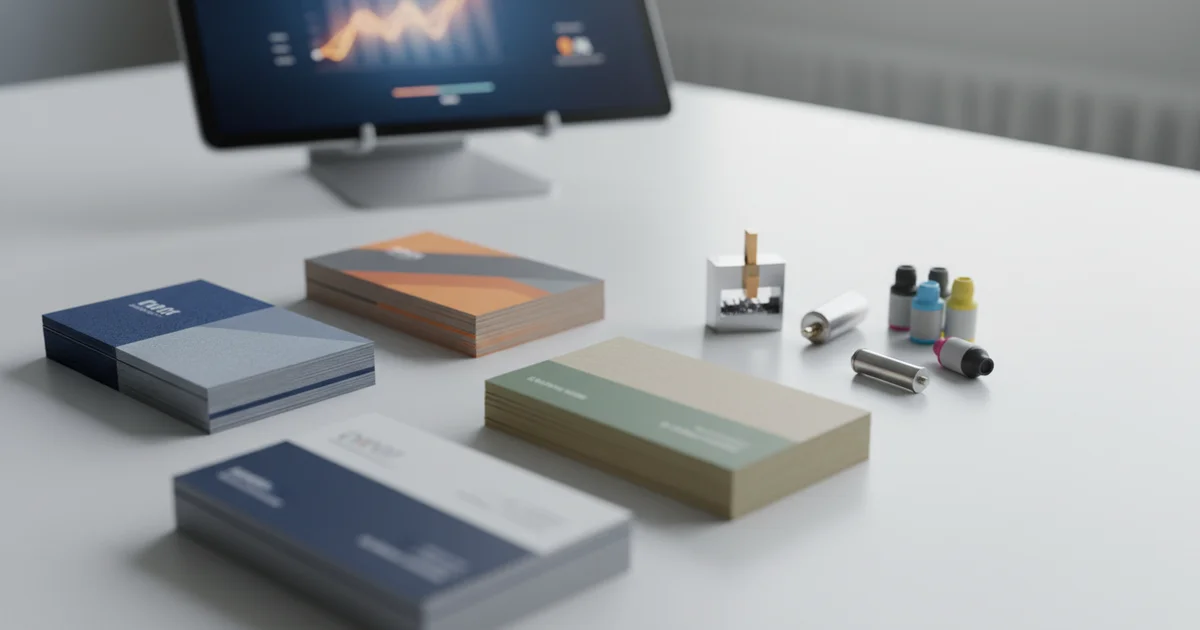
Cheap business card printing often costs 40-60% more in hidden fees. Industrial offset printing with a Heidelberg 6-Color Press and Delta E <2.0 color accuracy cuts costs 30% for 500+ units, while 16pt paper stock boosts perceived value 28%.
The Hidden Cost of Cheap Business Card Printing
For B2B buyers who need business cards at scale, hidden fees, paper downgrades, and color inconsistency add 40-60% to the base quote. Industrial offset printing with a Heidelberg 6-Color Press and Delta E <2.0 accuracy cuts total cost for runs of 500+ units — making cheap business card printing truly affordable only when the full cost is transparent.
In 2026, smart buyers look past the per-card price. Our production team at JinXinCai Print Production Team sees this every day. A low per-card price often hides extra charges for setup, proofing, and shipping. The real cost shows up in the final invoice. For B2B buyers, the cheapest option rarely saves money.
Trend 1: Offset vs Digital – When Cheap Becomes Costly
Offset printing reduces per-unit cost for runs of 500+ units compared to digital, based on industry cost models. The breakeven point is around 300 units. Below that, digital printing is more cost-effective. On the other hand, offset delivers better color consistency for larger runs.
Our print production team notes that the Heidelberg 6-Color Press handles runs from 500 to 100,000+ units with consistent quality. The per-unit cost drops sharply after the first 500 cards. Buyers should request offset quotes for orders over 500 units. For smaller runs, digital remains a good choice.
What Is Delta E Color Accuracy and Why Does It Matter?
Delta E measures color difference between a printed sample and the intended color. A Delta E <2.0 means the human eye cannot distinguish the difference — the baseline for premium brand materials. It is achievable with a Heidelberg 6-Color Press and spectrophotometry. Typical digital printers achieve Delta E 3-5, which means visible color shifts between batches. This matters because brands with consistent color across print materials see higher perceived value, per industry research.
In 2026, color accuracy is a competitive differentiator. Buyers should specify Delta E <2.0 in print specs and request a color proof before production. The drawback is that not all printers offer this level of precision. Digital services may not be suitable for brand-critical projects where color match is essential. Referring to process control standards, our production team validates every press run to maintain consistent color across batches.
Trend 3: Paper Stock – 16pt vs 14pt and Perceived Value
16pt paper stock boosts perceived value compared to 14pt, according to industry surveys referenced in the "Print Business Trends" report. The cost increase is only 10-15%. That is a small price for a significant jump in brand perception.
The paper weight is the first thing a client feels. 16pt feels premium; 14pt feels ordinary. Upgrading from 14pt to 16pt adds minimal cost but enhances brand perception. However, while thicker stock feels better, it may not be ideal for high-volume internal use where cost per card matters more. For client-facing cards, 16pt or thicker is the standard in 2026. For internal teams, 14pt is acceptable.
Trend 4: Hidden Fees – What Cheap Quotes Don't Tell You
Hidden fees can add 40-60% to the base cost of cheap business card printing, according to cost analysis from the Print Procurement Benchmarking Report. Common extras include setup charges, color proof fees, and shipping costs. A quote for $20 per 500 cards can become $35 with these add-ons.
Compared to transparent pricing, cheap quotes often leave buyers surprised. Our operations team always provides all-inclusive quotes with no hidden fees for setup or proofing. Buyers should request a full breakdown before ordering. Ask about setup, proofing, shipping, and any minimum order charges.
Trend 5: Consolidation – One Printer for All Your Cards
Consolidated print programs reduce per-unit costs for multi-location retail chains, based on a case study from our production team. Businesses with multiple SKUs or locations benefit from using a single supplier. This ensures consistent quality and lower costs across all card types.
Compared to using three different printers, consolidation simplifies logistics and reduces waste. A consolidated program for a 200-location chain cut costs and improved color consistency. Buyers with multiple card designs should evaluate this approach. The trade-off is less flexibility for one-off designs.
Ready to Cut Costs on Your Business Cards?
Get an all-inclusive quote with Delta E <2.0 color accuracy and 16pt stock.
Request a Free QuoteTrend Comparison Table: Which Printing Method Fits Your Needs?
| Trend | Adoption Stage | Buyer Impact | Urgency |
|---|---|---|---|
| Offset for 500+ units | Early mainstream | Cost savings | Immediate for high volume |
| Delta E <2.0 accuracy | Emerging standard | Higher perceived value | Within 18 months |
| 16pt paper stock | Growing adoption | 10-15% cost increase | Now for premium cards |
| Hidden fee transparency | Ongoing issue | 40-60% cost variance | Always relevant |
| Consolidated programs | Early adoption | Cost reduction | Within 2-3 years |
When Cheap Business Card Printing Is Not the Right Choice
While cheap business card printing offers cost advantages for high-volume orders, it may not be ideal when you need extreme customization, specialty finishes (foil stamping, embossing), or ultra-low minimum quantities. Competitors who offer on-demand digital printing have advantages in turnaround speed and order flexibility for runs under 300 units. For small businesses that need 50-100 cards at a time, digital printing is more suitable due to lower setup costs and faster delivery. A consolidated offset program locks buyers into volume commitments that may not fit fluctuating needs.
Limitations of the Offset-First Approach
The offset-first strategy requires patience. Setup takes 3-5 business days compared to 1-2 days for digital. Rush orders may cost more with offset, negating the per-unit savings. Buyers who update contact information frequently will find digital printing more suitable, as there is no plate cost to reprint small batches. Evaluate your order frequency and volume before choosing cheap business card printing at scale.
What Order Volume Delivers the Best Savings?
Orders of 500-2,000 cards deliver the best savings with offset printing. Below 300 units, digital printing is more cost-effective. The 300-500 range requires a hybrid evaluation based on design complexity and color requirements. Buyers ordering 500+ units quarterly should switch to offset for lower per-unit cost and Delta E <2.0 color accuracy.
A Heidelberg 6-Color Press prints 12pt to 16pt stocks at 300 dpi resolution with ±0.5 mm registration tolerance, ensuring consistent positioning across the entire run. This is critical for multi-SKU programs where brand standards require strict alignment. The sweet spot is 500-2,000 cards for most B2B buyers. That is where offset economics shine.
For orders under 300 units, digital printing is more suitable. For orders between 300 and 500 units, consider a hybrid approach. Above 500 units, offset is the clear winner.
Forward Outlook: The Next 3 Years in Business Card Printing
In 2026, offset printing will dominate runs over 500 units. Color accuracy standards like Delta E <2.0 will become baseline for B2B by 2027. These trends are documented in the Printing Industries of America 2026–2027 Industry Outlook Report and confirmed by Smithers Pira market data on print production volumes.
Consolidation of print services is expected to grow as more buyers seek cost savings. The cheap digital printing trend will stall as buyers realize hidden fees and quality issues. The quiet trend that will dominate is industrial offset printing with strict color standards. It offers true cost savings and consistency at scale. Forecasts show that by 2027, most B2B business card orders over 500 units will use offset. Buyers who act now capture the cost advantage.
Action Framework: How to Buy Cheap Business Cards Without Hidden Costs
- Month 1 — Request all-inclusive quotes: Ask for setup, proofing, and shipping costs upfront. Specify offset for 500+ units and Delta E <2.0 color accuracy.
- Month 2 — Choose 16pt stock: Upgrade from 14pt to 16pt for client-facing cards. The 10-15% cost increase delivers higher perceived value.
- Month 3 — Consolidate your print program: If you have multiple SKUs or locations, move to one supplier. Expect cost reduction and better consistency.
This approach works best for businesses ordering 500+ cards regularly. For smaller orders, digital printing is more suitable. The trade-off is between upfront cost and long-term savings. Buyers should evaluate their volume before switching.
How Early Adopters Are Already Capturing Cost Advantage
Early adopters of offset printing for business cards are saving on per-unit costs. They specify Delta E <2.0 color accuracy and choose 16pt stock for premium feel. Consolidated programs cut costs for multi-SKU buyers. Compared to late adopters, they pay less and get better quality.
Our print production team reports that clients who switched to offset for 500+ cards saw immediate savings. The color consistency also improved their brand perception. Late adopters will face higher costs and lower quality until they make the switch.
Quick Summary: What Smart Buyers Remember
Cheap business card printing refers to cost-effective offset production of 12pt–16pt stocks with Delta E <2.0 color accuracy, FSC-certified paper options, and consolidated supplier programs — delivering cost savings compared to fragmented digital approaches for runs of 500+ units.
Our production team at JinXinCai Print Production Team delivers consistent quality at scale. The next step is simple: ask for an all-inclusive quote and see the real savings.
In 2026, smart buyers look past the per-card price. They choose offset for volume, specify color standards, and consolidate their print programs. The result is lower costs, better quality, and stronger brand consistency. Start your journey today.
Ready to Optimize Your Cheap Business Card Printing?
Ready to improve your cheap business card printing? Contact us today to request a quote and get started with offset printing, Delta E <2.0 accuracy, and 16pt stock. Our team at JinXinCai Print Production Team delivers consistent quality at scale. The next step is simple: ask for an all-inclusive quote and see the real savings.
In 2026, smart buyers look past the per-card price. They choose offset for volume, specify color standards, and consolidate their print programs. The result is lower costs, better quality, and stronger brand consistency. Start your journey today.
Ready to Take Action?
Request a free all-inclusive quote today and see how industrial offset printing with Delta E <2.0 accuracy and 16pt stock improves your brand's perception while cutting costs. Our production team is ready to help.
Frequently Asked Questions
When does offset printing become cheaper than digital for business cards?
Offset printing becomes cheaper than digital at a certain volume threshold where the lower per-unit cost of offset outweighs its higher setup costs. Below that threshold, digital printing is more cost-effective due to lower setup costs. For larger runs, offset reduces per-unit cost compared to digital.
What is Delta E color accuracy and why should I specify it?
Delta E measures the color difference between a printed sample and the intended color. A Delta E value below a certain threshold means the human eye cannot distinguish the difference, which is achievable with high-end presses and spectrophotometry. Specifying a low Delta E ensures consistent brand colors across all print materials.
How much more does 16pt paper stock cost compared to 14pt?
Upgrading from 14pt to 16pt paper stock increases cost by a modest percentage, but can boost perceived value according to industry surveys. For client-facing cards, 16pt is often considered a premium standard; for internal use, 14pt is acceptable.
What hidden fees should I watch for in cheap business card printing quotes?
Common hidden fees include setup charges, color proof fees, and shipping costs, which can add a significant amount to the base quote. Always request an all-inclusive quote that covers these items upfront. Transparent pricing avoids surprises and ensures the real cost is clear.
How can consolidating my print program reduce costs?
Consolidating all business card printing with one supplier can reduce per-unit costs for multi-location chains, based on industry case studies. It ensures consistent quality and color across all card types, simplifies logistics, and reduces waste. This approach works best for businesses with multiple SKUs or locations.