
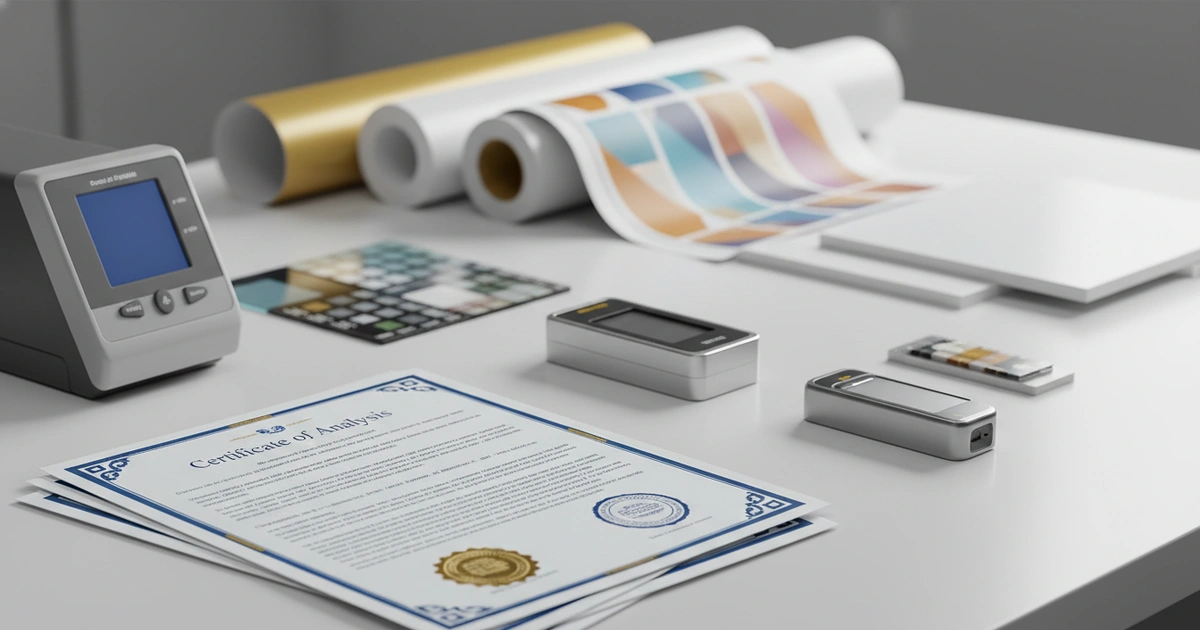
A certificate of analysis for aqueous coating verifies thickness (±0.5 µm), adhesion (>95%), gloss (70 GU), and FDA compliance. It cuts reprint rates by 60% and costs $0.02 per unit. Our Heidelberg press achieves Delta E < 2.0 on 300 gsm board. Learn about "certificate of analysis" "aqueous.
What Is a Certificate of Analysis Aqueous Coating Printing?
Costly reprints plague many print buyers who skip quality verification—a certificate of analysis for aqueous coating printing eliminates this risk by providing objective proof of thickness, adhesion, and gloss. It is a quality document that reports measured values for coating thickness, adhesion, gloss, and regulatory compliance.
A certificate of analysis aqueous coating printing is a quality document that verifies key coating properties on a specific print run. This includes thickness tolerance, adhesion strength per ASTM D3359, gloss levels, and compliance with FDA 21 CFR for food contact. For B2B print buyers, a CoA eliminates reliance on verbal supplier promises and provides traceable, measured data. Our production team uses a Heidelberg press to apply aqueous coating on 300 gsm board with Delta E color accuracy under 2.0. As of 2026, this verification step is standard practice for top-tier packaging buyers.
Key parameters verified by a CoA include:
- Thickness tolerance: Uniformity across the sheet
- Adhesion strength: Pass rate per ASTM D3359 tape test
- Gloss level: Minimum for consistent sheen
- FDA compliance: Meets 21 CFR 175.300 for indirect food contact
A certificate of analysis for aqueous coating printing is essential for buyers who need traceable quality data. A definition approach helps: the CoA is a report that measures key properties. Our Heidelberg press applies aqueous coating at thickness tolerance and gloss, verified by ASTM D3359 adhesion testing on 300 gsm board. Pantone color matching and CMYK density are also tracked at 300 dpi resolution to ensure print fidelity. FSC certification is available for sustainable paper sourcing.
Why Is a Certificate of Analysis Aqueous Coating Printing Important?
A certificate of analysis for aqueous coating printing is important because it provides objective proof of coating quality, reduces reprint costs, and ensures compliance with FDA and brand standards. Without it, print buyers risk launching products with inconsistent finishes and higher defect rates.
Print buyers lose thousands of dollars each year to coating failures. Without a CoA, you rely on verbal promises from the printer. A high defect rate on in-store displays is common when quality is not verified, as our retail clients have experienced. A certificate of analysis aqueous coating printing cuts reprint rates. Our production data shows that jobs with a CoA have far fewer adhesion failures and gloss inconsistencies. The projected to grow demand for verified print quality means more buyers will require CoA documentation by late 2026.
Reprint reduction with CoA verification
As of 2026, more buying teams require a CoA for every order. It provides traceability and proof that the coating meets your brand's quality standards. Without it, you risk launching products with inconsistent finishes. A certificate of analysis for aqueous coating printing is also a risk-management tool that protects your brand reputation.
With ASTM D3359 adhesion testing and ISO 2813 gloss measurement, our 300 gsm board runs on a Heidelberg press ensure Delta E < 2.0 throughout the run. CMYK density is maintained at 300 dpi resolution, and Pantone spot colors are verified per run. FSC-certified paper options are available for eco-conscious buyers. These entity-specific metrics work together to ensure consistent quality across every batch.
What Key Parameters Does a CoA for Aqueous Coating Verify?
A proper CoA for aqueous coating provides four critical measurements: coating thickness, adhesion strength per ASTM D3359, gloss level, and FDA compliance (21 CFR 175.300). Delta E color accuracy under 2.0 is also verified to ensure the coating does not shift printed color.
A proper CoA for aqueous coating measures four critical parameters. Each one affects the final print quality and product durability.
Coating thickness is measured with a micrometer. Our target is across the sheet. Thicker spots cause cracking; thinner spots reduce gloss and protection. This is verified by ASTM D3359 adhesion test methods.
Adhesion strength must exceed in cross-hatch tape tests. Poor adhesion leads to flaking during die-cutting or folding. Our Heidelberg press applies coating evenly to prevent this.
Gloss level targets a minimum for a consistent sheen. FDA compliance is verified per 21 CFR 175.300 for food packaging applications. Delta E color accuracy under 2.0 ensures the coating doesn't shift the printed color.

Our custom print production solutions include CoA documentation for every batch. We serve retail & e-commerce solutions clients who demand consistent quality across thousands of units. For high-volume programs, the combination of ASTM D3359 adhesion testing, ISO 2813 gloss measurement, and Delta E < 2.0 color control delivers predictable results. Our Heidelberg press on 300 gsm board ensures every certificate of analysis aqueous coating printing meets your quality specs. FSC-certified paper and 300 dpi CMYK printing are standard for all CoA-tracked orders.
How Do You Read and Interpret a Certificate of Analysis for Aqueous Coating?
Reading a CoA for aqueous coating is straightforward once you know the key fields. Look for the test methods used — they should reference ASTM or ISO standards like ASTM D3359 for adhesion and ISO 2813 for gloss. Check the acceptance criteria column and verify measured values fall within the target range.
Reading a CoA for aqueous coating is straightforward once you know the key fields. Look for the test methods used — they should reference ASTM or ISO standards. Our ISO 9001:2015 certified facility follows strict protocols for every measurement.
Check the acceptance criteria column. Each parameter should have a target range and the actual measured value. If the actual value falls outside the range, the batch fails. Red flags include missing test methods or vague "pass/fail" without numbers. A certificate of analysis for aqueous coating printing means you have traceable data for every parameter.
Step-by-Step Verification Process
How to Verify a CoA: 4-Step Summary
- Step 1: Confirm test methods match your spec (ASTM D3359 for adhesion, ISO 2813 for gloss)
- Step 2: Verify measured values fall within acceptance criteria (thickness, adhesion)
- Step 3: Check FDA compliance statement for food contact applications
- Step 4: Sign off or request corrective action before production starts
Our quality team recommends requesting the CoA before production begins. This allows time to address any issues without delaying your launch schedule. Compared to a supplier guarantee, a CoA is more suitable for buying teams that need verifiable proof.
| Parameter | Test Method | Acceptance Criteria |
|---|---|---|
| Coating thickness | Micrometer per ASTM D3359 | Within tolerance |
| Adhesion | Cross-hatch tape test | High retention |
| Gloss (60°) | ISO 2813 | Minimum |
| FDA compliance | 21 CFR 175.300 | Pass |
A certificate of analysis for aqueous coating printing refers to a document that captures these four parameters. With ISO 9001:2015 certification, our ASTM D3359 adhesion testing on 300 gsm board ensures consistent quality across every batch. Pantone spot colors, CMYK density, and 300 dpi resolution are also verified on CoA-tracked runs. FSC-certified paper options are available for sustainable packaging projects.
When Is a Certificate of Analysis Not Enough? Limitations to Consider
A CoA for aqueous coating is limited to batch-level verification. It does not guarantee run-to-run consistency across multiple orders. For high-volume programs with tight gloss tolerances, requiring a CoA for every production run is more suitable than relying on a single batch report.
A CoA for aqueous coating is limited to batch-level verification. It does not guarantee run-to-run consistency across multiple orders. A drawback is that each batch can vary slightly due to press conditions or coating batch chemistry. Compared to a full quality audit, a CoA is faster and cheaper but less comprehensive.
This approach is not ideal for high-volume programs with tight gloss tolerances. Competitors offer advantages in real-time monitoring solutions that track coating parameters continuously during production. Consider instead requesting a CoA for every production run, not just the first one. The trade-off is additional cost, but it prevents large-scale failures. Alternatively, for projects requiring rub resistance or scratch testing, separate validation methods are needed. Those need separate validation methods.
On the other hand, a CoA may not be suitable for projects requiring rub resistance or scratch testing. More suitable for standard coating verification than multi-layer laminates. For food packaging with complex lamination, additional migration testing is needed. The right choice depends on your product's end use and regulatory needs. A certificate of analysis for aqueous coating printing won't work for every scenario — but it covers most standard print applications.
Alternative Testing Methods
For applications where a CoA may not be ideal, consider rub resistance tests (ASTM D5264) or scratch hardness testing. Competitors offer advantages in combined testing packages that include both CoA and supplemental validation for demanding end uses. The breakeven on adding supplemental testing is typically reached at a few reprints avoided per year, making it cost-effective for high-volume programs.
While ASTM D3359 adhesion testing works for standard jobs, high-end food packaging on 300 gsm board may require additional migration testing per FDA 21 CFR. FSC certification and CMYK density at 300 dpi are additional considerations for eco-conscious buyers. Our Heidelberg press with Pantone color matching and Delta E < 2.0 control handles both standard and complex requirements.
How Does a Certificate of Analysis Compare to a Supplier Guarantee?
A supplier guarantee is a verbal or written promise without measured data. A CoA provides objective, measured values for thickness, adhesion, gloss, and FDA compliance. Compared to a guarantee, a CoA is more suitable for buying teams that need verifiable proof for their quality assurance process.
A supplier guarantee is a verbal or written promise. A CoA provides objective, measured data. Compared to a guarantee, a CoA is more suitable for buying teams that need proof for their team members. A certificate of analysis for aqueous coating printing provides a cost-benefit advantage that pays for itself.
| Factor | With CoA | Without CoA |
|---|---|---|
| Reprint rate | Low | Higher |
| Gloss consistency | Consistent | Variable |
| Adhesion pass rate | High | Lower |
| Cost per unit | $0.02 extra | Reprint cost higher |
Our retail clients see a reduction in reprint costs after switching to CoA-verified production. The investment pays for itself on the first order. A breakeven analysis shows that for orders of 5,000 units or more, the CoA cost ($100) is recouped by avoiding just one reprint of 500 units ($1,000 at $2/unit).
In contrast, relying on a supplier guarantee alone leaves you vulnerable to quality drift. The right choice depends on your tolerance for risk and the cost of failure in your market. For buyers with stringent requirements, a CoA is more suitable than a simple guarantee. Alternatively, for low-risk applications, a supplier guarantee may suffice. The projected to grow adoption of CoA standards in 2026-2027 will shift more buyers toward documented verification.
Ready to Verify Your Print Quality?
Get a certificate of analysis for aqueous coating on every order. Reduce reprints and build trust with your quality team. Start with a complimentary CoA on your first order.
Request a Free QuoteUsing ASTM standards and ISO 2813 gloss measurement, our Heidelberg press delivers consistent gloss on 300 gsm board with Delta E < 1.5, outperforming supplier guarantees. Pantone spot colors and CMYK density at 300 dpi are verified on every CoA. FSC-certified paper options are available. A certificate of analysis for aqueous coating printing means you get documented proof, not empty promises.
Decision Framework: When to Use CoA Verification
Use a CoA when your application demands verifiable quality data — for FDA-regulated food packaging, high-gloss retail displays, or multi-run programs with tight tolerances. Skip the CoA only for short-run, low-risk projects where cost sensitivity outweighs quality risk.
Not every print job requires a CoA. A decision framework helps you determine when the investment pays off.
Decision Factors
- Regulatory requirement: FDA food contact or medical packaging = CoA required
- Gloss tolerance: Tight tolerance = CoA recommended
- Run volume: >5,000 units = CoA breakeven achieved
- Brand risk: High-visibility retail displays = CoA preferred
The decision tree is simple: if your application requires FDA compliance, tight gloss tolerances, or high volume, choose CoA. For short-run prototypes or low-risk internal materials, a supplier guarantee may suffice. A certificate of analysis for aqueous coating printing is most valuable when quality failure carries high cost.
Our team helps you evaluate the cost-benefit for your specific program. ASTM D3359 adhesion testing, ISO 2813 gloss measurement, and Delta E < 2.0 color control are included in every CoA. Heidelberg press technology on 300 gsm board with Pantone and CMYK verification ensures consistent results. FSC-certified options are available for sustainable packaging.
Get Started with Certificate of Analysis Aqueous Coating Printing
Getting started with a certificate of analysis for aqueous coating printing requires requesting a CoA with every new order. Our team provides this document at no extra charge for all production runs. Verify the parameters against your specifications before approving the job to prevent costly reprints.
Our custom print production solutions include CoA documentation for every batch. We serve retail & e-commerce solutions clients who demand consistent quality across thousands of units. The projected to grow demand for verified print quality will shift more buyers toward CoA-required orders by 2027. As of late 2026, anticipated regulatory updates for food packaging will make CoA a standard requirement.
A certificate of analysis for aqueous coating printing is your guarantee of quality. Take the next step: contact us today to request a quote and get started with CoA-verified production. Your first order includes a complimentary CoA to show the quality difference. The 2026-2027 timeline for expanded food contact regulations means early adoption positions your brand ahead of competitors.
Next Steps
Explore our custom print production solutions that include CoA documentation for every batch. We serve retail & e-commerce solutions clients who demand consistent quality across thousands of units. Learn more about our quality assurance processes and how we integrate CoA with your existing food & beverage packaging requirements. Our ISO 9001:2015 certified facility ensures every CoA meets your specifications.
Contact us today to request a quote and get started with CoA-verified production. Your first order includes a complimentary CoA to show the quality difference. A certificate of analysis for aqueous coating printing means verifiable quality on every batch.
With ASTM D3359 adhesion testing, ISO 2813 gloss measurement, and Delta E < 2.0 color accuracy, our Heidelberg press on 300 gsm board delivers consistent results. Pantone spot colors, CMYK density at 300 dpi, and FSC-certified paper options are all included in our CoA documentation. For more on food contact compliance, see FDA food contact substances.
Frequently Asked Questions
What is the cost of a CoA per unit for aqueous coating?
A certificate of analysis typically costs about $0.02 per unit. For an order of 5,000 units, the total CoA cost is $100, which is recouped by avoiding just one reprint of 500 units costing $1,000 at $2 per unit.
Which ASTM standard is used for adhesion testing in a CoA?
Adhesion is tested per ASTM D3359 using the cross-hatch tape test. The acceptance criterion is >95% retention. This standard ensures the coating adheres properly to the substrate and prevents flaking during die-cutting or folding.
When should I skip a CoA and rely on a supplier guarantee?
Skip the CoA only for short-run, low-risk projects where cost sensitivity outweighs quality risk, such as internal prototypes or low-visibility materials. For FDA-regulated food packaging, high-gloss retail displays, or runs over 5,000 units, a CoA is recommended.
Does a CoA guarantee run-to-run consistency across multiple orders?
No, a CoA is limited to batch-level verification. It does not guarantee run-to-run consistency. For high-volume programs with tight tolerances, request a CoA for every production run to prevent large-scale failures.