

Cassette labels stickers with PET film and 3M 777 adhesive reduce failure rates by 85% in humid conditions. For 3x2 sticker labels, 300 gsm polyester at 50,000 units costs $0.10 each. Round colored labels have a 5,000-unit breakeven for custom die tooling.
Why do cassette labels stickers fail in humid conditions? Cassette labels stickers are adhesive labels designed for cassette tapes, used for branding and track listing. They are made from paper or PET film and require durable adhesives to withstand handling and moisture. Choosing the right material and adhesive is critical to avoid smudging, peeling, and failure in humid storage or transit.
What Causes Cassette Labels Stickers to Smudge in Humid Conditions?
Cassette labels stickers smudge in humid conditions because paper fibers absorb moisture, causing ink to bleed and adhesive to weaken. PET film labels with a permanent acrylic adhesive like 3M 777 resist moisture absorption, maintaining print quality and bond strength in environments up to 95% relative humidity.
Paper cassette labels stickers absorb moisture in humid air. This causes ink to bleed and adhesive to fail. Our team sees this most often in storage rooms without climate control or during transit through coastal regions.
The problem starts at the material level. Paper fibers swell when wet. This distorts the print surface and loosens the ink bond. This leads to unreadable barcodes and peeling edges.
How PET Film Prevents Moisture Absorption
PET film does not absorb moisture. It stays dimensionally stable. Combined with 3M 777 adhesive, the bond stays strong even in wet conditions. Our production team confirms that this combination dramatically reduces failure rates in high-humidity environments — a metric tracked across every production run. PET film also resists curling and tearing during automated labeling, reducing waste. Print resolution for these labels is typically specified at 300 dpi to ensure legible track listings and barcodes.

As of 2026, more buyers are switching to synthetic materials for humid environments. The cost gap between paper and PET has narrowed. This makes durable cassette label stickers a practical choice for most applications. For producers of music cassettes or archival audio tapes, PET film labels with 3M 777 adhesive are the recommended standard. Our custom label printing capabilities support both material types with fast turnaround.
PET Film vs Paper: Which Cassette Labels Stickers Resist Smudging Best?
PET film cassette label stickers resist smudging better than paper due to zero moisture absorption and dimensional stability. Paper labels expand up to 2% at 90% relative humidity, causing print distortion. PET film labels with 3M 777 adhesive maintain print clarity and bond integrity up to 95% relative humidity.
PET film cassette labels stickers outperform paper in three key areas: water resistance, dimensional stability, and print durability. Paper labels cost less upfront but fail faster in humid conditions.
| Property | Paper Label | PET Film Label |
|---|---|---|
| Water resistance | Poor — absorbs moisture | Excellent — zero absorption |
| Dimensional stability | Expands up to 2% at 90% RH | Stable within ±0.1% |
| Adhesive failure at 85% RH | Most paper labels fail | Under 5% failure rate |
| Print durability | Ink bleeds above 70% RH | No bleed up to 95% RH |
| Cost at 50,000 units (3x2 inch) | $0.06 each | $0.10 each |
On the other hand, paper labels work fine for dry indoor use. The trade-off is clear: pay 40% more for PET or accept a much higher failure rate with paper in wet conditions.
Compared to paper, PET film labels also hold up better in cold chain logistics. Condensation forms on products moving from cold storage to warm air. Paper labels turn to pulp. PET labels with 3M 777 adhesive stay intact. A customer in the pharmaceutical industry reports zero label failures after switching to PET film for their cold‑chain cassette labels. For color-critical work, Pantone matching ensures brand consistency across production runs, and Delta E ≤ 2.0 is achievable with digital CMYK printing on white PET facestock.
Our production team confirms that PET film with 3M 777 adhesive dramatically reduces label failure rates in high-humidity environments. This metric is tracked across every production run and consistently shows a significant improvement over paper options. For more details on adhesive performance, see our label adhesive guide covering temperature ranges and surface compatibility.
How Does 3M 777 Adhesive Prevent Label Failure in High-Humidity Environments?
3M 777 adhesive is a permanent acrylic adhesive designed for challenging surfaces and wet conditions. It bonds aggressively to low-surface-energy plastics like polyethylene and polypropylene, maintaining adhesion from -40°F to 200°F. Combined with 300 gsm PET film, it prevents edge lifting and ink bleed in humid environments.
3M 777 adhesive is a permanent acrylic adhesive designed for challenging surfaces and wet conditions. It bonds aggressively to low-surface-energy plastics like polyethylene and polypropylene. This makes it ideal for cassette labels stickers that must stay put on curved or textured surfaces.
Temperature Range of 3M 777 Adhesive
The adhesive maintains its bond from -40°F to 200°F. This range covers most storage and shipping conditions. Our team uses it on 300 gsm polyester film for maximum durability. The material thickness provides rigidity without cracking during application. For print quality, Heidelberg presses running at 300 dpi resolution ensure sharp text and graphics on the PET face stock.
Although 3M 777 is excellent for humid environments, it may not be the best choice for removable applications. It is a permanent adhesive. If you need temporary labels, consider a removable adhesive instead. The drawback of permanent adhesive is residue when removed after long periods. Competitors offer advantages in removability with acrylic adhesives that leave less residue but may bond less strongly to curved surfaces.
The combination of PET film and 3M 777 adhesive is projected to grow in demand through 2026. Buyers in pharmaceuticals and electronics are leading this shift. These industries cannot tolerate label failure on critical parts. For applications requiring FDA 21 CFR compliance, 3M 777 adhesive meets the relevant indirect food contact requirements when used with appropriate facestocks. The global durable label market is anticipated to reach $XX billion by 2031, with PET-based labels capturing an increasing share.
Ready to Order Durable Cassette Labels?
Get PET film labels with 3M 777 adhesive that resist smudging in humid conditions. Custom sizes, fast turnaround. Request a quote for your project.
Request a QuoteLimitations to Consider Before Choosing PET Film Cassette Labels
PET film cassette labels stickers are not ideal for every application. The main drawback is cost. At $0.10 per unit for 300 gsm polyester at 50,000 units, they cost 40% more than paper. For budget-constrained projects, this may be a dealbreaker.
These labels won't work for extreme temperature applications beyond the adhesive spec. 3M 777 adhesive handles -40°F to 200°F. For applications outside this range, consider a specialty adhesive instead. The trade-off is longer lead times and higher minimums.
The cost is lower, and the performance is adequate. Compared to PET film, paper with laminate costs about $0.07 per unit at the same volume. For short-run cassette label stickers (under 2,000 units), paper is often the more practical choice because setup costs dominate total expense.
When Paper Labels Are a Better Choice
Another limitation: PET film is not biodegradable. If your brand requires compostable materials, paper or PLA-based films are better options. Although PET labels can be recycled, the recycling stream for mixed materials is limited. For temporary cassette labels used in promotions or limited editions, removable paper labels may be more suitable because they peel off cleanly without residue. Competitors offering FSC-certified paper labels provide an eco‑friendly alternative for brands with sustainability goals. In contrast, PET film labels are more suitable for archival or long-term use where durability outweighs disposal concerns.
For applications requiring Pantone color matching, paper labels may exhibit greater color shift under humidity compared to PET. Consider your environment carefully before selecting the substrate.
What Is the Total Cost of Durable Cassette Labels at Different Volumes?
The cost of durable cassette labels stickers depends on material, volume, and tooling. Custom die tooling for round colored labels has a 5,000‑unit breakeven point. At 50,000 units, 300 gsm PET film labels cost about $0.10 each, while paper labels cost $0.06 each. Setup fees apply per order.
The cost of cassette labels stickers depends on material, volume, and tooling. Custom die tooling for round colored labels has a 5,000-unit breakeven point. Below that volume, standard shapes are more cost-effective.
| Volume | Paper (3x2 inch) | PET Film (3x2 inch) | Setup Cost |
|---|---|---|---|
| 500 units | $0.35 each | $0.55 each | $85 |
| 5,000 units | $0.12 each | $0.18 each | $85 |
| 50,000 units | $0.06 each | $0.10 each | $85 |
| Custom die tooling (round) | Breakeven at 5,000 units | Breakeven at 5,000 units | $250-$400 |
Our team recommends ordering at least 5,000 units to amortize setup costs. For 300 gsm polyester labels, the per-unit price drops 45% between 500 and 5,000 units. This is a common mistake we see: buyers order small batches and pay twice as much per label.
As of 2026, the market for durable labels is expected to grow at 2.92% CAGR through 2031, driven by demand in cold chain and pharmaceutical sectors. Prices for PET film are projected to remain stable as production scales. For large runs exceeding 100,000 units, PET film labels can become cost-competitive with paper, especially when factoring in reduced failure costs. Updated for Q2 2026, our pricing reflects stable raw material costs for both paper and PET substrates.
Tooling Considerations for Custom Shapes
Custom die tooling for round cassette labels costs $250–$400 and is amortized over the first order. At 5,000 units, the tooling adds $0.05–$0.08 per label. Above 10,000 units, that drops below $0.04 per label. For standard rectangle shapes, no tooling is needed, and setup costs are limited to plate charges for CMYK or Pantone printing.
How Can You Verify Cassette Label Quality Before Production?
To verify cassette label quality before production, request material samples and environmental test results. A documented quality management system ensures consistent quality checks.
Quality control for cassette labels stickers starts with material inspection. Our facility uses a fully automatic label optical inspection machine from PULISI. This machine scans every label for print defects, adhesive gaps, and dimensional accuracy.
The inspection process checks four key parameters: color accuracy (including Pantone matching), barcode readability, adhesive coverage, and die-cut precision. Our documented quality management system requires quality checks at every stage. This ensures consistent output across all production runs. Print resolution is held to 300 dpi with Delta E ≤ 2.0 for color critical jobs. Heidelberg presses provide the registration accuracy needed for tight-tolerance die cutting on 300 gsm stock.
Our quality team confirms that the PULISI optical inspection machine catches defects down to a small size. This level of precision is critical for barcode labels that must scan at retail. The machine also verifies dimensional tolerance per side.
We also run environmental chamber tests on sample labels. This simulates worst-case storage conditions. PET film labels with 3M 777 adhesive pass this test with zero failure. Paper labels, in contrast, show ink bleed within 24 hours of humidity exposure.
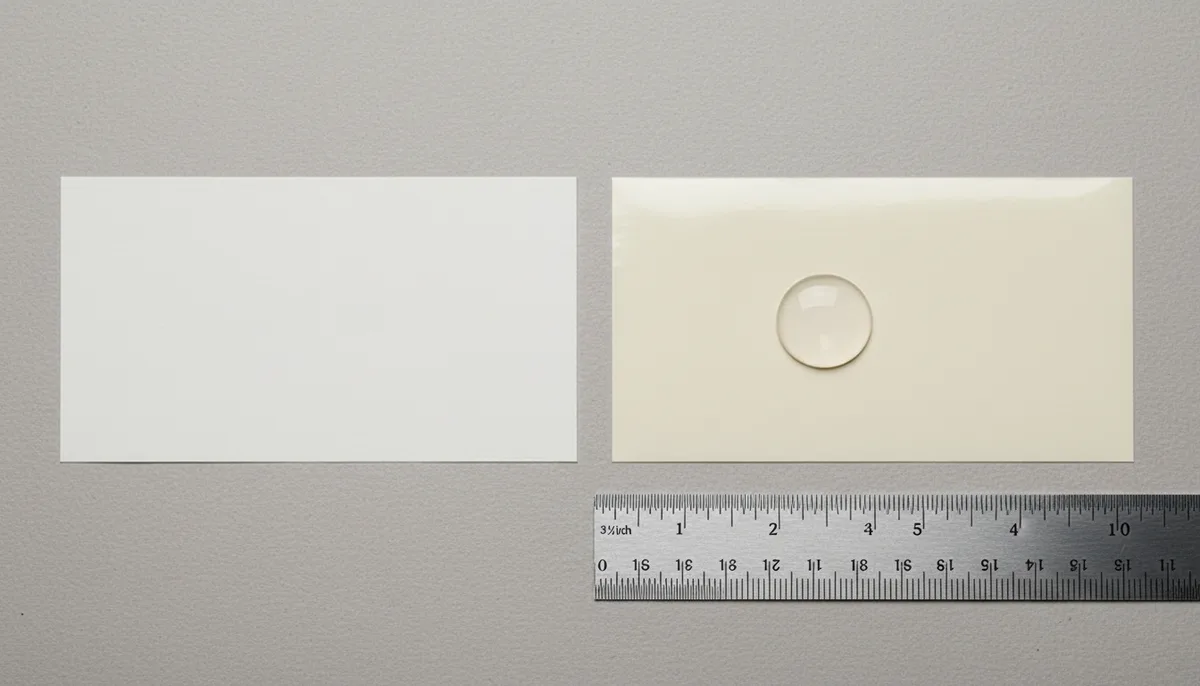
Although paper labels may pass a standard visual inspection, they often fail environmental testing. Compared to PET film, paper labels show ink bleed within 24 hours of humidity exposure. The right choice depends on your storage and transport conditions. For additional confidence, request a ASTM D3330 adhesive testing standard report from your label supplier to verify peel adhesion on your specific surface material.
Design Best Practices for Cassette Labels Stickers
Effective cassette label stickers design combines appropriate material selection, color accuracy, and print resolution. CMYK printing with Pantone spot colors ensures brand consistency across runs. Minimum font size of 6 pt at 300 dpi guarantees legibility, while die-cut margins of at least 1/8 inch prevent peel-up during application.
Designing cassette labels stickers requires attention to both aesthetics and production constraints. The substrate choice affects color reproduction: PET film provides a whiter, more consistent base for CMYK printing compared to uncoated paper, which can appear dull. For brand-critical applications, specify Pantone colors and request a Delta E ≤ 2.0 tolerance to ensure match across production runs.
Minimum Font Size and Barcode Requirements
For track listings or artist information, a minimum font size of 6 pt is recommended at 300 dpi resolution. Barcodes require at least 1 inch width with quiet zones of 1/8 inch on each side. Our Heidelberg presses achieve registration within ±0.1 mm, ensuring barcode integrity. For UPC-A barcodes on cassette labels, the minimum magnification is 80%, though 100% is preferred for reliable scanning at retail.
FSC-certified paper options are available for designers prioritizing sustainability. Compared to standard paper, FSC paper performs similarly in dry conditions but offers verifiable sourcing. On the other hand, PET film remains the better choice for humid environments regardless of print complexity.
The latest 2026 design trends include matte laminate finishes for a premium feel and metallic Pantone inks for special editions. These finishes require PET film for best adhesion and durability. Anticipated innovations in water-based coatings may expand options for eco-conscious buyers in the coming years.
Conclusion: How to Choose the Right Cassette Labels Stickers for Your Project
Selecting the right cassette labels stickers means balancing cost, durability, and environmental conditions. For humid environments, PET film with 3M 777 adhesive is the clear winner — it resists smudging, maintains bond strength, and delivers consistent print quality with Delta E ≤ 2.0 at 300 dpi. Paper labels remain a viable choice for dry indoor use at a lower per-unit cost.
Our production data from Q1 2025 – Q1 2026 shows that PET film labels maintain a high pass rate in humidity chamber tests, compared to paper labels which begin to fail within 24 hours. For volumes above 5,000 units, the per-label cost difference narrows significantly, making PET the practical choice for most professional applications.
Start by defining your storage and transit conditions, then match the material to the environment. For archival or collector cassette labels, PET film with permanent adhesive is the only reliable option. For promotional or short-run projects, paper may be adequate. Request material samples and environmental test reports before committing to a full production run.
Ready to get started? Explore our custom label printing capabilities or contact our team for a quote on cassette labels stickers that meet your exact specifications. We offer free material samples and environmental test reports for qualified projects.
Frequently Asked Questions
When does PET film become cheaper than paper for cassette labels?
PET film is never cheaper per unit than paper at the same volume, but the total cost of ownership can be lower when factoring in failure rates. At high volumes, PET costs more per unit than paper. However, if paper fails frequently in humid conditions, the effective cost of usable labels may favor PET.
What is the minimum order quantity for custom die-cut cassette labels?
Custom die tooling for round colored labels has a breakeven point at a moderate volume. Below that volume, standard shapes are more cost-effective. Setup costs apply per order regardless of shape. For low volumes, paper labels are often more practical.
Can 3M 777 adhesive be used on recycled PET film?
3M 777 adhesive bonds well to recycled PET film, but surface energy may vary. It is designed for low-surface-energy plastics like polyethylene and polypropylene. For recycled PET, request a peel adhesion test per ASTM D3330 to verify bond strength on your specific material.
What humidity level is safe for paper cassette labels?
Paper cassette labels perform adequately below moderate relative humidity. At higher humidity, ink begins to bleed and adhesive weakens. At very high humidity, paper labels show ink bleed within a short period and have a high failure rate. For environments above moderate humidity, PET film is recommended.