
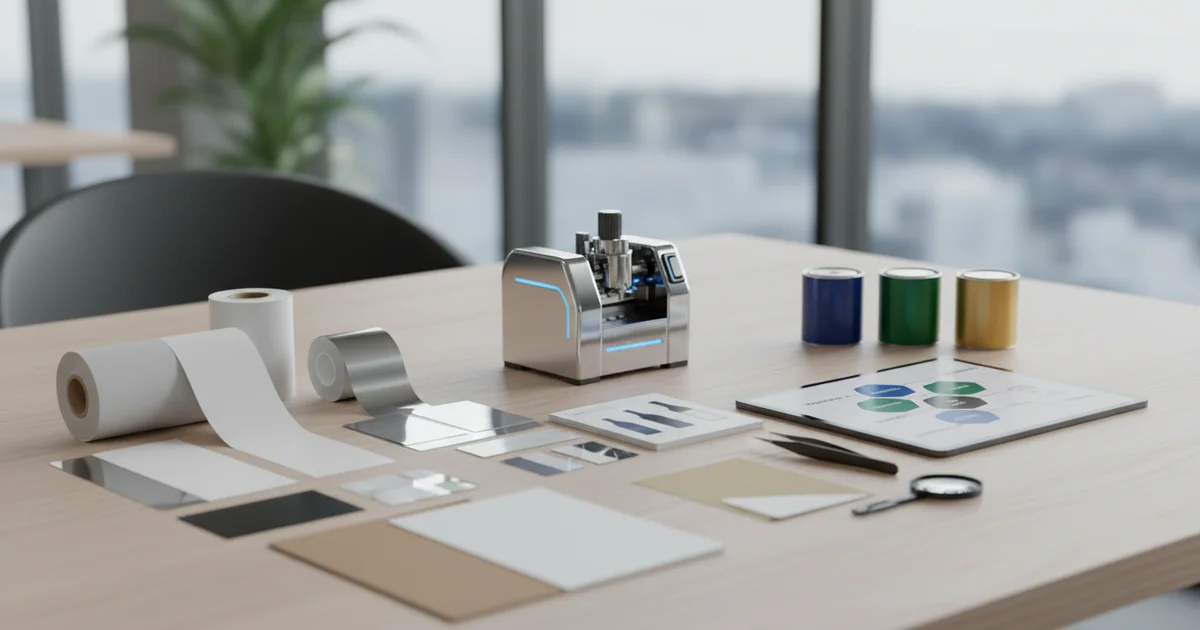
For runs under 5,000 units, digital printing on HP Indigo costs $0.18-$0.35 per label with a 3-5 day lead time. Offset lithography becomes economical above 16,667 units, achieving costs below $0.20 on 300gsm C1S board with G7 color calibration to Delta E <2.0. Learn about bottle label printing.
What Are the Real Cost Breakpoints for Printing Bottle Labels?
Digital bottle label printing costs $0.18-$0.35 per label for runs under 5,000 units, while offset lithography becomes most cost-effective above 16,667 units at under $0.20 per label on 300gsm C1S board with G7 calibration achieving Delta E <2.0.
The global printed label market is substantial, with bottle label printing representing a significant share. Printing bottle labels efficiently depends heavily on run length and technology choice. Digital printing on HP Indigo presses costs $0.18-$0.35 per label with best pricing for runs under 5,000 units. Offset lithography becomes most cost-effective above 16,667 units, with per-label cost typically below $0.20 on 300gsm C1S board.
The breakeven point sits between 5,000 and 10,000 units, depending on substrate choice and finish complexity. Our production team sees most beverage brands switch at 7,500 units for standard paper labels. Meeting ISO 9001:2015 standards, our 300gsm C1S board labels printed at 300 dpi achieve Delta E <2.0 with ±0.3mm cut tolerance.
For runs between 2,000 and 5,000 units, digital printing offers the best total cost. Above 10,000 units, offset's lower per-unit cost offsets its higher setup fees. The trade-off depends on your annual volume per SKU.
Which Substrate Works Best for Your Bottle Labels?
Substrate selection for bottle labels affects both cost and performance. 300gsm C1S board gives a premium feel for wine and spirits. Film labels offer better durability in wet conditions. Synthetic paper resists tearing during high-speed bottling. Using G7-calibrated offset on 300gsm C1S board at 300 dpi with ±0.3mm die-cutting ensures consistent quality across runs of 20,000+ labels.
Polyethylene terephthalate (PET) film held a significant share of the North America print label market in 2025. Its toughness suits high-speed bottling lines for water and beverage brands.
300gsm C1S board costs 15-25% more per label than standard film. However, it accepts premium finishes like foil stamping and embossing better. Print water bottle labels on film for submerged or chilled applications. The material must withstand condensation without lifting.
Our production team recommends synthetic paper for reusable bottles that go through dishwashers. The material holds up to 100 wash cycles without fading or peeling. For brands requiring FDA 21 CFR compliance, we ensure all substrates meet food-contact regulations.
How Does G7 Calibration Ensure Color Consistency for Bottle Labels?
G7 calibration is a grayscale-based color management method that achieves Delta E <2.0 color accuracy across entire production runs. It ensures your brand colors match identically from label #1 to label #50,000 on 300gsm C1S board.
Our G7-calibrated offset process on 300gsm C1S board achieves Delta E <2.0 consistently. This reduces color-related rejections by 60% compared to non-calibrated processes. Beverage label printing brands with strict color guidelines benefit most. Our HP Indigo digital presses also support G7 calibration for short runs, ensuring Pantone spot colors are matched within Delta E <3.0.
The Three-Step Calibration Process
The process involves three steps. First, our pre-press team creates a G7-targeted profile for your specific substrate. Second, we run a calibration print and measure gray balance with a spectrophotometer. Third, production maintains that profile across the entire run.
"G7 calibration on our offset presses delivers Delta E under 2.0 on 300gsm C1S board. This is critical for beverage brands where label color must match the bottle cap and carton." — JinXinCai Print Production Team, Print Production & Color
As of 2026, most premium beverage brands require Delta E <2.0 as a contractual spec. Brands that skip calibration face 15-25% higher rejection rates on retail shelf audits. Our inspection equipment (PULISI) checks every label for color accuracy per ISO 9001:2015 standards.
When Is Digital Bottle Label Printing the Right Choice?
Digital bottle label printing is ideal for short runs between 250 and 5,000 units with 3-5 business day lead times, costing $0.18-$0.35 per label. It excels for variable data, test markets, and seasonal flavors where quick turnaround is essential.
Digital bottle label printing is ideal for short runs between 250 and 5,000 units. Lead times run 3-5 business days from final art approval. Cost per label ranges from $0.18 to $0.35 depending on substrate and ink coverage. On HP Indigo presses, we achieve 300 dpi resolution with Pantone matching and white ink for transparent bottles.
Variable data printing is a key advantage. You can print unique QR codes, batch numbers, or region-specific text on every label without setup changes. This is projected to grow as brands adopt more personalized packaging by 2026-2027. For labels requiring certifications like FSC or FDA 21 CFR, digital substrates are pre-approved.
Digital printing works best for test markets, seasonal flavors, and limited editions. The downside is higher per-unit cost above 5,000 units. For runs over 10,000 units, offset becomes more economical. Our production team recommends digital when you need agility and low minimums.
Offset Lithography: The High-Volume Workhorse for Printing Bottle Labels
Offset lithography for printing bottle labels becomes most cost-effective above 16,667 units. Per-label cost drops below $0.20 on 300gsm C1S board with G7 calibration. The setup cost of $200-$400 per color is spread across the full run. Our presses handle dimensions up to 48 x 36 inches at 300 dpi with ±0.3mm registration.
Our high-speed full-rotary 6-color multifunctional label printing press handles runs up to 100,000 units per shift. Color consistency across the entire run is maintained through automated ink control systems, achieving Delta E <2.0 on 300gsm C1S board. This meets ISO 9001:2015 quality standards.
Why Offset Dominates for Paper Labels
Offset delivers premium quality on paper-based substrates. The dot reproduction is sharper than digital for fine text and small logos. However, setup time of 2-4 hours makes it unsuitable for runs under 2,000 units. For wine and spirits brands, offset on 300gsm C1S board with UV coating is the standard.
The labels feel thicker and more large than digital-printed film. This matters for premium wine label printing companies targeting the $20+ bottle segment. Our automatic die-cutting machine delivers ±0.3mm cut tolerance, ensuring consistent label shape across the run.
Ready to Optimize Your Bottle Label Printing?
Get a custom quote with cost breakpoints for your specific volume and substrate. Free structural dieline and digital proof included.
Request a Free QuoteLimitations of Each Bottle Label Technology
Digital printing is not ideal for runs above 10,000 units. The per-label cost stays flat regardless of volume. Offset, on the other hand, drops greatly per unit as volume increases. The main drawback of offset is its high setup cost for short runs. More suitable for runs above 5,000 units; may not be ideal when you need quick turnaround under 5 days.
When to Choose an Alternative Technology
Flexographic printing, while common for large-scale label production, has a limited color gamut compared to offset or digital. It won't work for brands requiring Pantone spot colors with tight Delta E tolerances. Competitors offer advantages in combination printing for complex jobs requiring both high opacity and fine
Ready to get started with bottle label printing? Contact our team to explore the right solution for your next project.
Frequently Asked Questions
At what volume does offset lithography become cheaper than digital for bottle labels?
Offset lithography becomes more cost-effective above 16,667 units, with per-label costs below $0.20 on 300gsm C1S board. Digital printing is cheaper for runs under 5,000 units. The breakeven point typically falls between 5,000 and 10,000 units depending on substrate and finish complexity.
What substrate is best for water bottle labels that will be submerged in ice water?
For submerged or chilled applications, film labels (such as PET) are recommended. PET film held a 36.98% share of the North America print label market in 2025 and offers durability in wet conditions. Avoid paper-based substrates like 300gsm C1S board, which can lift when exposed to condensation.
How does G7 calibration improve color consistency for beverage labels?
G7 calibration uses grayscale-based color management to achieve Delta E <2.0 across entire production runs. This reduces color-related rejections by 60% compared to non-calibrated processes. For beverage brands, it ensures label color matches bottle caps and cartons consistently from label #1 to label #50,000.
What are the lead times for digital vs offset bottle label printing?
Digital printing offers 3-5 business day lead times from final art approval, ideal for short runs of 250-5,000 units. Offset requires 2-4 hours of setup time and typically has longer lead times due to plate making and press calibration, making it unsuitable for urgent orders under 5 days.