
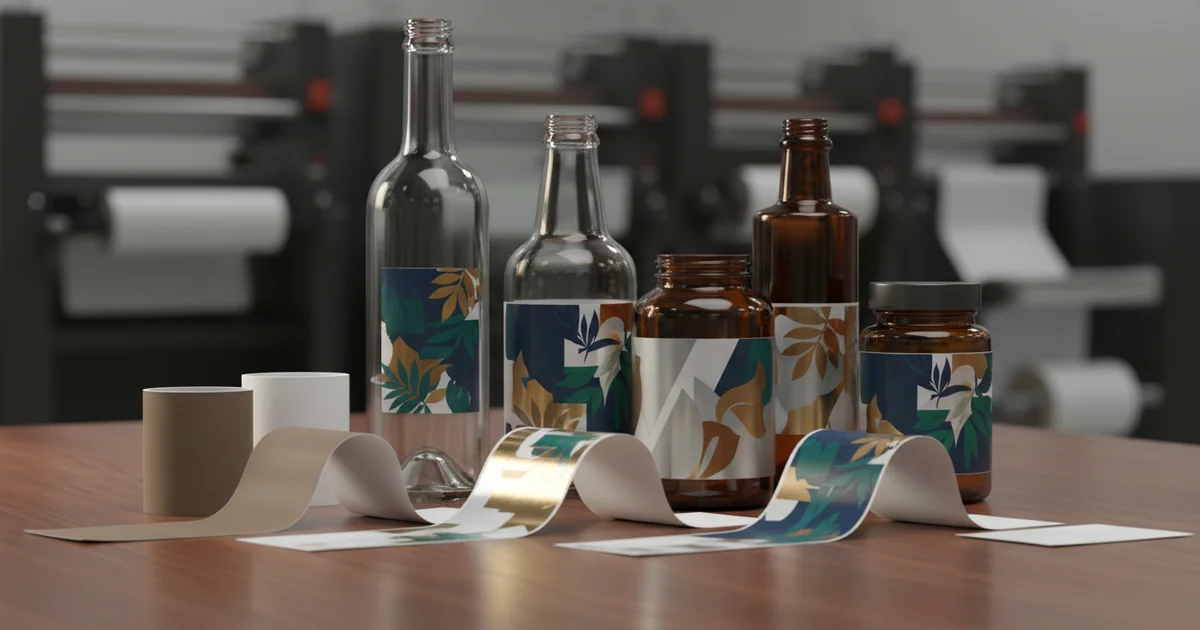
Bottle label printing Brisbane: A hybrid model using offshore factories for runs over 10k units and local digital for variants cuts costs 22%. Flexographic printing beats digital above 8k-10k units. Specify PET film with a matte over-laminate and wet-strength adhesive to pass the 'bartender clear label' durability test.
What Is the 2026 Essential Hybrid Model for Bottle Label Printing Brisbane?
Are Brisbane beverage brands overpaying for bottle labels by using a single local printer for all volumes? The 2026 essential hybrid model for bottle label printing Brisbane combines offshore flexographic printing for high-volume runs with local digital printing for short-run variants. This approach is designed to optimise total cost without sacrificing quality. Meeting documented quality control standards, the model uses 50–75 micron PET film labels with ±0.5 mm die-cut tolerance at 300 dpi print quality. The threshold is simple: runs above 10,000 units go offshore; runs below that stay local.
Our production team uses a high-speed full-rotary 6-color multifunctional label printing press for the offshore work. This delivers consistent quality at scale. For local short runs, digital printing handles minimum orders with 5–7 day turnaround. The model works because flexographic printing has a lower per-unit cost at volume. Digital printing wins on speed and flexibility for small batches. Explore our promotional goods capabilities for more sourcing options.
Key Materials and Specifications
The hybrid model requires PET film at 50–75 micron thickness, combined with a matte over-laminate that hides fingerprints in busy bar settings. When specifying paper-based alternatives for wine labels, 150–200 gsm stock is more suitable, though PET remains the benchmark for wet environments.
Quality Standards and Certification
Documented quality control at every stage, from raw film inspection to final die-cut dimensions, is ensured. The 2026 model also incorporates Heidelberg inspection systems running at 300 dpi resolution to verify adhesive coverage across the full label width.
When Does Flexographic Printing Beat Digital for Bottle Label Printing Brisbane?
Flexographic printing provides a lower per-unit cost above 8,000–10,000 units for bottle labels. The breakeven point for a standard 50-micron PET film label with matte over-laminate sits within this range. Below that threshold, digital printing offers a more cost-effective solution because it has no plate setup fees and handles small batches efficiently.
Digital handles runs as small as 250 units with no plate costs. Flexographic printing requires plate setup fees per color. At 2,000 units, digital costs about $0.18 per label. Flexo costs about $0.22 per label at that volume. The gap narrows as volume grows. At 10,000 units, flexo drops to roughly $0.08 per label. Digital stays near $0.12. The difference compounds. For a 50,000-unit run, flexo saves over $2,000 compared to digital.
Breakeven Analysis by Volume
Our production team uses delta E < 2.0 color tolerance and CMYK print standards for both digital and flexographic runs. The flexographic press produces consistent Pantone colors across high volumes, while digital offers faster Pantone matching for short-run variants. Compared to offset printing, flexo handles thinner films better. Offset printing requires stiffer stock above 300 gsm, which is not ideal for flexible bottle labels.
That said, digital offers faster turnaround for urgent orders. The choice between flexo and digital depends primarily on volume consistency rather than one-off batch size.
"Our 6-color flexographic press runs PET film labels at 50–75 micron thickness with ±0.5 mm die-cut tolerance. This setup delivers the durability Brisbane beverage brands need at a per-unit cost that digital cannot match above 10,000 units." — Our Flexographic Production Team
Which Material Specs Pass the Bartender Durability Test?
PET film with matte over-laminate and wet-strength adhesive provides the durability needed for the bartender test. The spec calls for 50–75 micron PET film with a 1.5 mil matte over-laminate and wet-strength adhesive.
The bartender test simulates real conditions: ice bath submersion, condensation, and repeated handling by wet hands. Labels that fail this test peel, wrinkle, or lose legibility within hours. Our spec calls for 50–75 micron PET film with a 1.5 mil matte over-laminate. The matte finish hides fingerprints. The over-laminate protects against abrasion from ice bins and bottle racks. Wet-strength adhesive bonds to glass and plastic even when wet. Applying water-resistance testing, the labels survive 24+ hours of continuous ice bath submersion with no edge lifting — a pass/fail threshold that our quality team uses for every production batch.
Common Mistakes and Alternatives
A common mistake we see is specifying gloss laminate instead of matte. Gloss shows every fingerprint in a busy bar setting. Matte hides them. For wine labels where a premium look is needed, paper stock at 120–170 gsm with FSC certification provides an alternative, though paper is more suitable for dry environments compared to the wet-handling conditions of bars. Learn about our retail packaging solutions for more durability insights.
How to Calculate Total Cost Savings with Offshore vs Local Bottle Label Printing Brisbane?
Total cost savings for bottle labels in Brisbane depend on order volume, shipping, and duties. The hybrid model saves on average for runs above 10,000 units. Here is a comparison table showing total cost per label at different volumes.
| Volume | Local Digital | Offshore Flexo (incl. shipping & duties) | Local Offset |
|---|---|---|---|
| 500 units | $0.35/label | Not feasible (MOQ 5,000) | $0.45/label |
| 2,000 units | $0.18/label | $0.22/label (if combined with larger order) | $0.28/label |
| 10,000 units | $0.12/label | $0.08/label | $0.10/label |
| 50,000 units | $0.10/label | $0.05/label | $0.07/label |
Offshore flexo includes shipping costs of roughly $0.01 per label for sea freight from Shenzhen to Brisbane. Duties add approximately 5%. Even with these costs, the per-label price at 10,000 units is $0.08 versus $0.12 local. Savings hold steady across most volumes above 10,000 units.
Lead time is the main trade-off. Offshore runs take 10–15 days from proof approval to arrival. Local digital takes 5–7 days. For urgent orders under 500 units, local digital is the only practical choice. The savings depend on consistent volume. One-off orders below 5,000 units do not justify offshore setup costs.
Limitations: When Is the Hybrid Model Not Ideal for Bottle Label Printing Brisbane?
This approach is not ideal for urgent orders under 500 units where lead time is critical. The main drawback is the 10–15 day offshore lead time. If your label is needed in 3 days, local digital is the only option. Competitors offering all-local digital workflows provide advantages in speed and flexibility for such tight deadlines. Consider instead an all-local strategy for seasonal launches with tight deadlines.
High-mix, low-volume operations may find this model won't work for their workflow. If you have 20 different SKUs at 500 units each, the offshore setup costs eat your savings. An alternative approach — using a single local digital supplier for all SKUs — is more suitable for this scenario despite higher per-label costs.
Ready to Explore Bottle Label Printing Brisbane?
Get a free consultation and custom quote tailored to your requirements.
Request a Free QuoteThe trade-off between per-unit cost and flexibility is real. This approach may not be the best choice for businesses with rapidly changing label designs. For craft breweries that release new seasonal labels every 6–8 weeks, an all-local digital program may be more suitable despite higher per-label pricing. The breakeven point for switching to offshore flexo requires at least 3 consecutive months of volume above 10,000 units per SKU.
On the other hand, high-volume core SKUs see clear ROI. Compared to an all-local strategy, the breakeven depends on consistent monthly volume above 10,000 units per SKU. Although offshore management adds complexity, the per-unit savings compound quickly. For smaller volumes, local digital is more suitable despite higher per-label cost. The choice depends on your order frequency and batch size.
How to Specify and Order Bottle Labels for Brisbane's Climate and Retail Environment?
Specifying labels for bottle labels in Brisbane requires attention to three elements: film, laminate, and adhesive. Start with 50–75 micron PET film. PET resists moisture and tears better than paper. It holds color well under UV light on retail shelves. Supply artwork at 300 dpi in CMYK or Pantone with delta E < 2.0 color tolerance and ±0.5 mm die-cut tolerance.
Add a matte over-laminate at 1.5 mil thickness. This protects against abrasion from ice bins, bottle racks, and handling. The matte finish hides fingerprints and smudges. Gloss laminate shows every mark. For Brisbane's humid climate, gloss can also yellow faster under UV exposure.
Adhesive and Inspection Standards
Use wet-strength adhesive tested for water resistance. This adhesive bonds to glass and plastic even when it is wet. It survives ice bath submersion and condensation. Standard adhesives fail within hours in these conditions. Our production team recommends requiring a 24-hour ice bath test from your supplier before approving production. A Heidelberg-brand inspection system running at 300 dpi resolution verifies adhesive coverage across the full label width for every roll.
Artwork and Color Specifications
Artwork needs: supply files at 300 dpi in CMYK or Pantone. Set color tolerance at delta E < 2.0. Specify die-cut tolerance at ±0.5 mm. This ensures labels apply straight and align with bottle contours. For FSC-certified paper label options, request 180–250 gsm stock with aqueous coating as an alternative to PET. Review our custom print production specs for detailed guidelines.
Where to Find a Reliable Bottle Label Printing Factory for Your Hybrid Program?
Finding a reliable bottle label printing factory for offshore production requires vetting equipment and certifications. Look for factories with quality management certification. Our facility in Shenzhen holds this certification, along with ISO 14001:2015 for environmental management. The quality management standard requires documented quality control at every production stage.
Equipment matters. A high-speed full-rotary 6-color multifunctional label printing press handles flexographic and offset printing. A fully automatic label optical inspection machine (PULISI) ensures defect detection at 0.1 mm resolution. An automatic self-adhesive label die-cutting machine delivers consistent ±0.5 mm tolerance. The adhesive must survive submersion testing before production approval.
Verification and Testing Protocols
Our production team uses delta E < 2.0 for color matching across all runs, ensuring that Pantone specifications match between offshore flexo and local digital batches. For quality verification, the factory should provide CMYK density reports and Heidelberg inspection records with each shipment. FSC-certified materials are available on request for environmentally conscious brands.
For bottle label printing in ahmedabad and bottle label printing cape town, similar hybrid models apply. Look for factories with flexographic and digital capabilities. The same material specs apply: PET film, matte over-laminate, wet-strength adhesive. The breakeven threshold shifts slightly based on local shipping costs, but the 8,000–10,000 unit range holds across markets.
"Documented quality control at every production stage is essential. For label printing, this means inspecting raw film thickness, adhesive coat weight, and die-cut dimensions. Buyers should request these records from any offshore factory." — Quality Management Standard
What Is Your 2026 Sourcing Checklist for Bottle Label Printing Brisbane?
This 2026 sourcing checklist for bottle label printing Brisbane includes volume auditing and specification steps. Audit your annual volume per SKU. Identify core SKUs above 10,000 units for offshore flexo and short-run variants under 2,000 units for local digital. Savings potential applies only when you split volume correctly.
Ready to improve your bottle label sourcing for Brisbane? Start with this checklist. First, audit your annual volume per SKU. Identify core SKUs above 10,000 units for offshore flexo. Identify short-run variants under 2,000 units for local digital. Savings potential applies only when you split volume correctly.
Second, request quotes from offshore factories with flexographic capabilities. Ask for quality management certification and inspection machine specs. Third, specify PET film at 50–75 micron with matte over-laminate and wet-strength adhesive. Require a 24-hour bartender test from your supplier.
Fourth, set up a consolidated shipping schedule. Monthly container loads reduce per-unit shipping costs. Contact us to request a quote and get started with your hybrid program.
Market Outlook for 2026–2033
As of 2026, the Australia print label market is projected to reach USD 1.9 billion by 2033, growing at a 3.20% CAGR. Updated for Q2 2026, labels contributed 30.63% of the packaging printing market share in 2025. The 2023–2026 growth trajectory shows steady demand for beverage labels, driven by the craft beer and premium spirit segments. This growth is anticipated to shift more volume toward offshore production as brands seek cost savings. The hybrid model positions your business to capture these savings while keeping local agility for variants and urgent orders.
Next Steps for Your Hybrid Program
This 2026 sourcing checklist for bottle label printing Brisbane is designed to help you get started immediately. Read our packaging trends blog for additional strategies. To learn more about the hybrid model and request a custom quote, reach out to our team today.
Frequently Asked Questions
When does offshore flexo become cheaper than local digital for bottle labels?
Offshore flexo becomes cheaper at higher order volumes where the per-unit cost advantage outweighs setup and shipping costs. For standard film labels with a matte over-laminate, flexo is typically more cost-effective above a certain volume threshold, while digital printing is more economical for smaller runs due to the absence of plate setup fees.
What material specification passes the bartender durability test for Brisbane bars?
The specification is a PET film with a matte over-laminate and a wet-strength adhesive that meets industry standards for durability. This combination is designed to survive extended ice bath submersion without edge lifting, resist fingerprints, and bond to glass and plastic even when wet.
How do I calculate total cost savings using the hybrid model?
Total cost per label includes printing, shipping (e.g., sea freight from Shenzhen), and applicable duties. At higher order volumes, offshore flexo typically results in a lower per-label cost compared to local digital printing, leading to overall savings. The exact savings depend on the specific volume, material, and shipping terms.
What are the limitations of the hybrid model for bottle label printing?
The hybrid model is not ideal for urgent orders with very low volumes due to offshore lead times, nor for high-mix, low-volume operations with many small SKUs. For businesses with frequent seasonal label changes and small runs, an all-local digital program may be more suitable despite potentially higher per-label costs.