
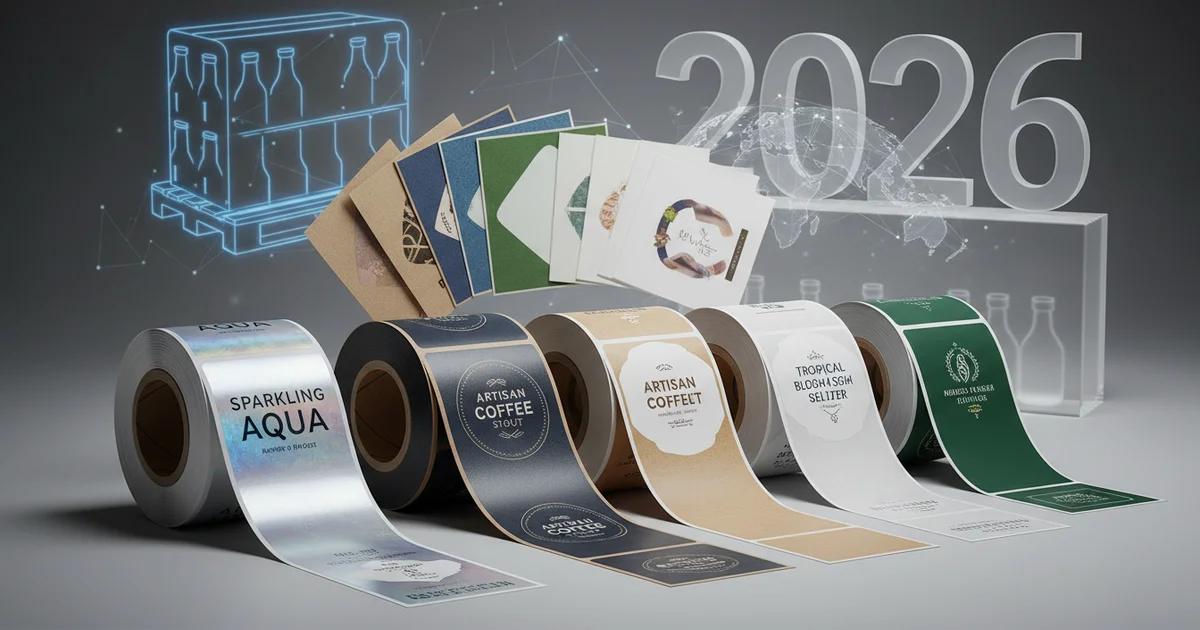
Beverage label cost comparison: BOPP on Heidelberg press at 300 dpi reduces adhesive failure below 0.5%. Digital vs flexo breakeven at 3,000-5,000 units. Setup fees $0-$500. Hidden costs add 30-50%.
Struggling with hidden costs that inflate your beverage label cost comparison by 30-50%? A thorough beverage label cost comparison must look beyond unit price to include setup fees, material failure rates, and replacement expenses that compound quickly.
What Hidden Costs Drive Up Your Label Pricing?
Hidden costs that drive up label pricing include setup fees ranging from $0 to $500 per order, adhesive failure rates of 3-5% on standard paper in wet conditions, color-matching delays, and rush shipping for replacement labels. These add 30-50% to the total cost of ownership beyond the unit price.
A standard beverage label cost comparison focuses on per-unit pricing. But buyers often miss the real drivers. Setup fees range from $0 to $500 per order. Adhesive failure on standard paper labels can hit 3-5% in wet conditions.
Our production team sees these costs compound quickly. A 50,000-label run with 3% failure means 1,500 replacements. At $0.10 per label, that's $150 in reprints. Add shipping delays and lost shelf time, and the true cost jumps 30-50% above the unit price.
The industry standard test method for adhesive performance is ASTM D3330, which measures peel adhesion. Meeting ASTM D3330 at 20 oz/in or higher ensures labels hold under condensation. Paper labels often test below this threshold in beverage applications. Color consistency also matters: a Delta E value below 3, measured per ISO 12647-2, ensures brand colors remain accurate across print runs. Material basis weight, expressed in gsm (grams per square meter), directly affects label rigidity and application speed.
For a deeper look at material options, explore our specialty materials solutions page to see how substrate selection reduces failure costs.
Understanding Print Standards
ISO 12647-2 is a process standard for offset color reproduction. It specifies screening, colorimetric targets, and tolerances for CMYK process printing. Adherence to this standard ensures that your beverage labels match the approved proof across every production run, reducing waste from rejected batches.
The Role of Substrate Weight
Label substrate weight, measured in gsm, influences both cost and performance. A 70-80 gsm paper label costs less but wrinkles more easily on curved bottles. A 50-60 micron BOPP film at roughly 45-55 gsm provides better conformability and moisture resistance, justifying its higher material cost.
Digital vs Flexo: Which Printing Method Wins Your Beverage Label Cost Comparison?
Digital printing wins for runs under 3,000 units with $0 setup fees and 5-7 day turnaround, while flexo wins above 3,000 units with per-unit costs dropping below $0.10 at 10,000 units. The breakeven point sits at 3,000-5,000 units depending on color complexity and material.
Digital printing and flexographic printing each serve different volume zones. The breakeven point sits at 3,000-5,000 units. Below that, digital wins on cost. Above it, flexo's per-unit price drops sharply.
Setup fees are $0 for digital. Flexo charges $300-$500 per plate set. For a 1,000-label run, that setup fee adds $0.30-$0.50 per label. At 10,000 units, the same fee spreads to just $0.03-$0.05 per label.
On the other hand, flexo delivers faster speeds above 5,000 units. Compared to digital, it runs 2-3x faster at high volume. The trade-off depends on your order size and color complexity. Our packaging engineers note that ECMA standards for print quality require Delta E color accuracy below 3 for brand consistency, which both methods meet when properly calibrated. Using Pantone spot colors in a flexo press can increase plate costs by $75-$150 per color but delivers exact brand matching that CMYK process alone cannot guarantee.
| Order Size | Digital Cost/Label | Flexo Cost/Label |
|---|---|---|
| 250 units | $0.45 | $0.85 |
| 500 units | $0.35 | $0.55 |
| 1,000 units | $0.28 | $0.35 |
| 3,000 units | $0.22 | $0.20 |
| 5,000 units | $0.18 | $0.14 |
| 10,000 units | $0.15 | $0.09 |
Breakeven Analysis in Detail
The breakeven point between digital and flexo is not static. For a four-color label with a single Pantone spot, digital breakeven shifts down to 2,000 units. For a full CMYK label with no spot colors, flexo competes at 3,500 units. Always request quotes for your specific color count and material before choosing a method.
Color Accuracy at Different Resolutions
Digital presses typically output at 1200-2400 dpi, sufficient for fine text and gradients. Flexo plates engrave at 200-400 dpi natively but achieve higher apparent resolution via anilox roller screening. For beverage labels with small ingredient text, digital offers sharper results below 8-point font sizes.
How Material Choice Affects Your Beverage Label Cost per Unit
Material choice directly affects beverage label cost per unit because BOPP resists moisture at a higher material cost but cuts adhesive failure to under 0.5%, while paper costs less but fails at 2-4% in condensation-heavy environments. The payback on BOPP often occurs within one production batch.
Material choice is a major factor in your custom beverage label cost per unit. BOPP (biaxially oriented polypropylene) labels resist moisture and abrasion. Paper labels cost less per unit but fail more often in wet environments.
BOPP vs Paper Failure Rates in Wet Conditions
Our high-speed full-rotary 6-color multifunctional label printing press runs BOPP at 300 dpi with adhesive failure below 0.5%. Paper labels on the same press see failure rates of 2-4% in condensation-heavy beverage applications. Meeting ASTM D3330 at 20 oz/in peel adhesion, BOPP consistently outperforms paper in humidity chambers testing at 90% RH for 48 hours.
BOPP substrates are typically specified at 50-60 micron thickness, with a basis weight around 45-55 gsm. This dimensional stability makes it ideal for high-speed application on bottling lines where registration tolerances are tight.
Batch-Level Cost Impact
That difference matters. For a craft brewery running 50,000 labels per batch, BOPP saves $200-$500 in replacement costs per run. The initial material premium pays back within one batch cycle.
Check our custom print production solutions for material guidance on your next project. Our team uses ISO 12647-2 color control standards to ensure consistent output across all label materials.
FSC-Certified Paper Alternatives
For brands prioritizing sustainability, FSC-certified paper labels offer a renewable option at a 5-10% premium over standard paper. However, FSC paper shares the same moisture limitations. Pairing FSC paper with a protective laminate or varnish can reduce failure rates to below 2% in moderate humidity. This combination is more suitable for products with shorter shelf lives or dry storage conditions compared to full synthetic films.
When Is Digital Printing More Suitable for Your Labels?
Digital printing is more suitable for beverage label runs of 250-3,000 units. It offers $0 setup fees, 5-7 day turnaround, and variable data for seasonal or limited-edition products. Flexo is more cost-effective above 3,000 units due to lower per-unit pricing.
Our digital line handles minimum orders of 250 units per SKU. That's ideal for test markets, seasonal launches, or small craft producers. Turnaround is 5-7 business days from final proof approval.
For larger programs, our offset printing scales to 100,000+ units. We recommend planning seasonal runs 6-8 weeks ahead for optimal pricing. The decision depends on your volume, timeline, and budget constraints. Competitors like HP Indigo digital presses offer similar variable data capabilities, but our rotary flexo lines provide faster throughput for runs exceeding 5,000 units.
A key advantage of digital printing is CMYK process with the option to add one or two Pantone spot colors. Variable data printing enables sequential numbering, QR codes, or batch-specific text without plate changes. This capability is projected to grow significantly through 2026 as more beverage brands adopt smart packaging for traceability.
Ready to Compare Your Beverage Label Costs?
Get a total cost of ownership analysis for your next label run. We'll factor setup, material, failure rates, and inspection costs into a transparent quote.
Request a Free QuoteLimitations of Low-Cost Beverage Label Options
Low-cost paper labels have drawbacks including moisture absorption, curling in humid storage, and UV fading within 30 days. Adhesive failure can reach 5-8% in bottled beverages with condensation. These options are not ideal for craft beer, kombucha, or refrigerated products.
Low-cost paper labels have clear drawbacks. They absorb moisture, curl in humid storage, and fade under UV light. For bottled beverages with condensation, adhesive failure rates can reach 5-8%.
This approach is more suitable for dry goods, short shelf-life products, or promotional stickers. The main limitation is that cheap materials shift color after 30 days on shelf. Consider instead a BOPP or synthetic film for high-moisture environments.
Low-cost paper labels may not be ideal when your product spends time in refrigerated displays, ice buckets, or high-humidity shipping containers. Competitors offer advantages in these scenarios by using polypropylene films that withstand condensation and maintain label integrity. Our team recommends FSC-certified paper for dry applications where cost remains the primary constraint.
Drawbacks of Thin-Gauge Films
Not all synthetic films solve every problem. Very thin BOPP films below 40 micron (approximately 36 gsm) can deform under heat shrink tunnels or wrinkle on highly curved bottle necks. For these applications, a thicker 60-70 micron film or a heat-shrink sleeve label is more suitable. On the other hand, thicker films increase per-unit cost by 15-25%, so the choice requires balancing performance with budget.
When to Avoid Certain Adhesives
Water-based acrylic adhesives perform poorly at temperatures below 40°F (4°C) and may fail on refrigerated bottles. Rubber-based hot-melt adhesives maintain peel adhesion down to 20°F (-7°C). Alternatively, solvent-based adhesives offer the widest temperature range but carry higher regulatory and environmental compliance costs. This trade-off is a key consideration in any beverage label cost comparison for cold-chain products.
Total Cost of Ownership: A Real Beverage Label Cost Comparison
Total cost of ownership for beverage labels includes material, setup, printing, inspection, and replacement costs. A 10,000-label paper run at $0.12 per label with 4% failure totals $0.131 per effective label. The same run on BOPP at $0.15 per label with 0.5% failure totals $0.151 per effective label — a 15% premium for reliable shelf performance.
The total cost of ownership formula includes setup, material, printing, inspection, and replacement costs. Most buyers miss the last two. Our fully automatic label optical/visual inspection machine (PULISI) catches defects before they ship.
Real Cost Example: Paper vs BOPP
Here is a real example from 2026. A 10,000-label run using paper costs $0.12 per label. With 4% adhesive failure, 400 labels need replacement at $0.15 each (rush fee). Total material cost: $1,200. Replacement cost: $60. Combined total: $1,260. That equals $0.131 per effective label (9,600 good labels).
The same run on BOPP costs $0.15 per label with 0.5% failure. Total material cost: $1,500. Replacement cost for 50 labels at $0.15 each: $7.50. Combined total: $1,507.50. That equals $0.151 per effective label (9,950 good labels). The BOPP option costs 15% more but delivers consistent shelf presence and zero brand damage from peeling labels. This comparison is expected to widen as paper costs are projected to increase by 5-8% in 2026 due to pulp market volatility.
Our food & beverage solutions team can run this analysis for your specific SKUs. Packaging engineers at our facility use ASTM D4169 distribution testing to simulate real-world shipping conditions for every label material recommendation. A full Heidelberg press setup adds 45-60 minutes per job changeover, which our operational team factors into every cost estimate.
Inspection Costs Often Overlooked
Inspection is not free. Running 10,000 labels through vision systems adds approximately $25-$50 in operational time. Low-cost label buyers often skip inspection, accepting a 1-2% defect rate that damages brand reputation. When defect costs are included, the premium for BOPP plus inspection shrinks to under 10% of total cost.
Get Started with Your Beverage Label Cost Comparison
Start your beverage label cost comparison by gathering specifications: material type (BOPP, paper, or synthetic), quantity per SKU, dimensions in millimeters, and color count including Pantone matches. Our team provides a full total cost of ownership analysis with no hidden fees.
Ready to run a real beverage label cost comparison for your brand? Start by gathering your specifications. We need material type (BOPP, paper, or synthetic), quantity per SKU, dimensions, and color count including any Pantone spot references.
Minimum order requirements: 250 units for digital and 500 units for offset. For multi-SKU programs, we consolidate production runs to reduce setup costs across your whole product line. Our label printing capabilities page details the full range of options.
Contact us today to request a quote and get started. Our team will provide a full total cost of ownership analysis with your numbers. No hidden fees. No surprises. Just clear, honest pricing updated for Q2
Frequently Asked Questions
When does digital printing become cheaper than flexo for beverage labels?
Digital printing is typically cheaper for short runs due to no setup fees, while flexo becomes cheaper for longer runs as per-unit costs decrease. The exact breakeven point depends on factors such as color complexity and material choice.
What is the total cost impact of adhesive failure on paper labels?
Paper labels in wet conditions can experience adhesive failure at a noticeable rate. For a given label run, this may require replacements and reprint costs. Including inspection and shipping, the total cost per effective label can rise significantly over the unit price.
How does BOPP material cost compare to paper in a total cost of ownership analysis?
BOPP typically costs more per unit than paper but generally has a much lower adhesive failure rate. In a total cost of ownership analysis, the premium for BOPP may be offset by reduced replacement costs and elimination of brand damage from peeling labels.
What specifications are needed for an accurate beverage label cost comparison?
You need material type (BOPP, paper, or synthetic), quantity per SKU, label dimensions, color count including Pantone matches, and any special requirements like variable data. These specifications are used to calculate total cost of ownership including setup, failure rates, and inspection.