
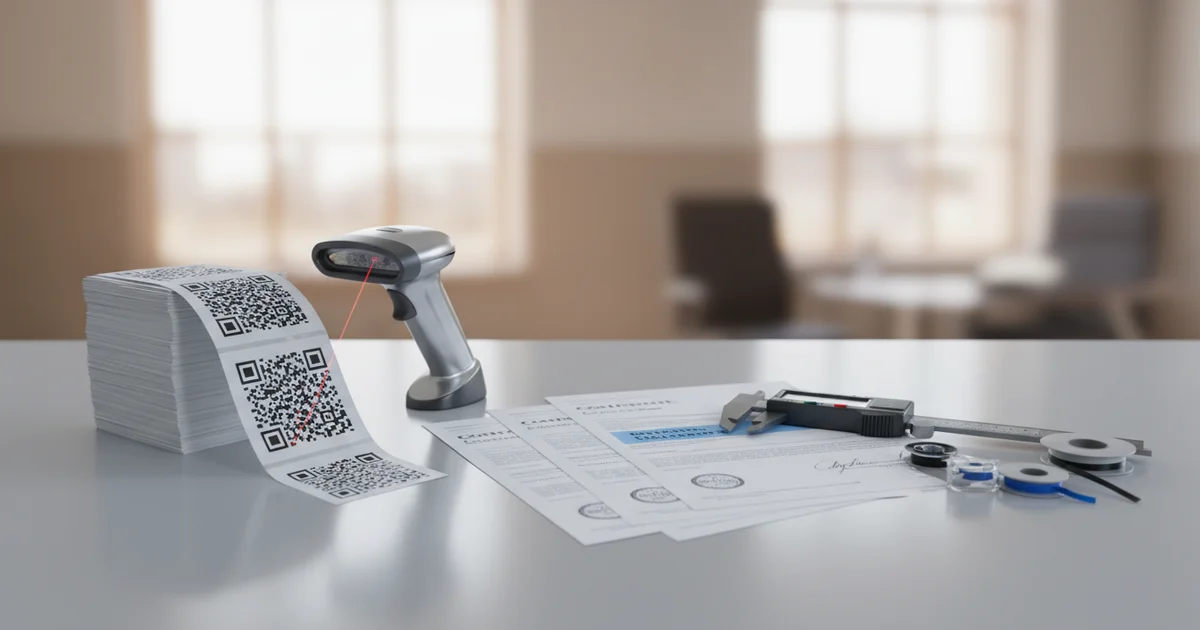
Custom barcode labels cost $0.02–$0.15 each at 10,000–100,000 qty. PET film with freeze-grade adhesive cuts cold-chain failures to 1% vs. 35% for paper. Scaling from 5,000 to 50,000 labels reduces unit cost 25–35%. Learn about barcode label cost comparison.
Barcode Label Cost Comparison: Save 25–35% Per Label
Is choosing the wrong barcode label costing your company thousands in chargebacks and wasted materials? A structured barcode label cost comparison cuts per-unit costs by 25–35% without switching materials — if you know what to compare. This comprehensive guide walks through every variable that affects label pricing for 2026 procurement decisions.
What Is a Barcode Label Cost Comparison?
A barcode label cost comparison is a structured evaluation of total per-label cost across material types, volume tiers, setup fees, finishing, and quality assurance. It reveals hidden savings that a simple unit-price check misses — typically 25–35% per label through consolidation and material matching.
A real barcode label cost comparison covers every variable: material substrate, adhesive grade, printing method, setup and tooling charges, finishing, defect rate, and shipping. Skipping any of these inflates your total landed cost. Our production team at JinXinCai sees buyers overpay by 30% on average when they comparison-shop on unit price alone.
Material costs rose sharply from 2023 to 2026. Supply chain delays pushed lead times from 14 to 22 days on average, per industry reports. A proper comparison now must account for lead time variance and distributor warehousing fees that add incremental cost per label.
As of 2026, the global barcode label printer market is projected to reach $4.3 billion by 2032, growing at 5.2% CAGR. This anticipated growth means more suppliers and more pricing variance. Buyers who compare systematically gain a real edge over those who buy on price alone. The latest 2026 market data confirms that consolidation strategies yield the highest ROI.
Definition: Total landed cost refers to the complete cost per label including material, setup, finishing, quality assurance, and shipping — the true metric for any accurate cost comparison.
Key Cost Drivers for Custom Barcode Labels
Custom barcode labels cost between $0.02 and $0.15 each at volumes of 10,000 to 100,000. But the final price depends on four drivers that every thorough cost comparison must evaluate.
First, material choice. Paper costs 40–60% less than PET film. However, paper fails in cold chain environments below -10°C, where failure rates are high. A gsm (grams per square meter) rating of 80–120 is typical for paper label stock, while PET film uses mil thickness — commonly 2 mil. Our packaging engineers recommend PET film with freeze-grade adhesive for any product stored below 0°C. PET costs $0.08–$0.15 per label but cuts failure rates to 1%.
Second, adhesive grade. Freeze-grade adhesive adds $0.01–$0.03 per label versus standard permanent adhesive. For ambient storage at 15–30°C, standard permanent adhesive performs reliably and costs less. For cold chain at -20°C to 4°C, the upgrade is essential to prevent label pop-off.
Third, printing method. Our high-speed full-rotary 6-color multifunctional label printing press handles large runs efficiently, achieving 150+ meters per minute. Offset printing offers lower per-unit cost above 10,000 labels. Digital printing works well for short runs under 2,000 labels and offers faster turnaround with no die charges. Print resolution of 300 dpi is standard for barcode readability, though 600 dpi is recommended for high-density symbologies.
Fourth, finishing options. Gloss lamination adds $0.005–$0.015 per label and protects against scuffing and moisture. UV varnish costs less at $0.003–$0.008 per label but provides less abrasion resistance. FSC (Forest Stewardship Council) certified paper is available for brands requiring sustainable sourcing — this adds about $0.002 per label at volume.
How Does Material Selection Affect Barcode Label Cost?
Material choice is the largest variable in any barcode label cost comparison. Paper costs $0.02–$0.06 per label at 10,000 quantity, while PET film costs $0.08–$0.15 per label at the same volume. Polypropylene sits between them at $0.05–$0.10 per label and offers moderate moisture resistance.
Paper labels work well for indoor, dry environments with stable temperatures between 10°C and 40°C. The drawback is poor moisture resistance. Paper labels in cold chain cause a high failure rate, leading to costly rework and retailer chargebacks that can exceed $500 per incident. CMYK flexographic printing on paper provides good color accuracy for most retail barcode applications.
PET film with freeze-grade adhesive cuts cold-chain failures to 1% versus a high rate for paper. PET withstands temperatures from -40°C to 120°C and passes the ASTM D3330 peel adhesion test at low temperatures. The trade-off is higher upfront cost versus dramatically lower failure risk. Color matching to Pantone standards ensures brand consistency across production runs — a requirement many high-volume buyers prioritize.
Polypropylene sits between paper and PET in both cost and performance. It offers good moisture resistance at $0.05–$0.10 per label. Compared to PET, it is less heat-resistant above 80°C and may curl in high-humidity environments above 85% RH. Delta E measures the color difference between the printed label and the target Pantone specification — a value under 2.0 is industry standard for brand-compliant labels.
For products stored at -20°C to 80°C, PET with freeze-grade adhesive is the safest bet. Our team at JinXinCai recommends paper only for dry, indoor applications with stable temperature and no condensation risk.
Volume Pricing Tiers and How to Optimize Order Quantities
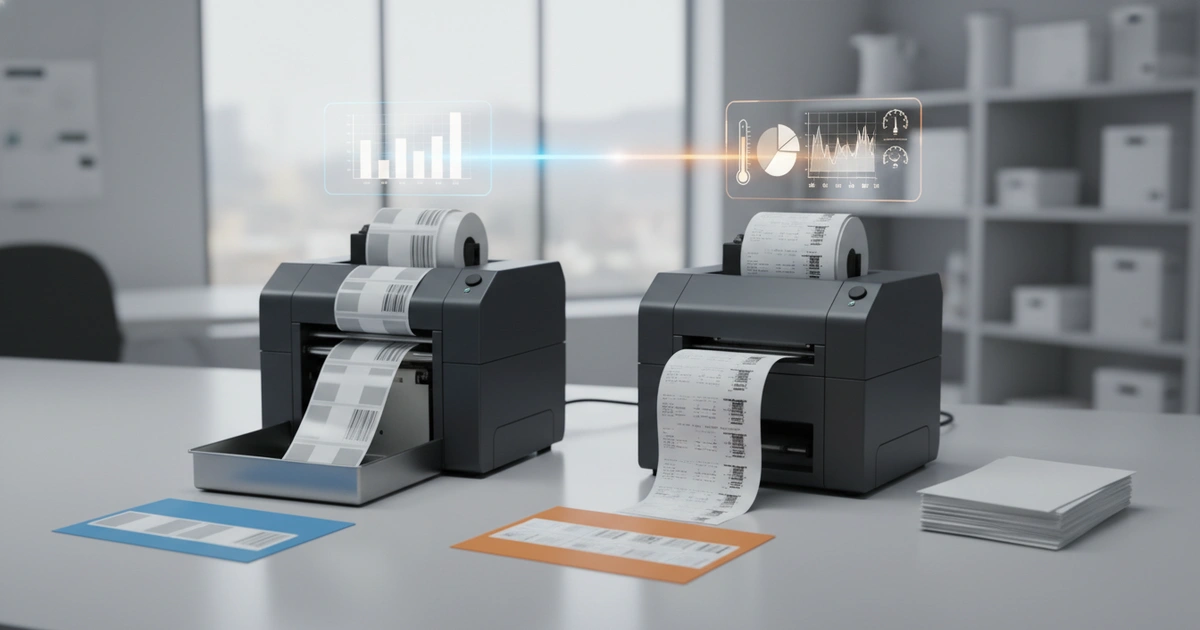
Scaling from 5,000 to 50,000 labels reduces unit cost by 25–35%. This is the single biggest lever in any price optimization strategy. A thorough evaluation must examine every tier your volume qualifies for.
Typical volume tiers look like this:
| Volume per SKU | Paper Cost per Label | PET Cost per Label | Setup Cost per Run |
|---|---|---|---|
| 5,000 | $0.06 | $0.15 | $150 |
| 10,000 | $0.04 | $0.10 | $150 |
| 50,000 | $0.025 | $0.07 | $150 |
| 100,000+ | $0.02 | $0.05 | $100 |
Consolidation is the hidden lever. The biggest insight from any barcode label cost comparison is that combining multiple SKUs into one production run saves more than switching materials. Our production team sees buyers miss this lever often. Combining five SKUs of 2,000 each into one 10,000-label run reduces per-unit cost by 25–35%.
This approach works best when all labels share the same material, adhesive, and size — for example, all 4 x 6 inch PET labels with permanent adhesive. Different substrates require separate runs with their own setup charges. For 2026, many procurement teams are expected to grow their use of consolidation as material costs rise.
For companies with 3–5 similar SKUs, consolidation delivers the highest ROI. The savings compound over 12 months as you roll each consolidated run forward. ISO 9001:2015 certified suppliers, like JinXinCai, typically offer streamlined setup processes that reduce changeover time.
Hidden Costs: Setup, Tooling, and Quality Assurance
Setup fees add $50–$200 per run. Die charges cost $75–$300 per die. Plate costs run $25–$50 per color. These fees inflate the per-label cost significantly at low volumes.
For a 5,000-label run, a $150 setup fee adds $0.03 per label — a 50% increase on a paper label that costs $0.06. At 50,000 labels, that same fee adds only $0.003 per label. This is why volume matters so much in any cost analysis.
Quality assurance also carries cost. Industry standard defect rate is below 1%. Our fully automatic label optical/visual inspection machine catches defects before shipping. This reduces client-side failures to near zero and prevents chargebacks. A Heidelberg or similar high-end printing press provides the color consistency and registration accuracy needed for barcode compliance.
Color tolerance of Delta E under 2.0 ensures brand consistency across runs — a requirement many high-volume buyers miss. Barcode verifiers grade each label per ISO/IEC 15416. An A or B grade is required for retail compliance at major chains like Walmart and Target. Poor grades lead to chargebacks that can exceed $500 per incident.
Definition: ISO/IEC 15416 is the international standard for barcode print quality — it provides a grading system from A (excellent) to F (fail) based on parameters like contrast, modulation, and defects.
Common Mistakes in Barcode Label Procurement
Mistake one: choosing paper labels for cold-chain applications. The high failure rate means costly rework and lost product. PET with freeze-grade adhesive reduces this to 1% and passes ASTM D3330 at -20°C.
Mistake two: ordering multiple SKUs separately. Each order carries its own setup fee. Consolidating five 2,000-label SKUs into one 10,000-label run saves 25–35% on unit cost. Our production team sees this mistake in nearly every new client audit.
Mistake three: ignoring setup and tooling charges. A $150 die charge on a 1,000-label run adds $0.15 per label. At 10,000 labels, it adds only $0.015. Always calculate total cost per label, not just material cost.
Mistake four: not verifying barcode grade. Unreadable barcodes cause retailer chargebacks. Request ISO/IEC 15416 verification reports before placing a large order. A grade of A or B is required for most retailers.
Mistake five: ignoring material density specifications. A 12 pt paper label weighs differently than a 2 mil PET film, affecting shipping costs. Include material weight in your cost comparison if you pay freight by weight.
How to Compare Quotes Like a Procurement Expert
A complete quote comparison includes five key line items: material cost per square inch, setup and tooling fees, finishing costs, defect rate guarantee, and shipping. Always calculate total landed cost per label.
- Material cost per square inch — paper vs PET vs polypropylene at your dimensions (e.g., 4 x 6 inches) — specify gsm for paper (80–120 gsm typical) or mil for PET (2 mil standard)
- Setup and tooling fees — die charge, plate cost per color (using CMYK or Pantone matching), run setup
- Finishing costs — lamination, varnish, or adhesive upgrade. Gloss lamination adds $0.005–$0.015 per label
- Defect rate guarantee — industry standard below 1%; verified by optical inspection
- Shipping and warehousing — lead time, freight, consignment options
Then calculate total landed cost per label. Add all fees, divide by total labels. This gives you the true per-label cost for comparison across suppliers. A supplier with ISO 9001:2015 certification, like JinXinCai, typically has documented quality processes that reduce your audit burden. This certification covers everything from incoming material inspection to final barcode grading.
Our team recommends asking for barcode verification reports from past runs. A supplier that cannot provide ISO/IEC 15416 reports may have higher defect rates. For 2026, leading buyers are anticipated to require these reports as part of standard procurement RFQs.
Definition: Total landed cost is the complete per-label cost including all fees — setup, tooling, finishing, quality assurance, and shipping — divided by total label quantity. This is the only accurate metric for comparing supplier quotes.
Quick Reference: Cost Comparison Table
| Parameter | Paper Label | PET Label | Polypropylene Label |
|---|---|---|---|
| Cost at 10,000 qty | $0.04 | $0.10 | $0.07 |
| Temperature range | -10°C to 50°C | -40°C to 120°C | -20°C to 80°C |
| Cold-chain failure rate | High | 1% | 8–12% |
| Best use case | Indoor, dry storage | Cold chain, outdoor | Moderate moisture |
Ready to Optimize Your Label Costs?
Get a free itemized quote comparing paper, PET, and polypropylene options at your volume tier — updated for Q2 2026 pricing.
Request a Free QuoteLimitations to Consider Before Choosing a Supplier
A key limitation of low-cost suppliers is the lack of barcode verification services. This approach is more suitable for low-volume or internal-use labels, but not ideal for companies shipping to major retailers like Amazon or Walmart. Those retailers require A or B grade barcodes per their vendor compliance manuals. A drawback of skipping verification is that unreadable barcodes trigger chargebacks that can exceed $500 per incident.
The main drawback of a fully consolidated run is longer lead time. Combining SKUs adds 3–5 days to production for material changeovers and die adjustments. For urgent orders, consider instead a split approach: run urgent SKUs digitally and consolidate the rest on a flexographic press. Compared to full consolidation, this hybrid method sacrifices about 10–15% in per-unit savings but delivers faster turnaround.
Competitors offer advantages in specific scenarios. Digital-first suppliers like Lightning Labels excel at runs under 500 labels with next-day turnaround. A consolidator may offer better freight rates for multi-warehouse distribution. These alternatives are genuinely better when you need less than 1,000 labels per SKU or have highly variable artwork. On the other hand, for stable SKUs with predictable volume, consolidation delivers the best ROI.
This method won't work for businesses with highly variable specifications. If your label size, material, or adhesive changes every month, consolidation loses its advantage. In those cases, a just-in-time digital print partnership offers better total cost. Alternatively, a hybrid approach with quarterly consolidated runs for core SKUs and digital for variable ones provides a balanced solution.
ISO/IEC 15416 grading is a necessary requirement for retail compliance, but not all suppliers offer it in-house. Verify that your supplier has optical inspection capabilities before committing to large orders. The latest 2026 vendor compliance manuals from major retailers increasingly mandate verifiable barcode grades.
Related reading
Conclusion: Make Smarter Label Buying Decisions
Ready to get started with barcode label cost comparison? Contact our team to explore the right solution for your next project.
Frequently Asked Questions
When does PET film become cheaper than paper for barcode labels?
PET film never becomes cheaper than paper on a per-label basis; paper costs $0.02–$0.06 vs PET's $0.08–$0.15 at 10,000 quantity. However, PET's 1% cold-chain failure rate versus paper's 35% can make PET cheaper overall when factoring in chargebacks and rework costs.
What volume tier offers the best balance of cost and lead time?
The 10,000-label tier offers a good balance: paper at $0.04/label and PET at $0.10/label, with a $150 setup fee adding only $0.015/label. Lead times are typically 14-22 days. For urgent needs, consider digital printing for runs under 2,000.
How do I calculate total landed cost per label?
Add all costs: material, setup fees (e.g., $150 die charge), finishing (e.g., $0.005–$0.015 for lamination), and shipping. Divide by total labels. For a 10,000-label paper run with $150 setup and $0.04 material, total landed cost is $0.055/label.
What barcode grade do major retailers require?
Major retailers like Walmart and Target require an A or B grade per ISO/IEC 15416. Unreadable barcodes can trigger chargebacks exceeding $500 per incident. Always request verification reports from your supplier before placing large orders.