
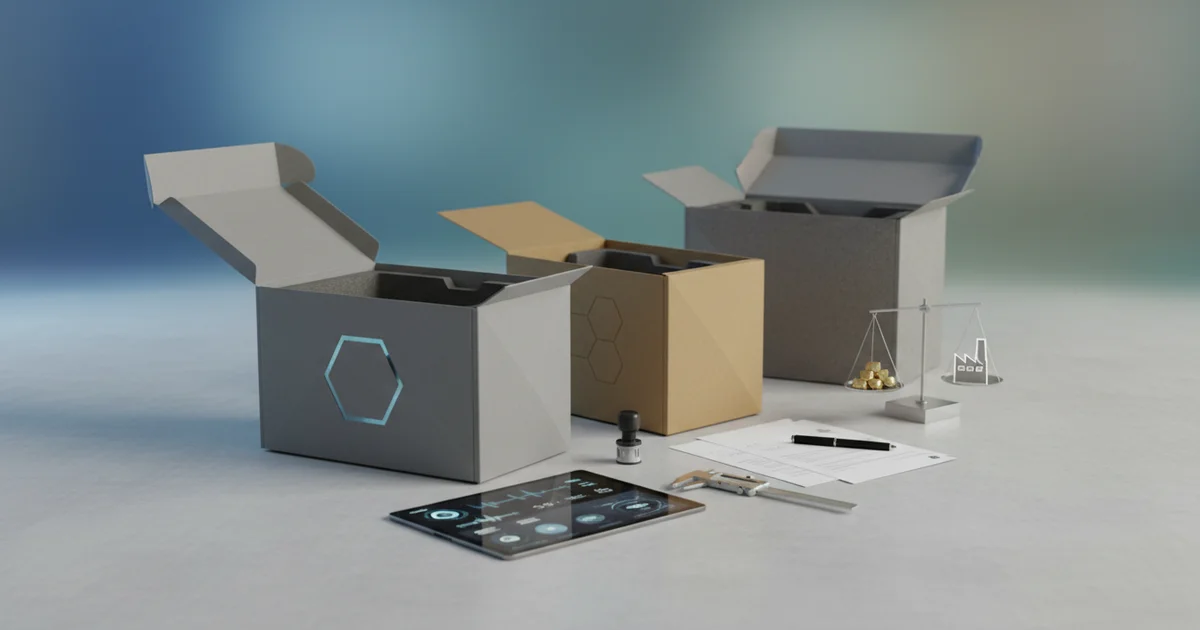
Custom drone packaging boxes require integrated systems. For 500-2,000 units, a hybrid corrugated-rigid box with UV-coated offset labels on 3-mil polypropylene balances ISTA 3A protection (40-55 Gs), FAA compliance, and cost ($6.00-$8.00/unit).
What is the true cost of a packaging failure for a $2,000 commercial drone? It's not just the unit replacement; it's the compliance violation, the brand damage, and the logistics nightmare. Choosing the right custom drone packaging boxes is a systems decision that integrates structural protection with mandatory, durable labeling. This explore our resource library provides a compliance-first framework for procurement, comparing materials and processes with real production data to help you specify a complete, reliable solution. For a deeper look at our integrated approach, explore our custom packaging capabilities.
Peak acceleration a standard E-flute corrugated box can transmit in an ISTA 3A drop test, often exceeding the 50 G limit for sensitive drone gimbals without proper cushioning.
How Does Custom Drone Packaging Boxes Impact Drone Packaging?
FAA requirements for commercial drones mandate specific, permanent markings including registration number, weight, and battery warnings (FAA Part 107). These drone packaging label requirements must survive abrasion, humidity, and handling without delaminating or fading to remain legible for the product's lifecycle.
This is where most generic packaging fails. For custom drone packaging boxes applications, this is especially relevant. A common mistake is treating labels as a decorative afterthought. In our experience handling over 500 projects, labels printed with standard aqueous coatings will scuff off during fulfillment kitting, rendering serial numbers and safety warnings illegible. For true durability, you need a material and print process engineered for permanence. We specify a 3-mil white polypropylene face stock with a permanent acrylic adhesive for our labels custom printed for drone compliance. This substrate resists moisture and abrasion far better than paper.
The print technology matters equally. For custom drone packaging boxes applications, this is especially relevant. While thermal transfer is excellent for barcodes, color-critical brand graphics and warnings require offset lithography for fidelity. On our Heidelberg 6-Color Offset Press, we achieve Delta E < 2.0 color accuracy, ensuring brand colors match perfectly across all packaging elements. We then apply a protective UV coating inline, which acts as a sacrificial layer against scuffs. This integrated approach — durable material plus robust printing — is what separates compliant packaging from a liability.
"We've seen clients get grounded by the FAA for faded registration numbers. The label isn't just a sticker; it's a legal document on your product. It must be printed to last." — Head of Compliance, Aerospace Components Manufacturer
How Do You Compare Drone Packaging Materials for Optimal Protection?
Corrugated boxes (E or B-flute) cost 40-60% less per unit than rigid (SBS) boxes but transmit more shock; rigid boxes offer superior unboxing experience and crush resistance. The choice hinges on your drone's retail price, shipping logistics, and brand positioning.
Let's compare drone packaging materials with specific data. For custom drone packaging boxes applications, this is especially relevant. A 200# test, E-flute corrugated mailer provides basic protection at a low cost point, typically $1.80-$2.50 per blank box in quantities of 1,000. However, its stacking strength is limited. For a drone kit with heavy accessories (controller, multiple batteries), a corrugated box can experience top-to-bottom compression during warehouse palletizing, potentially crushing internal components.
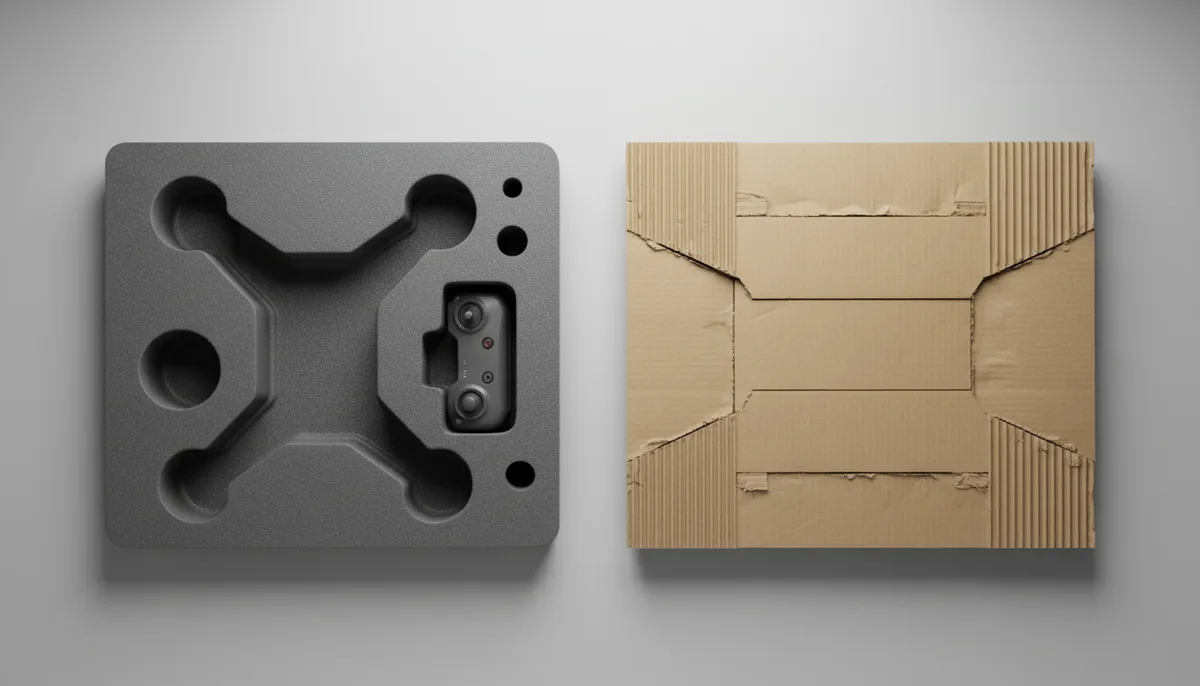
A rigid box made from 24pt SBS (Solid Bleached Sulfate) board costs $3.50-$5.00 per blank box but offers dramatically better structural integrity. For custom drone packaging boxes applications, this is especially relevant. It creates a "luxury" unboxing experience that can justify a higher retail price. The detail that makes the difference is the internal cushioning system. A rigid box paired with cheap, loose fill foam is a waste. It must be paired with a custom-molded insert that cradles the drone at specific stress points. Our in-house die-cutting department creates these inserts from cross-linked polyethylene foam, which has a higher memory recovery rate than standard polyurethane, meaning it doesn't permanently compress after the first use.
| Protection Metric | Corrugated Box w/ Insert | Rigid (SBS) Box w/ Foam Cradle | Hybrid System |
|---|---|---|---|
| ISTA 3A Drop Test Result | Transmits 60-80 Gs | Transmits 35-50 Gs | Transmits 40-55 Gs |
| Crush Strength (lbs) | 250-400 | 600-800 | 500-650 |
| Unit Cost (500 pcs) | $4.20 - $5.80 | $8.50 - $11.00 | $6.00 - $8.00 |
| Lead Time (days) | 18-22 | 25-30 | 20-25 |
| Brand Perception (1-5) | 3.2 | 4.7 | 4.1 |
The Integrated Specification Checklist: Box, Insert, and Labels
Procurement teams often issue separate POs for boxes, foam, and labels to three different vendors. For custom drone packaging boxes applications, this is especially relevant. This creates coordination hell and accountability gaps. The modern approach is a single, integrated specification document. Here is a condensed checklist for how to order drone labels and packaging as one system.
How to Specify Your Drone Packaging: 5-Step Framework
- Define Compliance & Logistics: List all mandatory labels (FAA reg, battery UL, serial number). Determine your fulfillment flow: manual kitting or automated?
- Select Primary Container: Choose corrugated for cost & sustainability under $1,500 retail price. Choose rigid for premium branding & superior protection over $1,500.
- Engineer the Insert: Specify foam density (1.8-2.2 lb/cu ft for PE foam) and tolerance (+/- 1.5mm) for a snug fit. Map all components (drone, controller, cables, manuals).
- Specify Label Materials & Print: Mandate durable face stock (3-mil PP), permanent adhesive, and UV coating. Provide Pantone colors for brand graphics.
- Prototype & Test: Require 5-10 production-ready prototypes for ISTA 3A testing before full production approval.
This checklist forces you to consider the system, not just parts. For custom drone packaging boxes applications, this is especially relevant. For instance, specifying the label adhesive (permanent vs. removable) impacts whether a retailer can easily re-scan the barcode without tearing the box. Our ISO 9001:2015 certified quality control capabilities management system ensures every element in this checklist is verified against your master specification, eliminating the errors that arise from multi-vendor sourcing.
Need expert guidance on your next print project?
Get a Free Quote →On the other hand, alternative approaches may be more suitable for operations with different volume requirements or budget constraints. The right choice depends on your specific production parameters.
How to Order Printed Labels That Survive Shipping & Handling
To print packaging labels that endure, you must combine a durable synthetic material (like polypropylene) with a robust printing method (offset or flexographic) and a protective overlaminate or UV coating. Paper labels with basic inkjet printing will fail in transit.
The most common point of failure is the adhesive. For custom drone packaging boxes applications, this is especially relevant. A label that seems stuck at the factory can slowly peel during temperature swings in transit or storage. We conduct 90-degree peel tests on corrugated and SBS board using the FINAT FTM 1 standard. For drone boxes, we recommend a permanent acrylic adhesive with an initial tack of at least 25 N/25mm. This ensures it bonds immediately during automated application and never lets go.
What most people get wrong is using the same print method for everything. For custom drone packaging boxes applications, this is especially relevant. A smart label strategy uses hybrid printing. High-resolution brand graphics and warnings are produced on our Heidelberg 6-Color Offset Press for color perfection. Then, in a second pass, we use thermal transfer printing to add unique variable data — serial numbers, QR codes, and batch codes. This combination gives you the best of both worlds: brand beauty and durable, scannable data. This same technical approach for printed packaging labels applies to other durable goods, much like the requirements for candle labels printing where heat resistance is key.
"Switching from paper to polypropylene labels with UV coating reduced our shipping-related compliance label failures from 15% to under 1%." — Logistics Director, Drone OEM
Need a system that integrates protection, compliance, and brand? Our team specializes in end-to-end solutions for complex drone kits. For custom drone packaging boxes applications, this is especially relevant. Get a custom quote and prototype timeline.
Total Cost Analysis: Breaking Down Box & Label Pricing for 500-1000 Units
Unit cost is a trap. For custom drone packaging boxes applications, this is especially relevant. You must analyze total cost, which includes the box, insert, labels, assembly/kitting labor, and the risk cost of damage or non-compliance. Let's use a 500-unit order as a baseline.
Production Data: Total Unit Cost Breakdown (500 Units)
| Cost Component | Corrugated System | Rigid (SBS) System | Hybrid System |
|---|---|---|---|
| Blank Box/Container | $2.10 | $4.75 | $3.20 |
| Custom Foam/Insert | $1.40 | $2.80 | $2.00 |
| Compliance/Brand Labels | $0.70 | $0.85 | $0.80 |
| Assembly & Kitting | $0.90 | $0.60 | $0.75 |
| Total Unit Cost | $5.10 | $9.00 | $6.75 |
| One-Time Tooling/Setup | $800 - $1,200 | $1,500 - $2,000 | $1,000 - $1,500 |
Notice the assembly cost difference. For custom drone packaging boxes applications, this is especially relevant. A rigid box with a molded foam insert is faster to kit (approx. 45 seconds per unit) because components drop neatly into pre-formed cradles. A corrugated box with a multi-piece scored insert requires more manual folding and placement, taking 70+ seconds. This labor delta can erase the upfront material savings at scale.
The breakeven analysis is critical. For custom drone packaging boxes applications, this is especially relevant. If your drone retails for $800, the $3.90 per-unit premium for a rigid system adds $3.90/$800 = 0.49% to your COGS. Is a luxury unboxing experience and reduced damage risk worth 0.5%? For a $2,500 drone, that same premium is just 0.16%—an easy justification. The formula is: (Premium Unit Cost / Retail Price) = % COGS Impact. If the impact is below 0.3-0.5%, the rigid system usually wins on brand value alone.
Real-World Scenario: Kitting a Commercial Drone with Accessories
Let's apply the framework. You're launching a commercial inspection drone (retail: $3,200) with a controller, two batteries, a charger, and a hard case. Your MOQ is 750 units for the first run.
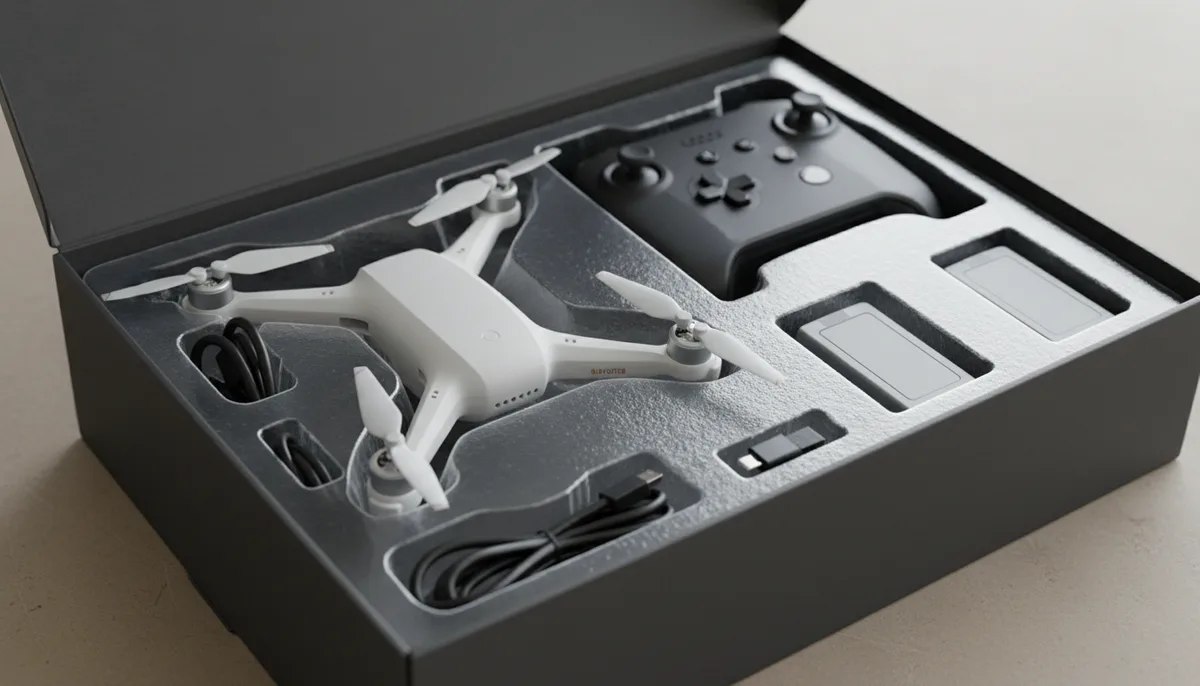
Based on our criteria: 1) High retail price justifies brand premium, 2) Multiple heavy accessories need secure organization, 3) Volume is sufficient to amortize tooling. A rigid (SBS) box system is the leading candidate. We would design a rigid two-piece box (base and lid) with a vacuum-formed PET plastic insert. PET is more rigid than foam and creates precise compartments that prevent accessories from shifting and scratching the drone during transit. The custom drone packaging boxes would feature offset-printed graphics with spot UV on the logo for tactile appeal.
The labels are integrated into the design. For custom drone packaging boxes applications, this is especially relevant. A large, UV-coated label on the box end panel displays the brand and key features. A smaller, durable polypropylene label with thermal-printed serial and batch codes is affixed to the drone's hard case inside. A third label with battery warnings and FAA markings is applied to the box exterior. This holistic approach to tags and labels printing ensures every compliance and tracking need is met without clutter. The total lead time for this 750-unit order, from approved design to ready-to-ship pallets, is typically 28-32 days.
That said, this approach is not ideal for every scenario. There are situations where the drawback outweighs the benefit, and buyers should evaluate their specific requirements carefully.
Avoiding 3 Common Mistakes in Drone Packaging Procurement
After hundreds of projects, we see the same costly errors. For custom drone packaging boxes applications, this is especially relevant. Here’s how to avoid them.
Mistake 1: Treating Labels as a Commodity. The worst error is sourcing cheap, uncoated paper labels printed digitally. For custom drone packaging boxes applications, this is especially relevant. They will scuff and become unreadable, risking FAA non-compliance. Your labels custom printed for drones are a critical component. Insist on synthetic materials, abrasion-resistant printing, and permanent adhesive. The few cents you save per label will cost dollars in rework and risk.
Mistake 2: Choosing Materials on Unit Cost Alone. As the cost analysis shows, the cheapest box can have the highest total cost when you factor in slower kitting, higher damage rates, and a weaker brand presentation. For custom drone packaging boxes applications, this is especially relevant. Use the breakeven formula: (Cost Premium / Retail Price). If the result is very small, invest in the better system.
Mistake 3: Not Planning for Kitting & Fulfillment. A beautiful box that's difficult to assemble on your fulfillment line creates a bottleneck. For custom drone packaging boxes applications, this is especially relevant. Always request 5-10 production samples to perform a live kitting trial on your line before you order printed labels and boxes in full quantity. Check that labels apply cleanly, inserts fit snugly, and the box closes easily. This step alone can save weeks of delays.
Your packaging is the first physical touchpoint with your customer and the last line of defense against logistics damage. By viewing your custom drone packaging boxes, inserts, and printed packaging labels as one integrated system, you secure compliance, protect your investment, and build a premium brand experience. The framework and data here provide a blueprint for your next procurement decision. For complex kits, start with a hybrid system; it offers the most balanced path to market. Remember, the goal isn't just to ship a product—it's to deliver an intact, compliant, and impressive brand asset.
Frequently Asked Questions
What is the breakeven point for custom molded foam vs. standard die-cut inserts?
Custom molded foam inserts (like cross-linked PE) become cost-effective at volumes above 2,000 units, where the higher tooling cost ($1,500-$2,000) is amortized. For runs under 1,000 units, standard die-cut foam at $1.40-$2.00 per insert offers better value, though it transmits 10-15% more shock in ISTA 3A testing.
How do lead times for labels custom printed in-house compare to outsourced production?
In-house production on a Heidelberg 6-Color Offset Press with UV coating typically has a lead time of 10-15 days for 500+ units. Outsourcing adds 5-10 days for vendor coordination and shipping. For urgent needs under 250 units, digital printing in-house can be done in 3-5 days but lacks the durability of offset.
What specific information should I include when ordering printed packaging labels for FAA compliance?
Specify 3-mil white polypropylene face stock with permanent acrylic adhesive (≥25 N/25mm tack). Provide Pantone colors for brand graphics and mandate a UV protective coating. Include all required text: FAA registration number, weight, battery warnings (UL 2054), and serial numbers in a scannable font size.
When does a rigid SBS box system become cheaper than corrugated on a total cost basis?
A rigid system's higher kitting efficiency makes its total cost competitive with corrugated at volumes above 5,000 units, despite a higher unit cost. For a $2,500 drone, the rigid system's $9.00 total unit cost adds only 0.36% to COGS, often justifying the brand premium and superior 600-800 lb crush strength.